![PortStrategy[GreenPort]](https://www.portstrategy.com/wp-content/uploads/2026/09/PortStrategyGreenPort.svg)




Clearing the blockchain blur
A digital ledger offers undeniable benefits of improved transparency and security, but which project should ports back asks Charlie Bartlett
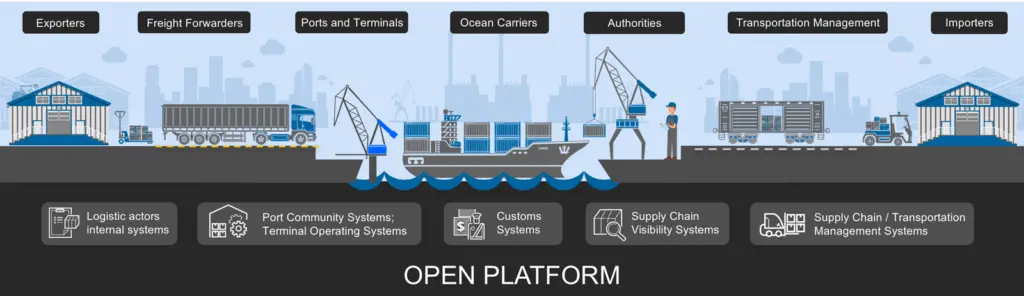
Maersk’s TradeLens might be a frontrunner, but it’s not alone in the sprint for blockchain domination. Antwerp is at its heels with its geofenced pin pick-up offering, while Tristar has focused on shoring up transparency and security in the warehousing and logistics side of the business. And there are many more contenders working on blockchain pilots or proof of concepts, ensuring that victory is far from guaranteed for TradeLens.
There is good reason why so many maritime industry players are developing blockchain platforms in parallel: profit. It is thought that the first viable blockchain set-up will be adopted throughout the supply chain, and the company which administers it will reap huge financial rewards. But one of the questions surrounding development of this technology is what will happen if every company develops its own version.
Late last year, the Port of Rotterdam embarked on a blockchain pilot project in collaboration with ABN AMRO and Samsung SDS, which was due to conclude in February 2019. A stated aim of the project was to integrate disparate types of systems in a practical fashion. Rotterdam chief financial officer Paul Smits commented: “Currently payments, administration and the physical transportation of containers still take place entirely via separate circuits, [which] results in inefficiency as many parties are involved and everything is organised via paper documentation…an average 28 parties are involved in container transport from China to Rotterdam.”
Since then, this project has unveiled Deliver, a new system to integrate these various processes with blockchain, but also connect disparate blockchain platforms, preventing double payments and enabling users to transfer assets from one to another. Deliver was unveiled by Samsung SDS at a Korean logistics conference in March.
“The Customs Clearance Blockchain System at the Korea Customs Service is based on Hyperledger Fabric, while Rotterdam Port in the Netherlands is using the Ethereum Platform,” said Han Seung-Yeop, manager at Samsung SDS. “We started the Deliver project to connect different platforms.”
Deliver is now being used for export customs clearance and has been used successfully for containers moving between Korea and the Port of Rotterdam. “Deliver will be the starting point of a trust society based on super-connected chains where different blockchains are interconnected on the Delivery platform,” Mr Han claimed.
TradeLens developments
In 2017, Maersk Line and IBM embarked on a project to digitise bills of lading using blockchain. Paperwork can make up as much as half the cost of a low-value container, and Maersk estimated at the time that to eliminate it could potentially save the container industry $38bn annually.
In mid-April, Tradelens got a robust vote of confidence when a Maersk rival, Israel’s ZIM, signed up to use the service for its own cargoes. It became one of only two non-Maersk affiliated customers to do so, the other being Pacific International Lines (PIL). In a statement, TradeLens head Mike White was eager to stress that the service would “deliver… benefits while still allowing carriers like ZIM and others to maintain their competitive advantages”.
At the same time, Tradelens garnered a new ecosystem partner – as distinct from a paying customer: Canadian customs broker Livingston International. Mr White added: “The more carriers and other ecosystem members that join the platform, the closer we come to bringing about a new era in global trade.”
“We have always prided ourselves on being a forward-thinking customs broker and trade-services provider,” said Craig Conway, chief technology officer for Livingston International, at the time of the announcement. “We are excited to be working with Maersk, IBM, CBSA and other members of the TradeLens ecosystem on an initiative we believe will serve our industry well and provide transparency and security in the global movement of goods.”
“The current number of ecosystem partners is a little over 100. These include ports, customs authorities and freight forwarders,” explains Mikkel Elbek Linnet, Maersk Line spokesman.
At time of writing around 20 ports are signed up to the service, including PSA Singapore, International Container Terminal Services Inc, Patrick Terminals, Modern Terminals in Hong Kong, Port of Halifax, Port of Rotterdam, Port of Bilbao, PortConnect, PortBase, and terminal operator Holt Logistics at the Port of Philadelphia.
Getting smart
Dubai-based downstream petroleum and chemicals player Tristar provides land- and sea-based logistics throughout the Middle East, Africa, Central America and Asia. In 2017 it embarked on a blockchain pilot project. “We started with a proof of concept for our warehousing and distribution business,” explains chief executive Eugene Mayne. “The point of having blockchain is to provide full visibility to the customer – details on when the material comes into the warehouse, where it is stored, what time it is loaded.
“There is no paperwork – customers can communicate through the app. The final step for us will be to implement smart contracts, which can facilitate agreements with the customer with no further validation required.”
Arguably more important than straightforward cost-savings, though, are the benefits of transparency. In recent months, container shipping has faced an epidemic of fires, thanks to a lack of clarity on the contents of containers. Many shippers are unwilling to pay a premium for hazardous cargoes, such as calcium hypochlorite, which must be placed on the outer corners of a ship’s container stack, and so deliberately mis-declare it.
Obviously, the logistics of container terminal operations prevent wide-scale box inspection and antitrust law limits the extent to which container lines are able to take meaningful action to share information. Moreover, carriers cannot name-and-shame customers to other lines. In 2017, the New-York headquartered National Cargo Bureau (NCB) managed to inspect the contents of 31,000 containers. For an individual agency, this represents admirable diligence; but for a major container port like Shanghai, it is less than a third of a single day’s trade.
This is another area where blockchain could come into its own, since centralising the information in a digital ledger would allow shipping lines to access information on the container’s origin, contents, and destination as a prerequisite of passage. This would make it much harder for a shipper to get away with mis-declaring its contents.
The last big hurdle
Though it has long been clad in a the language of safety, with a decentralised database, trusted partners and so on, a blockchain network is still accessed in the same way as any digital system – through a computer, which may not be secure. Indeed, today’s market is ready for blockchain in almost every aspect apart from one: that of trust. Despite considerable benefits for users even at this early stage, and the collaboration with so many partners in terms of its ecosystem – a large number of whom are required for a network to be effective – Maersk’s Tradelens still boasts relatively few paying customers.
“A couple have joined, two or three,” Maersk’s Mr Linnet explains. Clearly, rival shipping lines are unwilling to join a network administered by one of their competitors, however well-intentioned it may seem.
So while the barriers between platforms are being broken down, the counterproductive hype cleared, and many of the other start-up issues are now being ironed out, if blockchain is to gain wider acceptance, its biggest hurdle is not technological, but psychological. “The biggest challenge we have now is that systems have to talk,” explains Tristar’s Mr Mayne. “For this to happen, people have to let go. Some people don’t want to let go, and this is the bottleneck.”
LOOKING TO THE LOCAL DIMENSION
In Antwerp, a convoluted system reliant on bills of lading – one often taken advantage of by cargo thieves and smugglers – is eagerly being replaced with a blockchain system. A truck driver presents a carrier-generated PIN code relating to a specific container. The PIN code can be emailed, faxed, or sent by SMS, and is routinely known to more parties than necessary; it can be intercepted by criminals in a variety of different ways, particularly if one of the computers involved is hacked.
But with a comprehensive history of everyone who has accessed the service, and relevant credentials required from all parties who update the ledger, it becomes much harder for the wrong people to get access to the relevant information. Antwerp has also added a local dimension, a ‘geofence’ that stops the ledger being accessed from outside the relevant terminal.
With the pilot project completed, Antwerp is now looking to commercialise the product, and make it available to other terminals. But with Maersk and IBM’s system gaining traction, at least in terms of port operators, it has plenty of competition.

Related Articles
 TERMINAL OPERATIONS
 DIGITAL
 DIGITAL