![PortStrategy[GreenPort]](https://www.portstrategy.com/wp-content/uploads/2026/09/PortStrategyGreenPort.svg)





A vision for Greenport operations
DNV Climate Change Services North America explores the growing pressure on ports to balance emission reductions initiatives with the need to maintain commercially competitive facilities and operating conditions
A number of factors are pushing ports to explore how to respond to climate change, in particular stakeholder expectations, anticipating regulations, operational efficiencies, and adaptation planning. The importance of each factor can vary by port location and size, the degree of competition from other ports and from other modes of transport.
Stakeholder expectations. Ports face stakeholder pressures related to climate change, and are responding with their own emissions reduction commitments. These commitments will in turn flow through to port operations. Ports are required to balance the powerful tension between the costs of climate action and the economic pressures borne by taking those actions. Also, there is the question of how ports and maritime businesses can compete, serve their customers AND address climate change.
At the commercial level, manufacturers and retailers are increasingly focused on their environmental performance, including the GHG performance of their supply chains. Scope 1 emissions encompass a port’s direct GHG emissions from on-site fuel combustion and other industrial combustion activities. Scope 2 accounts for energy that is purchased from off-site (primarily emissions associated with the use of electricity). Scope 3 is vastly broader and can include employee travel, ‘upstream’ emissions embedded in purchased products, and ‘downstream’ emissions associated with disposing of products and with the ships that dock at the port.
Large shares of emissions associated with port operations are associated with the ocean transit of goods themselves, which fall into Scope 3. Any successful initiatives to reduce GHG emissions will need to show that the port is productively engaging in Scope 3 emissions reductions activities (or projects), even if they cannot directly control them. Due to their association with ocean transit goods, shipping companies and other port stakeholders have significant influence on the development of port business in a carbon constrained world.
Anticipating GHG Regulatory Compliance. GHG emissions from ships and the maritime industry are already the focus of considerable attention. Several international proposals exist to regulate shipping emissions, including those under the IMO and UNFCCC, and the US federal legislation may include a levy on bunker fuels. Other key environmental issues for ships include ballast water; scrapping/recycling; SOX, NOx, PM, scrubbers and volatile organic compounds. In the European Union (EU) SOX/NOX/CO2 regulatory issues determine the way a port is operated. The EU Directive EC 2005/33 on 1.5% sulphur limit in the IMO Sulphur Emissions Control Area (SECA), 0.1% sulphur limit for marine gas oil (DMA) in EU territory (12 nautical mile zone), 0.1% sulphur limit for any fuel used onboard ships in EU ports as of January 1, 2010. California Air Resource Board (CARB) regulations require operators to use the low sulphur marine distillate fuels in auxiliary diesel and diesel-electric engines, main propulsion diesel engines and auxiliary boilers on ocean-going vessels within 24 nautical miles.
Although CO2 is pre-eminent on the agenda, ports must understand how these regulations will impact the competitiveness of maritime transport relative to other transport modes because any modal shift will have direct implications on port revenues.
In addition to the regulatory attention focused on ships, other GHG considerations will more directly affect ports. The US EPA’s recent endangerment finding related to GHG emissions from motor vehicles has the potential to trigger the regulation of GHG’s from port facilities under the Clean Air Act. In the absence of clear federal guidance on GHG emissions, states are beginning to implement their own GHG regulations. For instance, recent amendments to the California Environmental Quality Act that require mitigation of greenhouse gas emissions prevented the Port of Los Angeles from expanding its operations without accounting for GHG emissions in its Environmental Impact Assessment.
In general, it’s not clear yet which ports may be directly regulated under pending legislation at the state and federal level, which will simply have to report their emissions, and generally how ports will be required to help reduce ship-based emissions. But more and more ports are seeing the regulatory handwriting on the wall. Operational Efficiencies. In a carbon con – strained world, ports and their tenants will need to be more sensitive to operational efficiencies than ever before. Energy prices paid by ports and shippers could rise substantially as the price of carbon is passed through the energy economy as a result of regulatory initiatives like cap-and-trade and Low Carbon Fuel Standards. This in turn will create opportunities for ports prepared to help with retrofitting to make ships more energy efficient.
Additionally as port congestion is a continuous challenge for port operators and potentially impacts the entire logistics/ supply chain. Port congestion leads to higher air pollution in the vicinity of the port. Air emissions associated with port congestion can be improved through better communication between ships and ports reducing congestion with the additional benefit of reducing fuel consumption and associated reduced air emissions.
Getting the jump on adaptation planning. Although climate change is thought of as a long-term phenomenon with a focus on reducing GHG emissions global impacts associated with sea level rise and adaptation will have direct impact on ports. Ports often located at the confluence of rivers and the sea are among the first facilities to need to adapt to climate change. Even modest sea level rise, combined with more frequent storms and associated storm surges, will force many ports to undertake expensive adaptation measures. The earlier such adaptation planning is begun, the easier it will be to reduce costs through design changes and other means. Similarly a study shows that while it will cost up to 128 billion yen (€1 billion) to secure Japanese harbours against stronger winds and more frequent storms, failure to do so could result in the loss of 1.5-3.4 percent of Japan’s GDP by 2085 (Japanese GDP in 2007 was €3.41 trillion). This is due to an increased number of days where harbours will be forced to close.
Climate change is being factored into port planning including considerations for increases in downtime due to wind and rain. Additionally, sea defenses which limit damage caused by waves are increasingly being considered as there is the potential for disruptions in ports as intermodal centres for goods movement.
Ports leading the way
The World Ports Climate Initiative (WPCI), launched by the International Association of Ports and Harbors (IAPH), is an example of how the world’s ports are beginning to respond to the several pressures profiled above. The WPCI is made up of six specific programs, each of which is being piloted by one or more global ports.
– GHG Foot printing for Ports
– Upgrading Cargo Handling Equipment
– Promoting the Environmental Ship Index
– The Environmental Ship Index (ESI)
– Switching to Onshore Power Supply
– Lease Agreement Changes
Further information is published in the article on page 34 of this issue.
These are a few of the ways in which ports are beginning to tackle the issue of climate change. What is clear is that these issues will become more and more important as a carbon constrained world becomes the new reality, and as those constraints tighten markedly over time.
DNV – a familiar presence
DNV’s staff have been involved in climate change management for more than 20 years, working with businesses, governmental agencies, and not-for-profit organisations to help strategically manage the risks and opportunities associated with GHG emissions and climate change. DNV is leveraging its expertise in maritime, energy, and climate change advisory services to assist ports to focus on their response to climate change pressures. DNV can help in the following ways:
Stakeholder engagement
DNV recognizes that ports need to manage diverse stakeholders, from local communities to the shippers that rely on the port to quickly and reliably move their cargo. DNV can assist ports in developing a cohesive climate action plan, can certify a port’s efforts to mitigate greenhouse gas reductions, and can assist in branding the impact of moving cargo through the port against moving cargo through other sources.
Climate Action Planning
Successful climate action planning relies on the transparency, reporting, and stakeholder management of the plan. Strategically addressing climate change and carbon management requires an understanding of whether the impacts of decisions will be positive or negative, and to what extent.
Certifications & Brand Support
DNV has established a number of rating programmes that estimate GHG emissions from production through the transportation chain to the retailer. These programmes provide a port and its customers the proof necessary to make the argument that it is reducing its footprint, while also highlighting points for performance improvement. Rating programmes rely on a variety of parameters and data, such as: “Triple E” for Ports: an environmental monitoring and scoring system that makes use of relevant and existing data to demonstrate environmental management of a ship or port and ensure that initiatives are implemented effectively. It’s scoring relies on reliable and verifiable data, such as:
• Whether environmental management systems are in place and implemented
• Whether fuel efficient operation is part of policies, action plans and daily operations
• Whether operations are designed efficiently
• Whether monitoring, measurement and documentation methods are verifiable
Marlen (Maritime logistic chains and the environment) evaluates logistics networks against parameters such as cost and GEEC (GHG Emission and Energy Consumption) and compares supply chains by analysing the operational, organisational, and con – tractual conditions that influence fuel efficiency and environmental performance. DNV carried out GEEC process mapping for Statoil supply bases to determine how the operation of the port as a base impacts the efficiency of the entire supply chain (time fences, operational procedures, legal issues) to determine how the internal operation can be organised to optimise external operation.
Environmental Shipping Index (ESI) is a web-based tool delivered for the Norwegian Maritime Directorate. An ESI is calculated on the basis of consumed fuel, transported cargo, distance sailed and carbon emissions factors. The computed index values can be compared for a fleet, sister ships or specific periods of time and eventually be used to benchmark and minimise emissions from transport. This type of benchmarking approach can assist ports in implementing incentives and in providing the tools to facilitate communication and documentation with ships.
GHG Emissions Inventory can set the foundation for a climate change strategy, set a baseline to help provide a point of comparison to other organisations of similar size and operations and identify avoided emissions. While ports may not wish to offset GHG emissions due to local community stakeholder concerns, estimating CO2 emissions avoided through efficiency improvements can assist in evaluating future opportunities for ports and their stakeholders.
Emissions Verification Opinion may be required by law or, when not required, can help a port provide confidence to stakeholders that the inventory will not be seen as incomplete or faulty. Many prominent firms who have quantified their GHG footprint have faced accusations of “green washing” and found that they would have been better off doing nothing at all — verification of inventories can minimise this risk.
Regulatory Compliance
Ports can engage now to advocate for policies that advance port interests and prepare for liabilities or opportunities that may arise from regulation. This could be in the form of mandates to monitor and report GHG emissions, requirements or incentives to provide ship electrification or reduce congestion and ship hotelling, or the need to respond to shipping efforts to conserve fuel and reduce emissions. DNV can assist ports in assessing the likelihood of a particular regulation given the context of broader climate policy developments, determining the risk-adjusted cost/benefit of different pre-compliance actions, implementing internal mitigation efforts, and developing offset portfolios to meet compliance needs. At a high level financial and business strategy questions associated with the most probable regulatory and carbon market scenarios likely to impact ports and their stakeholders can enable a port to think through and strategically react to changes in such scenarios. DNV’s experience building tools to analyse carbon markets and cap and trade policy can help a port:
• Determine under what conditions and in what policy scenarios shipping is cost effective relative to alternate transport modes in a carbon-constrained world
• Determining a port’s exposure on major capital investments to a price on carbon
• Analyse the regulatory impact on ports, either directly or indirectly through fuel and material costs,
Pre-compliance Action Support
An understanding of potential policy scenarios can help a port to determine precompliance strategies and cost-effective capital investments. DNV can also help to protect emissions baselines in anticipation of regulation to ensure that a port doesn’t have fail to achieve benefits from measures that were taken in anticipation of regulation.
Stranded cost analysis
Many of a port’s reduction options require large and discrete investments, and small changes in policy would drastically affect payback periods of investment choices, leaving a port with either overinvestment or underinvestment in low-emitting technologies and stranded costs. DNV can assist in assessing payback periods for different mitigation strategies, performing sensitivity analyses to determine how those payback periods change with relatively minor changes in policy, the price of carbon, the price of fuel, or the volume of traffic at the port.
Offset portfolio development
If offsets are likely to be allowed as part of mitigation efforts, DNV’s experience in the global carbon market can help to determine a portfolio that meets both regulatory and branding needs: some projects may be more likely to meet regulation, whereas others may be more likely to meet approval from community groups and other stakeholders, and an effective portfolio requires balancing these needs. Further, DNV’s familiarity with carbon offset markets and with compliance strategies in different sectors of the economy can help guide a port that is seeking new business or revenue opportunities.
Operational efficiency
As international trade increases, the volume of cargo moved through ports will increase as well. In response, ports will need to expand their operations, either through greater use of existing facilities or the construction of new facilities. In either case, expansion will make it more difficult for ports to comply with environmental regulations. Meeting this growing demand through energy and operational efficiency will reduce this liability while saving resources and increasing competitiveness.
By more effectively using quays and equipment, for example, ports will be able to increase traffic while keeping costs low, generating greater revenues. In addition, ships using a more efficient port will realise reduced waiting times and reduced fuel consumption, saving money and reducing ship-owner emissions liability, and making the port more attractive than its competitors. Streamlining port operations can thus create competitive advantage over a port’s piers.
DNV can work with ports to identify and prioritise operational efficiencies, so that they can focus on those opportunities that are most economically efficient and cost effective.
Best internal carbon price
As opposed to a black box price for carbon, a best internal carbon price (BICP) is a forecasted price of carbon tailored according to an individual port’s unique risk sensitivity and vision for the future. Development of a BICP is transparent and interactive process that can encourage ports to ask reflective questions and allows for development of strategic positioning with respect to climate regulation risks.
Energy savings identification
Expert system for Technical Energy Saving Identification (EXTESI) is an energy audit tool for industrial facilities. It ensures that at a minimum all common energy savings opportunities are identified in the audit and assesses the energy savings potential of each opportunity.
Navigator
The Navigator tool is designed to improve communication between ships and ports, so that ships can more efficiently submit the information required to enter and leave a port. It is currently used by 85 owners/ management companies and 1,500 vessels. Navigator allows ships to move in and out of a port in a more safe and timely manner, resulting in more efficiently used port infrastructure, as well as more productive vessels
Benchmarking and best practice
To enable ports to collaborate to combat climate change and to develop solutions, DNV is supporting five Mediterranean ports with the CLIMEPORT initiative. This initiative’s goal is to benchmark the best practices of the individual ports, define possibilities of alignment of European and National policies and measures to combat climate change. CLIMEPORT is also designing action plans focused on critical activities which affect environment and society; assessing the costs and benefits arising from such action plans, defining state-of-the-art technology solutions and implementing pilot projects.
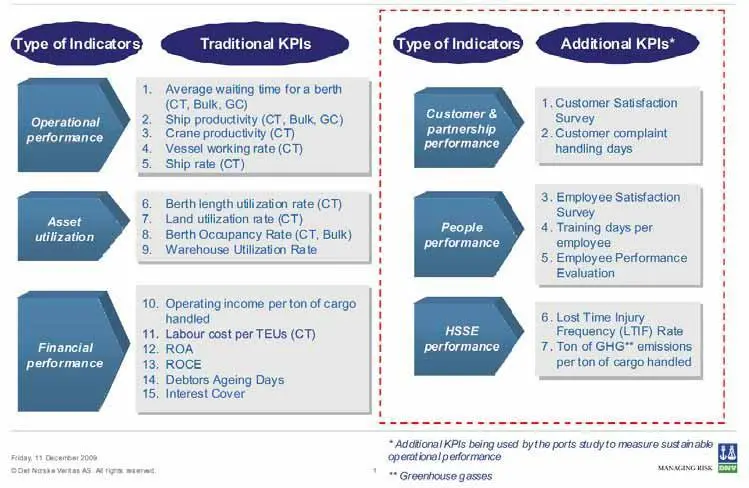
Another port benchmarking study was carried out for Jurong Port, a leading multipurpose port in Singapore. This study compiled and analysed traditional key performance indicators (KPIs) being used by the port industry. Jurong Port found that the traditional KPIs did not include climate change. However, climate change KPIs are being used as indicators, e.g., ton of GHG emission per ton of cargo handled.
Internal mitigation option analysis
DNV has developed an ontology of port operations, essentially a flowchart that maps out the route that cargo travels from the moment it arrives on a ship at port until it leaves the port grounds. This ontology can be customised to an individual port’s operations, allowing a port to analyse all of its processes to identify operational bottlenecks and greenhouse gas mitigation opportunities. The benefit to the port is a reduction in fuel costs, process times and delays.
Port-ship communications
Synchro Port. Lack of communication in marine management system’s leads to unnecessary delays before a ship can enter a harbour. Speed adjustments of vessel to time arrival at destination ports based on real-time port capacity does not factor into current decision making. This leads to unnecessary fuel consumption and queuing. SynchroPort is being designed to increase co-ordination between ships and ports, so that ships can more effectively manage their speed and routes. This allows port resources to be fully utilised while reducing greenhouse gas emissions and saving money and fuel for ships.
For more information:
indira.balkissoon@dnv.com
Related Articles
 ALTERNATIVE FUELS GREENPORT