![PortStrategy[GreenPort]](https://www.portstrategy.com/wp-content/uploads/2026/09/PortStrategyGreenPort.svg)




TUNNEL VISION
A new tunnel is the “best solution” for Port of Santos cross-port connectivity. In an exclusive interview, Rob Ward talks to Casemiro Tercio Carvalho, a leading proponent of the tunnel option, to hear the case for this option.
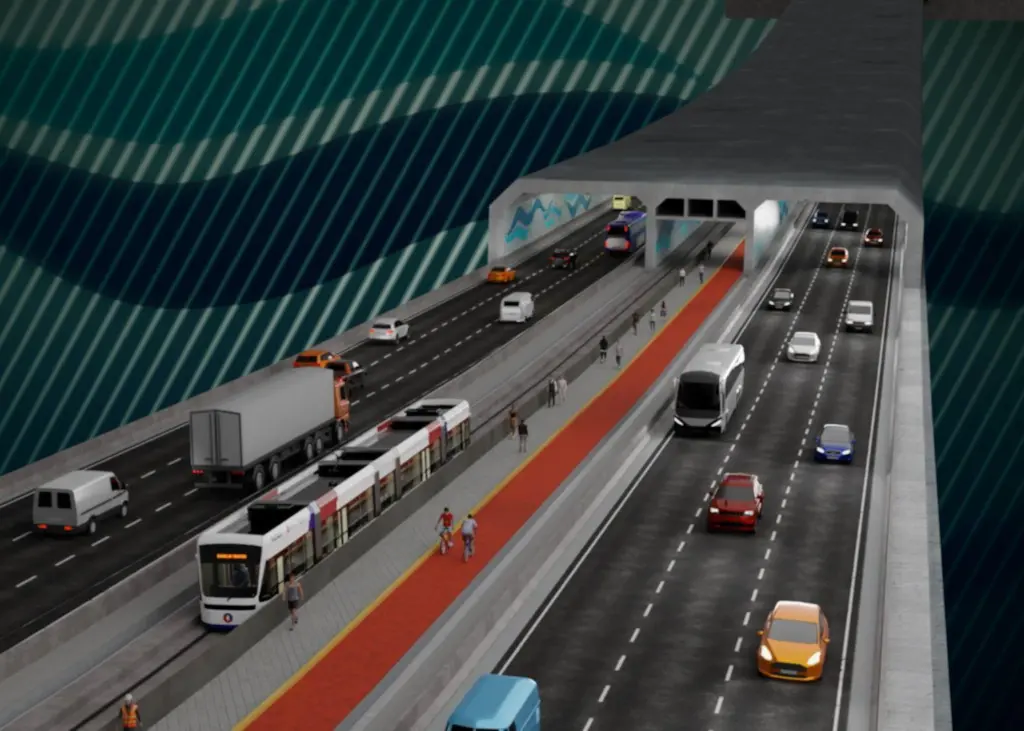
A tunnel is a much better option than a bridge for the Brazilian port of Santos. It is cheaper, almost as quick to build and will allow for bigger ships to eventually berth there, said Casemiro Tercio Carvalho, Director for Port Aff airs, University of Santos (UniSantos) and Senior Infrastructure Partner at StonePartners, a consultancy firm in an exclusive interview with PS.
He adds that with a new, cheaper tunnel plan and by utilising under-used shipyards in Brazil for fabricating concrete blocks for the tunnel, the Reais2.5-3 billion (US$474.8m-$569.7m) tunnel could be built in around two years. This is a comparable timescale to the competing Reais3.9bn Santos Bridge project, which estimates 18 months to two years for its construction phase.
SPLIT COMMUNITY
The port community in Santos has been split regarding whether a tunnel or bridge is needed to connect the two sides of South America’s largest container volume port (Guaruja is on the left bank and Santos is located on the right), or if money can be saved by building neither.
Beneficial cargo owners could have benefitted hugely years ago when multiple liner calls would drop off containers for transshipment that might need trucking from the Santos right bank of the port to the Guaruja left bank, some 40 km and up to 90 minutes (depending on traffic) away, but since then the merging of services means far fewer boxes now make that journey.
However, despite that contraction in cargo, there are solid gains for a crossing for the two port cities, and especially its denizens who work in the port of Santos (which employs directly or indirectly some 60 to 70 percent of all workers) many of whom live on one side of the channel but work on the other. Reliable sources in Santos and Brasilia say that at least one of the projects will move forward over the next year or so for a variety of political and logistical reasons, with Sao Paulo state governor Joao Doria backing the bridge and Brasilia backing the tunnel.
Santos Port Authority (SPA) has called for initial studies for a new crossing to be submitted this month (February 2020). “There are so many different advantages to be accrued by choosing the tunnel option, and one of them is cost, plus it doesn’t impede the arrival of mega ships in the future,” states Carvalho.
He explains further: “Also, worldwide, ports that are strategically important to a country’s logistics do not have bridges they have tunnels. A tunnel will be a much more efficient connection for the two sides of the port.”
“I’M TAKING THE TUNNEL”
Carvalho, who was also the president of the Santos Port Authority (SPA) from February 2019 to May 2020, notes the Vou de Tunnel (“I’m taking the tunnel”) consortium has generated a new plan and reduced the cost from Reais3bn to Reais2.5bn.
Moreover, during the same period the Bridge project, from highway concessionaires Ecovias (which also owns the Ecoporto ro-ro terminal), has increased the size and span of the bridge (by 700 meters to increase accessibility for maximum size vessels) and therefore its cost has jumped from Reais3bn to Reais3.9bn.
Carvalho, who is advising Vou de Tunnel, says that the consortium is comprised of a much wider group of companies than those backing the bridge project, and it would be a benefit to “all citizens in both municipalities”.
Among the tunnel backers are Tarcisio Gomes de Freitas, the Minister for Infrastructure in Brasilia, and 34 companies and entities including, Van Oord and Boskalis dredging firms, Abratec (which represents many container terminals) Centronave (the association for foreign flag shipowners in Brazil), Sindamar and various others.
Building a tunnel would also “revolutionise” real estate values in Guaruja, the rival beach-front municipality located across the channel from Santos, which has always suffered in the past because it is around 40-50 km by congested roads to Santos – where most of the work is – and the current ferry boat shuttle is time consuming and invariably overloaded.
Carvalho, who likes to think “outside the box,” argues that the tunnel option could benefit from the current moribund state of Brazil’s shipyards and mentioned three – EAS in the northeast, Ishikawajima in Rio de Janeiro and ERG in Rio Grande, in the far south – that could pre-fabricate blocks and save the cost of building a facility in Santos.
Shipbuilding expert Armando Freigedo Rodrigues, Director of Aquapar in Rio de Janeiro, agrees that building blocks from these yards is “definitely feasible” and this location is the best choice at it is closer and, “heavy lift transport of the units will be much cheaper”.
OPPOSING LOUD VOICES
Despite these strong views from Carvalho there are still loud voices calling for the bridge or to “leave things as they are”. Carlos Sepulveda, CEO, Santos Brasil, a left bank box terminal, favours a bridge.
At the same time, Leandro Carelli Barreto, Managing Director, Solve Shipping, says that from a “cargo point of view” there is no longer any need for a bridge/ tunnel crossing but from a civic improvement position there is an argument for it.
Port Strategy will be looking closely at Santos and its port authority and terminal privatisations in a forthcoming issue.
Related Articles
 SOUTH AMERICA
 PORT & TERMINAL NEWS
 PORT & TERMINAL NEWS