![PortStrategy[GreenPort]](https://www.portstrategy.com/wp-content/uploads/2026/09/PortStrategyGreenPort.svg)





Under false pretences?
Questions are being asked of AP Moller in Suape, Brazil, after Maersk announced its intention to remove liner services from the existing ICTSI terminal to its own new facility, as Rob Ward discovers
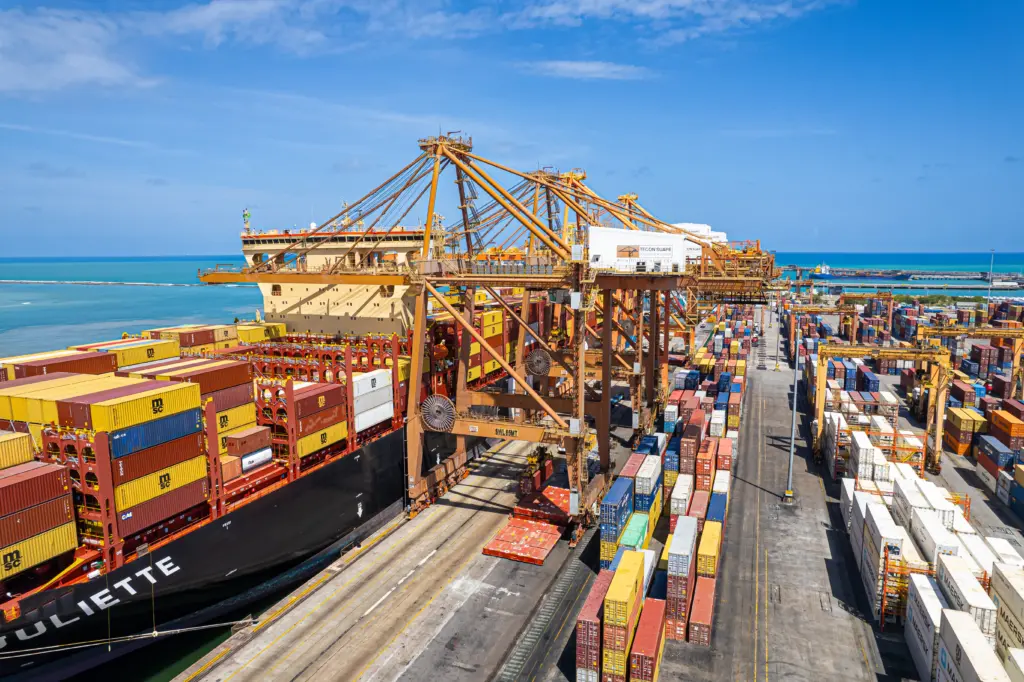
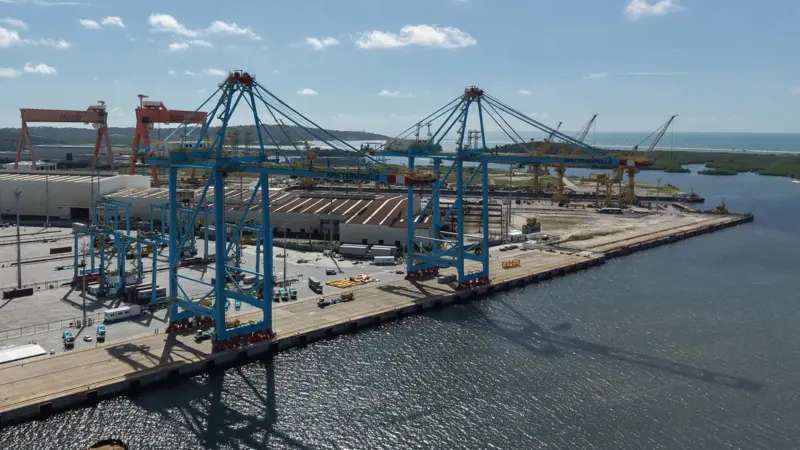
“It was all supposed to be so different,” mused one experienced Brazil watcher observing the dark black cloud that descended over the initial celebrations following the official inauguration of the Reais2bn (US$350 million) APM Terminals Suape container facility in June 2026.
Lauding Latin America’s, first fully electrified port facility and Brazil’s first additional, and much needed, new container capacity since DP World and Brasil Terminal Portuaria (BTP) opened for business in Santos in August of 2013, Maersk and almost the entire port community were in celebratory mode, proud that US$47 million of the overall spend had gone on electric equipment.
Maersk promised that the, initial, 400,000TEU capacity terminal would create additional jobs, bring in new cargoes, help fruit exporters and various importers, as well as bolster the Suape Industrial Port Complex (SIPC, which also acts as the port authority) and encourage industry in general in the largely impoverished, Northeast state of Pernambuco.
“APM Terminals Suape reflects our long-term commitment to Brazil’s growth and to strengthening the country’s logistics infrastructure,” declared Daniel Rose in a press release. He has been appointed CEO for the new facility, to add to the same role at Maersk’s similar facility at Pecem, on the north Coast of Brazil. “More than a new port asset, the terminal expands capacity in the Northeast and has already generated 1000s of new jobs, he was additionally quoted.”
One of the new jobs has gone to Carolina Merkle Brown, the new COO for both terminals, which will be competing with each other for the lucrative fruit export markets, which lie inland roughly equidistant to the two ports. Total fruit exports were worth US$1.45bn last year (up more than 50% since 2021), according to the Brazilian Fruit Exporters and Producers Association (Abrafrutas), with more than 25% from the Northeast region; with mangoes and grapes the most lucrative fruit exports, followed by melons. In terms of imports, car parts for the growing auto industry (especially Stellantis and some Chinese manufacturers) feature strongly, as well as components for the firms manufacturing in the SIPC and also another large industrial park to the north of Recife.
Then came the clouds
Then came the clouds. During the second week of August 2026, Maersk’s managers delivered an official note to Tecon Suape, the existing box terminal in the Suape Industrial Port Complex, stating that the end of the month the two Maersk services currently calling were going to start migrating to the new APMT Suape facility across the bay, with more services likely to follow.
Tecon Suape, which is part of the International Container Terminal Services (ICTSI), hit back immediately alleging that this move was “illegal, and not part of the agreement that APMT Suape had signed up for” with all the relevant authorities. The company issued legal notices and said that in taking away those two services, Maersk was removing around 25%-30% of the terminal’s entire throughput and jeopardising the terminal’s viability. This facility handled 725,000TEU in 2025 and recorded 333,786 TEU during the first half of 2026, the same as in the 2025 six-month period.
“To get the deal past the Brazilian authorities Maersk promised new cargoes and new services but instead they are taking ours,” explained Thomas Lima, the CEO for Tecon Suape.
ICTSI and Lima also added that the sale of the land had been made under “false pretences,” in that it was supposed to be returned to the state if the initial shipyard venture was halted. Instead, it was sold by owners, Grupo Camargo Correa, and Queiroz Galvao, to APMT for Reais450 million (US$85.9 million) having been purchased for just Reais10 million (US$1.9 million) a few years earlier. ICTSI claims this is illegal and that the Brazilian authorities need to investigate possible “irregularities.” Deputy Attorney General, Lucas Furtado, requested the inquiry based on documents received from ICTSI and if irregularities are confirmed it could lead to a review of the terminal’s status, according to reliable sources.
“On top of that,” continued Lima, “the port authority may end up losing out on the port concession fees we pay every year [estimated at $77.8 million in 2025] which APMT will not be paying as it is a TUP [Private Use Terminal], while we may also have to lose over 100 jobs to stay at least close to viable. This much-vaunted new terminal is not creating new business and jobs, but is, in fact, destroying existing ones.”
First two services
The first two services to make the switch are understood to be the cabotage operations by Maersk that uses the Brazilian flag Alianca branding ALC1 and ALC2, although APMT Suape will not confirm this, despite repeated requests. Lima said two deep-sea services, one to Asia and one to Europe, might also come under threat. This would leave Tecon Suape with only seven services (three deep-sea and four other cabotage) and it might not be enough to ensure continued viability, said various sources.
From its side, Maersk/APMT Suape has not made it clear when operations will begin.
ICTSI is now proposing that it brings forward a plan to extend its current concession, which ends in 2031, and invest up to Reais4bn (US$770 million) in extending that contract by at least 20 years, from 2031 to 2051, and take its annual capacity up to 1.4 million TEU per annum and create more than 1,000 new jobs.
“The plan is to, hopefully, invest more than double what APMT is spending and create more jobs than their Suape project,” Lima stated.
Armando Monteiro Bisneto, CEO, Suape Port Authority, said that it was “unfortunate” that the two container terminal owners were vehemently opposed to each other but he hoped that eventually things would calm down and that the port of Suape, the nearby city of Recife (capital of Pernambuco with 1.6 million inhabitants) and industrial parks will benefit from increased container capacity.
“It is our job to be a point of balance between the two terminals and not take sides in this quarrel,” he said in a lengthy interview with Port Strategy.
Bisneto added: “APMT Suape will add volume to the public port and hopefully we will become a very competitive public port and the two terminals will complement each other. To me, it is a privilege to have APMT here and the extra equipment they bring will improve our capacity to handle imports and exports and with the EU (new trade) agreement coming into force it will help enormously. I do understand why ICTSI is worried about the situation, but I think there is space in the port for both operators. They complain about each other but then it is our job to play the honest broker in the middle. We are unique in the Northeast in having two container terminals in one port, and with over one million TEU of capacity, and this could be a good selling point to importers and exporters.”
He added that Maersk has also offered to bring in new services connecting to markets in North America and Europe and then there would be enough cargo for everyone. Bisneto said he hoped to win back some of the fruit cargoes, namely mangoes and grapes, which had migrated to the ports of Salvador and Pecem from the Sao Francisco Valley.
Uneven playing field
However, there are fears from Rio Grande, in the far south of Brazil, right up to Suape, in the Northeast, via Santos, that the expansion of shipping lines into port operations and other levels of the logistics chain are creating an “uneven playing field.”
“It seems very much like the shipping lines – MSC as well as Maersk, and CMA CGM to some extent – are taking over or establishing new container terminals in Brazil and then transferring as soon as they can, all their services to their in-house terminals,” said our veteran Rio de Janeiro based Brazil watcher, who did not wish to be identified, for fear of losing future business. “This is terrible for the maintenance of fair competition and for rival terminals to be playing on a level playing field. These worries are also reflected in the forthcoming tender for STS 10, where Maersk and MSC are also likely to compete. Brazil does urgently need more container capacity, so from that point of view the new facility in Suape is beneficial, but we also need an even playing field.”
Lima believes there are various government bodies that should be over-seeing the process that saw a moribund shipyard turned into a Terminal de Uso Privado (or TUP), with all of them taking a narrow view of the gradual development and building of APMT Suape and not an over-arching view that would have pointed out the “inconsistencies” in the process.
During a couple of tense August 2026 weeks, Andres Kjeldsen, ICTSI regional vice-president of the Americas, jetted into Suape to re-affirm his company’s continued support to the region. “We have a strong commitment in Suape and our expectation and intention is to stay here for many years to come and continue to invest,” he said during a meeting with Bisneto.
“We had talks regarding an early extension to ICTSI’s current contract, which is due to expire in 2031 but now we might renew until 2051 to encourage even more investment in the port,” added Bisneto.
Port Strategy contacted APMT Suape managers between early July and mid-August 2026 and repeatedly asked what cargoes the terminal would be competing for and what plans existed to entice new cargo, as well as what would be the first vessel to call. One reply stated it will be targeting fruit exports but apart from that the responses were merely vague hints that the first call would be a smaller, likely cabotage call (operated by Maersk subsidiary Alianca Navegacao) and probably be carrying empties. APMT managers also said that delays were only due to the “homologation” (or ratification) of the new draft, of 15.1 metres and that it was “imminent.” Other sources said that Maersk would not be able to poach any deep-sea calls until it obtained authorisation for their planned 238,000m2 proposed bonded area, from Brazilian customs authorities, who were delaying this.
Related Articles
 PORT & TERMINAL NEWS
 PORT & TERMINAL NEWS
 PORT & TERMINAL NEWS