![PortStrategy[GreenPort]](https://www.portstrategy.com/wp-content/uploads/2026/09/PortStrategyGreenPort.svg)






A juicy carrot for Polish wind – but no plain sailing
Poland’s nascent offshore wind industry is looking at a large and juicy carrot – a draft PolishEnergy Policy calls for 8GW of offshore wind to be installed in the next decade, writes Stevie Knight.
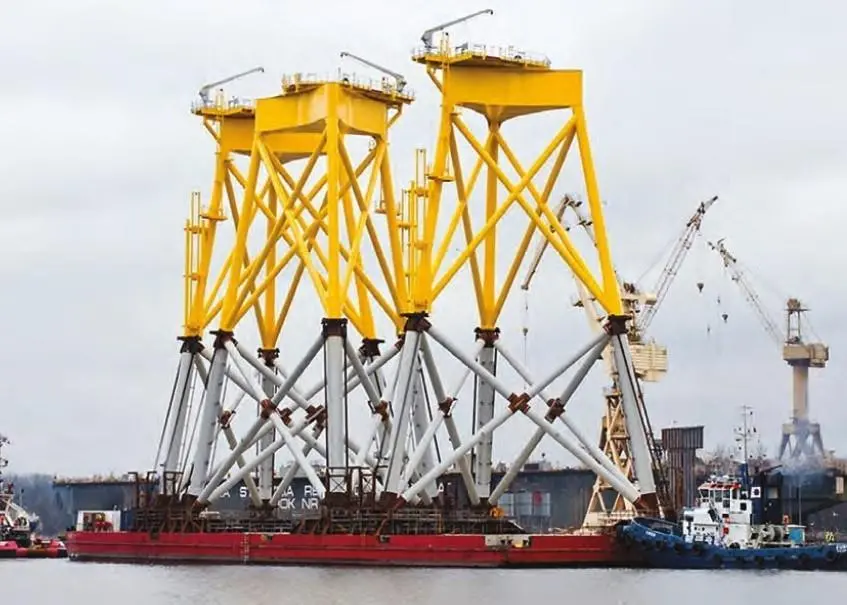
The headlines are calling it ‘one of the largest investments in the history of the Polish energy industry’ adding that it’s expected to be ‘the engine of economic development of coastal areas and the whole of Poland’. At the heart of it are estimates that it will create over 25,000 jobs, adding billions of zlotich to the country’s GDP.
HUB POTENTIAL
Local facilities are eyeing their marshalling yard and even wind hub potential, with the idea of planting the seeds for supply chain companies, factories and in the longer term, operation support services.
Yet as Monika Morawiecka, CEO of Polish utility company PGE Baltica notes, there are challenges. Offshore turbine power is shooting up, taking component sizes with it and, in particular, foundations.
Water depth and soil type also help define monopile dimensions. “From today´s perspective, 10m diameter piles and a total weight of more than 2,000 tonnes seem feasible,” says Marcus Klose of DNV GL.
However, he warns that “predictions of the past have been exceeded more than once”. Further, Jakub Budzyński of the Polish Offshore Wind Energy Society points out manufacturers will likely be offering turbines of 11MW or 12MW by the time Polish orders are placed.
Although this leaves a current shortfall in capable vessels, according to Morawiecka, market demand will yield solutions combining better levels of transport load capacity and lifting heights. She says this will “further improve installation times,” but admits the heft of the new ships along with the scale of the new components will “likely require some ports…to consider upgrades.”
Moreover, it is an expensive business. Even in the established wind port of Oostende in Belgium, in the last few years an additional €30 million was spent to widen the seaward entrance to allow the bigger installation vessels into its REBO Terminal.
Clearly, some are better prepared than others. REBO’s quays have been specified to 20t/m2 says CEO Dirk Declerck, adding, “so I think we are good for up to 15MW”. Yet since the scaling-up affects every aspect of the handling process, from cranes and barge transport to seabed and quay foundation reinforcement, he does expect a thinning out of older wind facilities for whom the extra investment is a step too far.
VIRTUOUS vs. BOOM-AND-BUST
The problem, says Declerck, is wind has proved to be “a cyclic industry” but and even the well-known REBO Terminal is facing a considerable drop in demand after 2021 – unfortunately, the next utility bidding round is not going to be tabled until 2025/26.
Luckily for Oostende it has other options. Project cargo, decom and its science park (complete with ocean basin and towing tanks) gives it a ‘Blue Growth meets R&D’ appeal for companies. Investing in research is key to the future says Declerck. “It is not only about having the infrastructure, it is about developing the base for upcoming technology which then feeds back to strengthen the business,” he explains, explaining that it creates a virtuous circle which should help to counter the boom-and-bust cycle.
However, Oostende is not alone, with many European facilities facing similar challenges. Sadly, this was avoidable. WindEurope’s offshore ports group has been trying to convince developers and governments to ditch over-reliance on market economics and work with them on policy to smooth out the wrinkles in demand.
“Without guidance from industry and sufficient planning timelines, ports face the choice of making investments without any guarantees of business,” it notes. Further, the organisation points out that even a contract can still result in non-paying assets, given short lease terms. Although gaining traction, WindEurope’s efforts to raise awareness of the problem haven’t prevented the next dry spell.
HOT CONTEST
Into this arena comes Poland’s 8GW prize, which promises to create “a large enough pipeline to incentivise needed investment and to guarantee adequate returns” for contract winners, underlines Morawiecka.
However, while she says that “location is the top priority,” the second element is “the local content factor,” meaning an expectation that the supply chain will swing in support of Polish companies. Further, the country is putting in place “legal tools to encourage developers to look for local partners”, adds Budzyński. PGE Baltica, responsible for 2.5GW of the development, is already in talks with Danish wind giant Ørsted.
Despite this, decisions on port facilities will likely come from an open tender, which means that while there will be some tilt toward home players, it is not the end of the story. Poland’s biggest contender, Gdynia, “has a track record in both heavy project cargo and onshore wind blades and nacelles,” says Budzyński. Certainly, the port has a lot going for it including established barge transport and a group of stakeholders that span the city’s supply chain and manufacturing base.
So, while the port may still not be entirely ready to pick up a hub role for the initial projects, he confirms that, “Gdynia is one of the leading possibilities, but it still has a lot of investment ahead.”
Exactly how much investment it will take is not yet known, but there is some clue that the port is supersizing requirements for its Hungary wharf upgrade as it’s specifying yard space strengthened to 250kN and quay areas reinforced to 500kN. It will likely also create other supporting infrastructure such as pre-assembly sites, adds Budzyński.
Despite Gdynia’s future capacity, both the German port of Sassnitz and Rønne in Denmark currently have the advantage as they are already operating. Plus, other facilities may offer an extremely competitive bid given that they want to fill the gap in their schedules. As Declerck notes, a wind port’s territory can reach “over 300km in any direction”.
As a result, Declerck says that port hopefuls should realise how, “current players will defend their position against new entrants,” before concluding with a truly salient point. “People are already aware that further dilution of the market could be an issue.”
BEING MENTALLY PREPARED
The cost implications have been complicated by “a very big jump” in turbine capacity, says Arnstein Eknes of DNV GL, commenting that as soon as the industry unveiled its 10MW size, manufacturers started looking at 12MW. Since these are now under development, there has been some talk about 14MW, although that may not be the end of it, as Eknes confirms. “Some are now saying we should be mentally prepared for 20MW.”
So, it may be the industry needs to explore alternative technologies. Certainly, monopiles may require huge penetration depths in deeper waters, so there will be “some tough issues… which could affect foundation approaches”, says Eknes’ colleague, Henning Carlsen, stating how “jackets, gravity, suction or hybrid solutions could prove more cost-effective.”
Eknes considers the issue further. “If we can considerably reduce the cost of floating wind, for example through economies of scales as we have seen in fixed offshore, then it could well be the answer for 12MW to 16MW turbines.”
However, he admits that is a challenge, as the engineering can be more demanding than for fixed installations, although it is the most likely answer for locations further offshore and interest is rising. One of the various Polish sites is in 60m-plus waters “so it will probably rely on floating foundations”, says Budzyński.
Yet as Carlsen explains, “any technology shift and the equations change very quickly”, the knock-on affecting what is required of ports. For example, floating systems allow a complete tower and nacelle to be constructed in port: a strategy currently being explored by Principle Power and Shell-acquired EOLFI. These could demand even larger prefabrication and float out facilities.
SHAPE SHIFTING
Certainly, landside limitations are even now driving change, and this promises to continue no matter what technology takes the lead: “The weight and length of the towers and foundations are already too great to transport by road,” says Declerck.
Eknes agrees. “Putting 110m blades on a trailer and getting them around corners is extremely difficult.” As a result, there is a growing trend to bypass the highways entirely with components coming in by barge, before moving on via seagoing transport to the installation site.
This in turn will alter the character of future wind facilities. “Locations which have not yet seen a huge industry boom…including some out of the way cruise ports, could find themselves in demand, as these are less likely to be impeded by bridges or other structures,” confirms Eknes.
Related Articles
 TERMINAL OPERATIONS
 TERMINAL OPERATIONS
 CONTAINER & CARGO HANDLING