![PortStrategy[GreenPort]](https://www.portstrategy.com/wp-content/uploads/2026/09/PortStrategyGreenPort.svg)





Encouraging Gaia to slow down (amended)
Despite being more environmentally-friendly than other transportation sectors, the shipping industry continues to lessen its environmental impact, as Patrik Wheater finds out
There is of course still much debate about the factors governing the rise in global average air temperature, which has risen by 0.76ºC since 1850. But whether it is due to anthropogenic air pollution from the burning of fossil fuels or the cyclical climate changes that this planet has experienced for millennia, or indeed both, the fact is that by the end of this century the predicted 4°C increase will create a very different world to the one in which we currently inhabit. Our climate is changing and whatever we can do to lessen man’s environmental foot print is not only altruistic but makes commercial sense as fossil fuels are finite.
Today, commercialism and legislative requirement override altruism as the driving forces behind green thinking, but it is likely that governments will soon compel port authorities to reduce their emissions through levies of some sort.
Early last year, the Norwegian government introduced a NOx (oxides of nitrogen) tax on shipping and now ships entering its waters will have to pay NOK15 ($2.7) per kg/NOx emitted. Sweden and Denmark are considering the concept and the Baltic States also see it as a means of reducing NOx emission around environmentally sensitive areas.
Port authorities globally are catching on to the idea of harbour emissions dues and in Canada, the Port of Vancouver introduced a three-tier Harbour Dues Programme in April 2007. Incentive based, it offers discounts to ships burning less sulphur fuel; so if a vessel’s engines burn 1%-2% sulphur fuel then harbour dues would be comparable to 2006 rates. Burning between 0.5% and 1% of sulphur fuel would be accredited with a 10% discount, while the top tier discount of 20% would be awarded to those ships using less than 0.2% at anchor or at dock.
But these schemes are in the minority at the moment. For the time being, shipowners, whose annual fuel bill can account for 63% of a vessel’s total operational costs and whom flinch at the prospect of incurring additional direct or indirect fuel costs, cold-ironing, or plugging in to Alternative Marine Power (AMP) sources is becoming an extremely viable proposition.
The Port of Los Angeles has been a keen advocate if not leader of the technological development and in 2004 opened the world’s first container terminal to use Alternative Maritime Power. This was at the West Basin Container Terminal at Berth 100. Since then, the Port of Los Angeles has developed its Yusen Terminal to allow vessels to receive AMP and in November last year the NYK Line containership Atlas became the first ship to hook-up to the Yusen facility.
Other shipping lines have signed memoranda of understanding to implement AMP technology on their container vessels and to use the facility at Los Angeles terminals. These include: CSG, Evergreen, MOL, Yang Ming Line, OOCL, P&O Nedlloyd and NYK Line, of which the latter has announced intentions to retrofit 38 of its vessels with the onboard equipment required to utilise the concept.
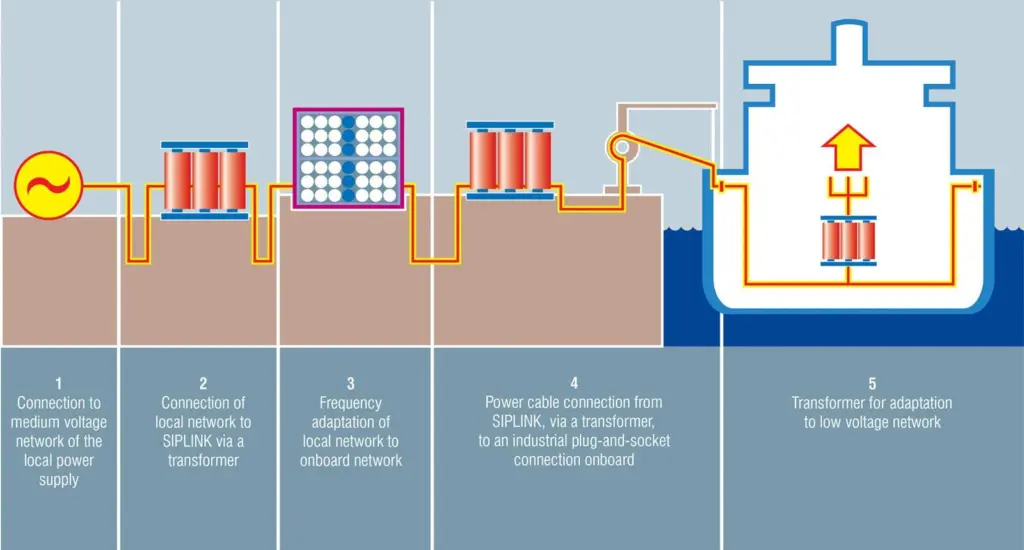
Although AMP systems are being marketed by a number of companies – ABB, Cavotec, SAM Electronics and Siemens – the concept is pretty much standard: a shore-side power source, a conversion process to transform the shore side power voltage to match the vessel power systems, and a vessel that is fitted with a system capable of taking on electrical power while at dock. Depending on the size of the ship, estimates are that AMP can reduce NOx by one ton and reduce SOx (oxides of sulphur) emission by half. Siemens Power Transmission and Distribution’s newly launched ship-to-shore power system, Siplink, also claims to reduce soot, fine dust and noise together with energy savings of between 25%-30%. But, as with all the solutions, emissions-reduction comes at a cost.
Speaking to Port Strategy, Siemens’ marketing manager Steve Goldspink, says, however, that once ports have made the initial investment, around £500,000 per one million volt amp (MVA), then ports will be able recoup the cost by charging ships for the power, although this should not exceed the costs associated with running shipboard equipment in harbour as it would defeat the objective.
Mr Goldspink adds that Siplink is being considered for installation at Mersey Docks and Southampton while the company is working with Cavotec on a bid to supply the system to the port of Rosyth, Scotland. “Cavotec have all the cable management systems and we recognise that together we can offer the complete [AMP] solution,” Mr Goldspink says.
However, there is some concern that AMP may not be the panacea to cutting emissions as it is perceived to be. The opinion of the Copenhagen Malmö Port (CMP) is that “shore side supply can only – and not in every case – be relevant for frequent traffic made by the same ship. Most often the ship can obtain the same or almost the same effect through scrubber technology and other concepts onboard the ship,” says CMP’s manager Gert Nørgaard.
“This has a further advantage in that it also works when the ship is sailing between ports, which are much better for the regional and global environment. Further it works in direction of reducing noise nuisance in ports, which is becoming an issue of increasing importance in city-ports. In short, you achieve more environmental improvement spending relatively less money,” he says.
At present, the two CMP ports offer no shore-side facilities for shore-side power supply to ships, although the ferry terminal used by DFDS, DFDS Tor Line and P&O ferries is prepared to install such a system should the market dictate.
Related Articles
 TERMINAL OPERATIONS
 TERMINAL OPERATIONS
 CONTAINER & CARGO HANDLING