![PortStrategy[GreenPort]](https://www.portstrategy.com/wp-content/uploads/2026/09/PortStrategyGreenPort.svg)





LOW EMISSIONS STRATEGY
As ports look for ways to cut their emissions, management teams are faced with a bewildering choice of low emissions technologies, and the risk of implementing a technology that mightbecome obsolete. Steve Roberts, Associate Director, Ports & Marine, AECOM, looks at how to navigate the options and find not only the best option technologically, but strategically.
Environmental credentials have never been more important in the transport sector, and society as a whole, than now. Globalisation was driven by cost reduction and maximised the comparative advantage of different economies creating a boom in seaborne trade in the process. This model only accounts for the direct financial costs of production and shipping, and not the wider externalities such as environmental impacts.
Today, shippers, striving to meet customer expectations of environmental responsibility, increasingly look for ‘green’ supply chain options with lower emissions. Some leading port groups have successfully differentiated their offering on this basis, with the reward that customers attracted by this attribute tend to be more captive.
There is also the opportunity to reduce operating costs by adopting low emission technologies, both from fuel and maintenance cost savings, and there may also be possibilities for ports to generate revenue.
VARIOUS SOURCES
Ports are built on complex systems of operation and consequently reducing or eliminating port emissions is a complex affair. By default, most ports use at least two power sources (electricity and diesel) and sometimes more: LPG for forklift trucks, petrol for road vehicles, and if bunkering for vessels is provided other fuels enter the equation.
An immediate question for anyone devising a low emissions strategy is: which technology offers the best emission reduction and financial return (including consideration of whole-life costs)?
To arrive at the answer, ports must consider which technologies currently on offer will be available over the next 10 or 15 years – the typical lifespan of port equipment that today cannot be fully or easily electrified. This, in turn, begs the question, is technical superiority the key to predicting which power source will gain the critical mass needed to become mainstream, and how much does that matter for your port?
To help address this issue we consider some of the strategic, rather than technical, considerations. For port systems such as buildings, supplying shore power to ships or bunkering of vessels lower emissions can be achieved through the purchase (or on-site generation) of renewable electricity, providing shore supply to ships if grid capacity permits, or provision of LNG as a bunker fuel. For these asset types, the best options are fairly clear-cut.
For cargo handling equipment electrification appears to offer an ideal solution to many problems: eliminating on-site emissions and if supplied from renewable sources eliminating emissions altogether.
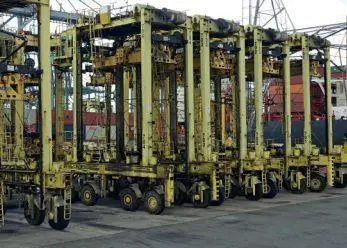
While this is a good option for assets such as ship-to-shore and yard cranes, items such as terminal tractors, payloaders, reach stackers, empty container handlers and so on (‘mobile equipment’) remain difficult to electrify with current technology.
Mobile equipment has the common characteristics of being mobile, subject to weight limitations, and having usage patterns that mean they have little downtime. It is this area of port operations where identifying the best low emission option is most complex.
For these situations alternative energy sources and technologies may be the answer. Alternatives to fossil fuels such as diesel include:
- Electrification with cable connection
- Battery electric power
- Fuel cell electric power e.g. hydrogen fuel cell
- Liquified natural gas (LNG)
- Hydro treated vegetable oil fuel
- Petrol or diesel hybrid drives
- Biodiesel fuel
- Hydrogen duel fuel
- 100% Hydrogen internal combustion engines
They offer varying:
- Reductions in emissions
- Capital, fuel and maintenance costs
- Retrofit capability for existing vehicles and plant
- Suitability for different applications in ports
- Availability
These alternatives can also be categorised as either:
- Fully aligned to traditional internal combustion engine technology, e.g. biodiesel or 100% hydrogen internal combustion engines,
- Partially aligned with internal combustion engine technology, e.g. hybrid drive technologies, or
- Aligned with electrical power, e.g. fuel cell options, battery vehicles and pure electric options
DECISION MAKING
When creating a low emission strategy the following strategic factors should be weighed up in addition to the technical reduction in emissions and direct costs:
Keeping things simple
- How many different fuels and technologies do we want to be operating with? Each additional fuel, energy source or unique type of technology potentially adds: space requirements; inventory costs, training costs, and may require permitting for on-site storage. A non-standardised fleet also reduces flexibility and the ability to cover equipment breakdowns or staff shortages. Fewer different fuels and technologies will generally be easier and cheaper to manage.
Obsolescence or unfavourable perceptions in the future
- Will other technologies become suitable for this application in the future? Some alternative fuels have shown promise and been used in pilot schemes but did not become as widespread as expected. Electricity is the most commonly convertible type of energy and used in the final drive of hybrid vehicles, fuel cell vehicles and battery electric vehicles, so technologies that incorporate electrical drives may suffer less obsolescence.
- Does the technology result in a genuine reduction in emissions or does it create a new environmental problem elsewhere in the energy supply chain, or in the lifecycle of the equipment? The green credentials of biomass power stations are now being questioned as the notion of shipping wood chips from one continent to another, and the ability to re-plant sufficient trees at a fast enough rate, has already put some investors in the port sector off backing this technology in the future. Equally relevant, while battery electric vehicles potentially offer zero emissions at point of use and during power generation, battery waste at the end of vehicle life is still an open question.
- Are there ethical considerations over how the fuel is produced? Is there potential conflict between the production of the fuel or manufacturing of the technology and resources such as water, land for food production, or waste from mining? Today this may seem a small concern, but how could it look in 10 years’ time?
Implementation and operation
- How does the technology match the duty cycle of the application? Does the refuelling/recharging time coincide with periods the equipment is not in use, both in terms of frequency and duration? This may depend on specific usage patterns at a port rather than a general characteristic of a given type of equipment.
- How easy is it to implement? Does the technology require large amounts of infrastructure within and outside the port such as fuel tanks, pipelines or upgraded grid connections? What investment in training is needed for staff, and how easy is it to source people with the right skills? What licences may need to be held? How dependant is implementation on the actions and cooperation of third parties? What are the space requirements? In general, small scale self-contained schemes will be easier to implement.
- Scaleability – how easily can the technology be further rolled out if volume growth requires more equipment? Are there ‘tipping points’ that need to be reached before an increase in fleet or infrastructure makes financial sense for a given technology, and if so how big are the steps between tipping points?
Long term viability and lower unit costs
- Will there be long term support and widespread adoption of this technology? What evidence is there the technology is gaining critical mass, at least at a local level?
- What might happen to energy prices in the long term? This is hard to predict but as a general rule if something is widely adopted costs should come down in the long term. It is worth considering: can the energy be generated from a variety of sources and are those sources spread throughout the world? If so, unexpected price increases due to natural disasters, conflicts, loss of refining capacity, or cartels are less likely. Taxes on fuels should be viewed carefully: if currently higher taxed fossil fuels are largely replaced in the long term, how will governments replace this revenue?
Risks
- What are the sunk costs if the technology proves unreliable and conventional equipment has to be brought back into use? And what are the consequences of disruption caused by equipment failure?
- What are the options for leasing rather than purchasing? Or for suppliers to fund some or all of the infrastructure?
- If fixed infrastructure needs to be introduced, is there a risk of siting it in a location that inhibits future development plans?
Upsides
- Can this energy source also generate revenue for the port? Could the energy source be located in the port and any excess sold to third parties? Could the port be a hub for distribution or retailing of this fuel – even if generated by a third party – with a rent or % of sales creating a revenue stream for the port?
A LOGICAL PATH
As with most things, there is likely to be a trade-off between cost and benefits. The greater the investment the more crucial it is to de-risk the strategy by choosing options likely to be reliable, simple to implement and become widely adopted.
Options that incorporate electric drives and fuels such as hydrogen which is both non-polluting at point of use, can be produced using renewable electricity (creating ‘green’ hydrogen), and does not appear to conflict with other human needs; are likely to be safer long term choices.
However, hybrid drive or battery electric solutions may be more appropriate given the scale, equipment lifespan and space constraints of an individual port.
What is most suitable will depend on the specific circumstances of each port. A wide range of strategic considerations and a systematic decision-making process should guide development of a low emission strategy for ports.
Related Articles
 TERMINAL OPERATIONS
 TERMINAL OPERATIONS
 CONTAINER & CARGO HANDLING