![PortStrategy[GreenPort]](https://www.portstrategy.com/wp-content/uploads/2026/09/PortStrategyGreenPort.svg)





No longer all at sea
While the recent emphasis on port security has been centred on cargo, little attention has been paid to actively scanning individuals, many of whom regularly access port terminals as part of their legitimate employment. Alex Hughes reports.
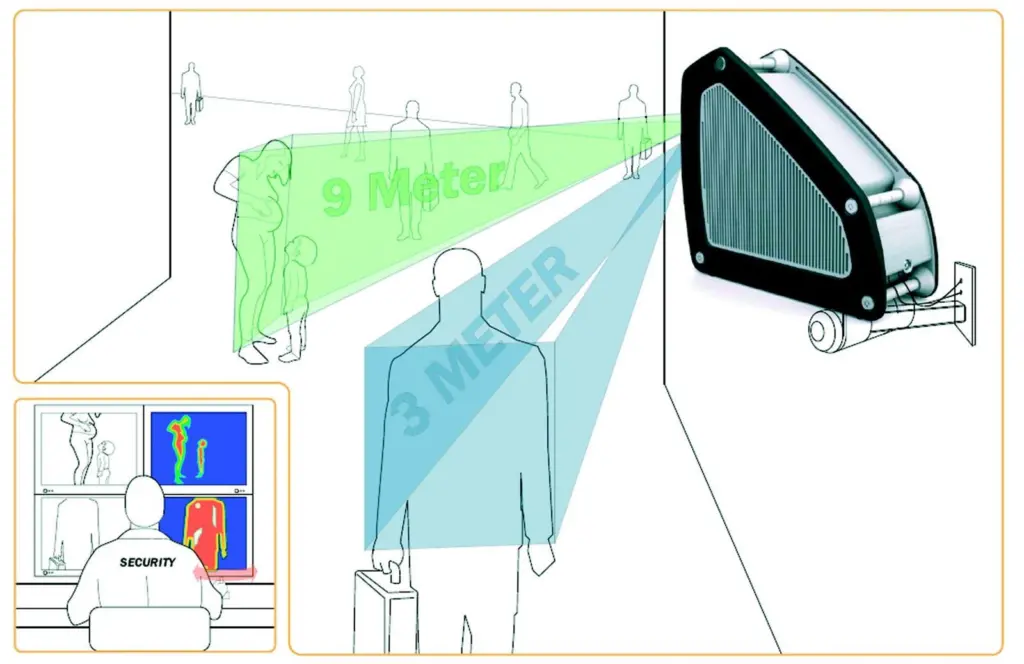
While background checking can help eliminate employees with dubious background histories, little is actively done to limit the potential ingress of dangerous materials that might be sneaked through what are often rudimentary gate checking processes.
Nevertheless, the UK-based company ThruVision recently presented its revolutionary passive terahertz imaging technology which introduces new possibilities into the field of person screening.
Unlike standard metal detectors, this new technology will image any concealed object irrespective of what it is made of.
This is possible because terahertz waves occupy the part of the electromagnetic spectrum between microwave and infrared radiation, encompassing frequencies invisible to the naked eye in the range from 100GHz (1011Hz) up to roughly 30THz (3x10¹³Hz).
For the moment, ThruVision has brought two products to market: the T-4000 and T-5000. By deploying the former, security personnel can have access to both a terahertz and a real time image view of a person as they are being imaged as part of a security screening process. The T-4000 can seek out objects that people may have concealed about their person. Significantly, this can be done even when those people are not stationary and also when they are comparatively distant from the scanning camera.
Although it is possible to mount the T-4000 camera on standard pan and tilt mechanisms, it can be acquired as part of the T-Scan 5000 package. This takes the form of a portable “bollard”, which also offers full integral pan and tilt capability, into which the T-4000 camera unit is fixed. This allows more discreet imaging of subjects.
Unlike other imaging technology, passive terahertz does not illuminate or radiate a subject. In fact, no ionising radiation is used at all. Instead, the T-4000 makes use of the natural radiation emitted by objects and people. Furthermore, because of the very short wavelengths involved, terahertz imaging equipment takes up a significantly smaller footprint than other types of scanning equipment, although prices for the T-Scan 4000 and 5000 are no more expensive than for existing x-ray scanners.
SCANNING TRUCKS? Truck scanning remains a fundamental aspect of modern day port security, especially for those ports doing business with the US. In Saudi Arabia, the Customs authorities at both Jeddah and Dammam are operating five CX-9000F high-energy cargo X-ray screening systems supplied by EG&G Middle East, L-3’s local distributor. These replace the former manual checking of containers, which was both inefficient and resulted in potential damage to the contents.
According to L-3’s VP for cargo systems, Jay Payne, the contract to supply the equipment was made against an international tender and involved all the major X-ray screening manufacturers.
“Our equipment fitted into the limited available space at the ports, while its ability to scan 50 trucks/hour meant it has the highest throughput in the world, ” notes Payne.
He points out that the effectiveness of X-ray systems is subject to certain criteria, including penetration, image quality and speed of throughput. In the case of the CX-9000F, the operators have a 9.0 MeV high-energy X-ray that can penetrate more than 370 mm of steel.
The X-ray source and detector array are fixed and a patented motion system takes the vehicle past the X-ray to generate images, so scan speed is precisely controlled for consistent, distortion-free images.
“Typically, the primary use for the technology in this application is to match the contents of containers and vehicles to Customs manifests. The system’s detector electronics produce detailed images, so Customs officials can quickly spot questionable contents and see items that may or may not be on the declared manifests, ” observes Payne.
As a result, the system can be used to inspect trucks, vans, automobiles, as well as ISO containers. Furthermore, inspectors can screen for concealed items in both the body of the container and in the chassis area because the CX-9000F captures images of vehicle from a point just above the ground to the top of the roof.
Quizzed as to how ROI can be calculated on X-ray equipment, Payne notes that there are immediate hard cost benefits in the form of tax revenue increases which often result in the system paying for itself in the first year alone. Other benefits obviously include the overall threat deterrent and the number of seizures of weapons, drugs or stolen goods that are made.
AND ANOMALOUS VESSELS In addition to landside security concerns, companies are now paying attention to the detection of anomalous vessels spotted offshore.
Smiths Detection-LiveWave, for example, has been awarded an US$850,000 contract by the State of Rhode Island to engineer and deploy a prototype security solution called the Rhode Island Port Security Wireless Communications Network in Narragansett Bay.
According to Peter Mottur, president of Smiths Detection-LiveWave, the contract essentially has three main components.
The first of these involves group partner, Raytheon, which is linking radar systems used to track vessels in the Bay to a CCTV network, which uses both new and existing video and thermal imaging cameras to create a visual image of a vessel straying into a restricted area.
Software developed by LiveWave enables the nearest camera to focus in on and track the suspect contact, or allow the pre-warned system operator to do this manually.
The second component is a broadband wireless network that will enable visual, radar, text and voice input to be accessed by both the system operator as well as mobile first responders. Indeed, those involved in Bay security will be able to receive visual images through such devices as laptop computers or wireless PDAs as part of the wide area network being established.
In addition to the abovementioned fixed imaging devices, LiveWave is also equipping vessels operated by the US Coast Guard and the Rhode Island Department of Environmental Management enforcement officers with mobile cameras that will also be integrated as real time images into the wide area wireless security network. At the same time, on board terminals will also enable those officers operating offshore to access visual images or suspicious radar contacts. They will also be able to make their own input available to colleagues onshore.
However, to avoid a communications bottleneck in any emergency situation, the FirstView software deployed allows a local hierarchy to be established among responders. If, for example, several people want to access a single camera, the system software will determine which of those has first access priority.
“The most important thing about this programme is its role in creating an interoperable communication system for real time situational awareness. Data can be shared between all project stakeholders: the local police department, the harbour master, state law enforcement officials and also federal agencies, such as the Coast Guard and DHS (Department for Homeland Security), allowing for far better coordination amongst responders, ” says Mottur.
Indeed, it is the integrated nature of the network that Mottur points to when asked to justify the investment in such a system. By sharing data, rather than duplicating it, the various agencies involved in providing the necessary funding have not only saved money upfront, but also ensure that, in the case of any emergency, resources thrown at the problem can be optimised.
Related Articles
 TERMINAL OPERATIONS
 TERMINAL OPERATIONS
 CONTAINER & CARGO HANDLING