![PortStrategy[GreenPort]](https://www.portstrategy.com/wp-content/uploads/2026/09/PortStrategyGreenPort.svg)




Peering inside the box
Bill Mawer of Smiths Detection explains to Alex Hughes how those who need but cannot afford scanning equipment, can be helped out.
In the post-9/11 environment, significant opportunities have arisen as new security based programmes have placed great emphasis on the need to proactively seek out arms, explosives and nuclear material being imported into countries such as the US for use by terrorists.
“Authorities used to concentrate on seeking out contraband;
nowadays there is a much larger (and deadlier) range of things that could be potentially shipped around the globe, notes Mawer. “So, whereas previously screening was a vital element in a nation’s attempt to protect revenue, nowadays it functions very much as a first line of defence against possible insurgent attacks.”
Nevertheless, while the various organisations now undertaking standard security screening around the world may well have changed, many of the front line personnel remain the same. Indeed, Customs authorities worldwide remain the biggest users of screening equipment produced by companies such as Smiths Detection.
Mawer explains that the US-inspired Container Security Initiative (CSI) has allowed modern screening equipment to reach most corners of the world. As part of the CSI, authorities in the US have either deployed personnel and equipment overseas as a means of extending their own national security borders, or even ceded equipment to other countries unable to afford their own.
Indeed, many of those countries considered to be in the high-risk category are effectively “cash poor” and struggle to acquire world class container scanning equipment. It has therefore been incumbent upon manufacturers to find innovative ways of getting equipment to those that need it most, but who cannot necessarily afford it.
THE BUSINESS END Smiths Detection has been one of several companies involved in the security sector that have long recognised this problem and in recent years several public private partnership (PPP) schemes have sprung up around the globe to resolve it. Essentially, this involves the manufacturer in seeking out finance in order to place its own equipment at ports which would otherwise not be able to afford it. As Mawer points out, shippers in those countries are wholly accustomed to paying outside agencies fees to undertake manual inspection of consignments prior to despatch. Under the PPP revenue model, companies like Smiths undertake such inspections themselves and use the revenue derived from making the relevant images available to the authorities, to offset the capital invested in the original equipment.
Notwithstanding the hoohah currently surrounding all aspects of security at ports, the number of containers being scanned still remains negligible. However, the rate of deployment of screening systems is continuing to increase thanks in part to PPPs, although the bulk of new equipment is being procured as part of highly ambitious security programmes involving major budgets.
Nevertheless Mawer says that actually predicting what percentage of internationally shipped cargo will eventually be scanned is not currently possible.
“Using existing technology, it is not realistic to screen 100% of all internationally shipped containers. Nor do I believe it will be possible to do so in the next 5-10 years. Furthermore, screening undertaken in isolation should not be considered as a security panacea. Instead, it should form part of a multi-layered approach to security, ” emphasises Mawer.
When pressed to explain what form this should take, he points to good background intelligence that would allow authorities to identify high-risk containers in the first place. In addition, use of technology to tag and track containers throughout the entire logistics chain has to be a must, while the use of high-tech seals should also be mandatory. Finally, known or trusted shipper programmes will drastically cut the number of containers that really do need screening anyway.
Complicating the whole security issue is the fact that the type of concealed objects now being sought is much harder to detect. Rather than looking for substantial amounts of cocaine in a container stuffed with scrap metal, for example, an operator might nowadays be looking for something the size of a lunchbox containing explosives, weapons or even nuclear material. This has quite profound implications for the latest generation of screening equipment, which must offer both greater levels of penetration through metal, whilst also making available higher quality imaging to the operator.
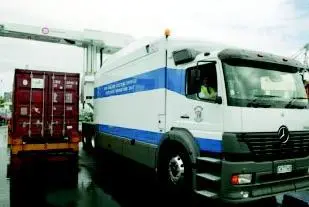
MOBILITY VS SOPHISTICATION Mawer nevertheless points out that current scanner technology is reasonably familiar and makes use of either x-ray or gamma radiation screening techniques. At one end of the scale, there is highly mobile equipment that can be relocated very rapidly within a port, easily moved from one port to another, or even deployed at a border crossing post. As an example, he cites SAIC’s Vacis, which makes use of a non-intrusive gamma ray imaging system, while Smiths Detection’s similar Cab 2000 is pitched at the more sophisticated end of this particular market.
“These scanners have a pretty reasonable capability, but their ability to find a small object within a densely packed container is always going to be limited, ” concedes Mawer. “It is really quite simply a question of physics: the higher energy x-rays you use, the more penetration you get, which in turns gives you a better image quality and a greater chance of detecting something.”
Larger machines, such as Smiths Detection’s HCV 2, provide a mix of high-energy in what remains a mobile system and can penetrate up to 300 millimetres of steel. The HCV 2, which takes only 15 minutes to assemble, produces high image quality, while the latest version has an inbuilt radiation detector as well.
Finally, the very largest scanners, which can be mobile as well as fixed installations, have very high-level energy components, which typically present the operator with views from the side of the container and also from above. Both Hamburg and Rotterdam already have these units, while Mawer reveals Smiths Detection has recently installed a big dual view system in an Israeli port.
“Our view is that what the market wants is technology combining high energy x-ray penetration and mobility, which will allow the greatest degree of flexibility of use. It was for this reason we decided to invest heavily in our HCV 2 system, ” he says.
Asked whether future development will also involve wholly automated systems, Mawer says that most major industry players are investing significant money in this area. However, the main stumbling block is how to remove a trace sample from a closed container for analysis. One promising area appears to be using high power gamma radiation to excite material inside, thereby causing the energy level of electrons to rise and a significant emission to take place that can be detected externally. One industry player, Rapiscan, is also trialling a high-power linear accelerator with the same aim in mind.
“There are nevertheless fundamental issues with using nuclear techniques which are still some way from being resolved. One of these is the fact that you are screening with very high energy systems that are themselves emitting radiation. Post screening, you could also potentially be left with a radioactive substance which wasn’t there before” warns Mawer, who nevertheless stresses that Smiths is seriously looking at this solution and is open to collaboration with potential partners.
Related Articles
 TERMINAL OPERATIONS
 TERMINAL OPERATIONS
 CONTAINER & CARGO HANDLING