![PortStrategy[GreenPort]](https://www.portstrategy.com/wp-content/uploads/2026/09/PortStrategyGreenPort.svg)






Port automation best approached in stages
Taking a step-by-step approach to automation is sensible because it allows for time for terminals to become orientated with functionality and processes, the managing director of LASE has said.
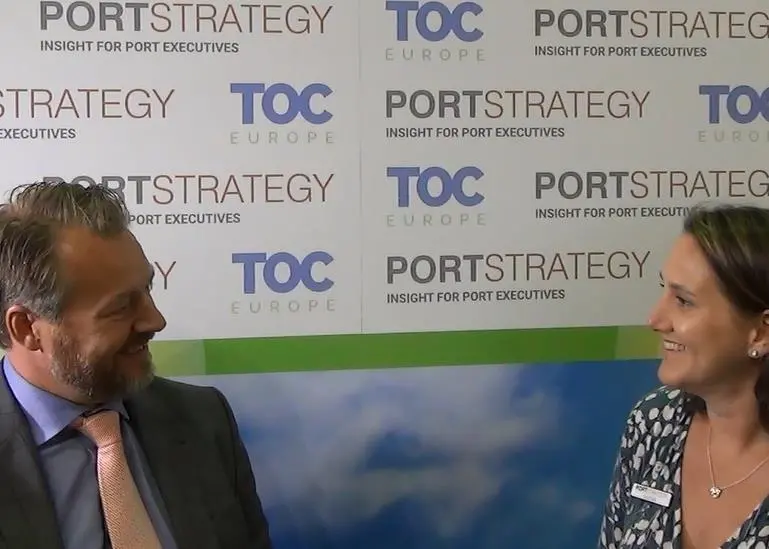
Taking a step-by-step approach to automation is sensible because it allows for time for terminals to become orientated with functionality and processes, the managing director of LASE has said.
Speaking exclusively to Port Strategy at TOC Europe, Lars Ambrosy stressed that understanding the implementation requirements for automation is important to achieve your goals, as well as making sure employee are briefed and onboard with changes.
He said: “It is good to take everybody with you and reduce the risk by going step by step. It makes it easier and it is also continuous progress. You have to take your staff with you and its very important that they learn to operate the systems and that they are willing to take the next step.”
Bigger vessels
On the subject of making improvements at existing terminals, Mr Ambrosy believes the fact that vessels are becoming increasingly bigger is a driving factor for terminals to change their operations and think about upgrades and digital technology such as apps.
“When you are used to having vessels every other day but are now getting two peak moments during the week you have to handle it and rethink what you are doing and certainly one of the key decisions is whether to go over to automation because you cannot have staff onsite over the whole week and only working during just two peak moments, “ he explained. “I would say automation is a big opportunity to prove something.”
Automation is not just an opportunity for large terminals, said Mr Ambrosy, pointing out that all terminals can decided to which degree they get involved. Changes such as automating a fleet of RTGs can be achievable for smaller terminals and has a knock-on effect for staffing efficiency. “You can replace drivers of 10 vehicles with two or three remote crane operators, so it makes sense,” he said.
Despite the benefits, it’s not worthwhile for some terminals to pursue automation and we will not see 100% of terminals automated, stated Mr Ambrosy. “I think that in 20-30 years I would expect 50% to be fully automated,” he surmised.
Related Articles
 TERMINAL OPERATIONS
 TERMINAL OPERATIONS
 CONTAINER & CARGO HANDLING