![PortStrategy[GreenPort]](https://www.portstrategy.com/wp-content/uploads/2026/09/PortStrategyGreenPort.svg)





The law of unintended consequences
Roman Poersch of Wilhelm Borchert argues that over and above the regulations, “the law of unintended consequences” means that some environmental port initiatives could have a life of their own.
“There are a number of objectives that vary from region to region, such as reducing oil dependency, or cleaning up emissions in sensitive areas,” says Mr Poersch. “These aren’t, by themselves, economic concerns but political ones and ports are largely economic propositions.”
So, while there are incentive schemes for all sorts of initiatives, getting involved may be expensive, even if it’s layered with grants.
The European Community is, for example, trying to put an end to the ‘chicken and egg’ impasse faced by LNG technology, since the technology won’t be widespread among maritime transport until the bunkering is in place and vice versa. This calls for LNG stations to be added at 139 ports on the Trans European Core Network, with a 2020 deadline for the maritime ports and 2025 for inland ports. Even though the stations will be small, you are still looking at a fair amount of infrastructure including chilling or pressurised facilities.
However, getting the LNG ships in will take a kick start of some order, explains Mr Poersch, as gas really isn’t so good for retrofitting “and newbuilds will take some encouragement to come on stream in today’s climate”.
Added to this there’s the question of how the feedstock will get in to the port. “Beyond those with big import facilities, what about those with shallow draft or restricted space?” asks Mr Poersch. Some will doubtless have to haul in gas tanks by road, which seems counter-intuitive.
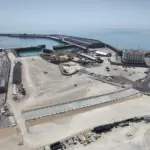
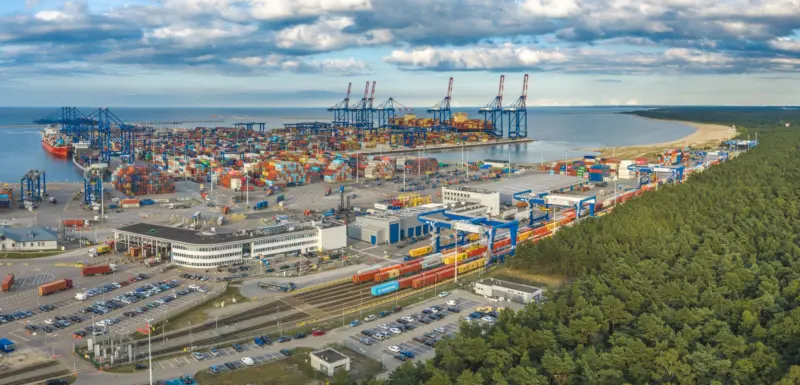
Despite the expense, some facilities are ploughing ahead. Poland for example is building an LNG terminal in Świnoujście in an attempt to slake Central and Eastern Europe’s LNG thirst and cut down dependency on Russian imports. Scheduled to being operations in the second half of 2014 with a capacity of 5bn cubic metres of LNG a year it will, beside a long term oil-indexed contract, also be taking on some spot market buying in order to raise the bar on competition. Very clever. However, the terminal doesn’t come cheap.
Part of the required €660m will come from the European Bank for Reconstruction and Development which is providing a €75m, 12-year loan, and it seems that some financing will also come from EC grants, but this still leaves a sizeable hole to fill.
Mr Poersch’s main point is that the cumulative effect of all this is to treat some ports very differently to the rest of the general transport network.
“Because money will be more of an issue for some ports than others, what you will see resulting from this initiative is a widening, not closing, of the gaps between core network ports as the disparity between the haves and the have-nots gets bigger,” says Mr Poersch.
Related Articles
 TERMINAL OPERATIONS
 TERMINAL OPERATIONS
 CONTAINER & CARGO HANDLING