![PortStrategy[GreenPort]](https://www.portstrategy.com/wp-content/uploads/2026/09/PortStrategyGreenPort.svg)





Time gentlemen please
The US 100% scanning diktat failed to meet its 2012 deadline, so where next, asks Felicity Landon
In May this year, the US homeland security secretary, Janet Napolitano, officially confirmed to Congress that her department (the Department of Homeland Security) would not meet the July 2012 deadline that was first set for scanning 100% of cargo coming into the US for nuclear or radioactive materials.
That announcement, and a proposal to extend the deadline by two years, came as no surprise – but there were protests from both sides of the house, and questions as to why the DHS could not meet the requirements that were set down as a direct result of 9/11.
In response, Ms Napolitano said the DHS had done everything it could to work through US Customs and Border Protection, the US Coast Guard and other agencies to mitigate any threat posed by nuclear or radiological material being shipped as sea cargo; she said 100% scanning of maritime cargo remained impractical because of the high cost, including the cost of business of delays, and the lack of access to many overseas ports where the DHS would want to scan cargo before it departs for the US.
Subsequently, the clause requiring all incoming containers to be scanned at foreign ports was confirmed anyway by the House of Representatives, but the DHS then exercised an option to defer the requirement until 2014.
So where does this leave the scanning ‘movement’ and, in particular, foreign ports handling container services to the US?
Brawn and brains
The industry – particularly smaller ports – isn’t ready for 100% scanning, says marine consultant Richard Clarke. At present most countries focus on an intelligence system and scan what they are worried about, he says. That matches Ms Napolitano’s suggestion last year that a ‘more layered approach’ to container security – a combination of scanning, data and risk analysis, physical checks and closer cooperation with ports and countries around the world – was more realistic than 100% scanning.
Meanwhile, most ports seem to have managed to meet the US’s 24-hour notification requirements relating to US-bound containers, says Mr Clarke. “But whether they just make it up or just attempt to tell them what is in the container, who knows?”
Andrew Goldsmith, vice president of marketing at the US-based security inspection systems supplier Rapiscan, says: “I think my sense, from customers around the world, is that for several years they have been planning around the need to have a more layered security approach, to have a minimum level of screening and security.
“For the past year there has been a realistic expectation that there probably wasn’t going to be 100% screening but some form of phased approach.
“However, from our perspective we don’t see much let-up in terms of interest from ports needing to do security inspections. It may not be 100% screening but they are certainly interested in deploying advanced screening solutions, whether higher speed or greater penetration or more mobile, more rugged, more portable, etc.”
Mr Goldsmith says Rapiscan sees strong demand from transhipment hubs, and the very large ports handling a high level of US business are definitely concerned with meeting screening requirements for potential inbound threats – “and I think that will remain the case”.
Customs concern
However, take a step back from the US scanning headlines, and there’s another world to consider.
“One of our biggest pieces of business is customs organisations,” he says. “These groups are more interested in revenue collection; and that is a worldwide concern, with government budgets very much under pressure. They are trying to collect whatever they can.”
There appears to be a public perception that the primary driver for inspecting cargo is about stopping WMD and nuclear threats, says Mr Goldsmith. “Ultimately the most horrific threat is of a container going up in a large port in the US – after all, following 9/11 that was the scenario people were really concerned about.
“But over time, from a more global perspective, people are concerned about a much broader range of threats. There is no question that narcotics are a major driver in regions such as Latin America. It is probably fair to say that Latin American countries are much more concerned about currency and weapons coming into their countries than the prospect of WMDs.”
Faking it
Carina Dixon, security expert at consultancy firm Newmarket Partners, says that in matters of port security, sometimes there is too much emphasis on terrorism.
A very real threat, often forgotten, is the transportation of illegal goods, which is huge and growing, and at shocking levels, she says.
“People generally think drugs smuggling is terrible but they forget that the rip-off handbag they buy down the market was probably made in some child sweatshop somewhere. There are lot of issues to do with illegal goods that people are really not aware of. They buy cheap alcohol – but what on earth is in it? Or, worse, there are the [medical] drugs being sold in the developing world which at best don’t cure but at worst can make people more ill.”
Security consultant Harry Harper says the impact of a 100% scanning requirement will clearly depend on how much a port exports to the US. “The technology, and the costs of operating it are beyond the reach of many ports,” he says. “A lot of ports imposed an ISPS charge to claw back the costs of implementing that. But to enforce 100% scanning at origin? Many countries around the world won’t be able to afford it and won’t do it anyway because of the increased costs.”
All-encompassing
A new departure for Rapiscan is offering container scanning as an all-in service, rather than just supplying the equipment.
“Not every country has the depth of knowledge as to how to set up a system – and there is the capital aspect too,” says Mr Goldsmith. “There were sceptics who doubted that there was a market for the concept of cargo inspection as a service, or whether we could do it, but recent contract awards have proved there is definitely demand for a turnkey screening system.”
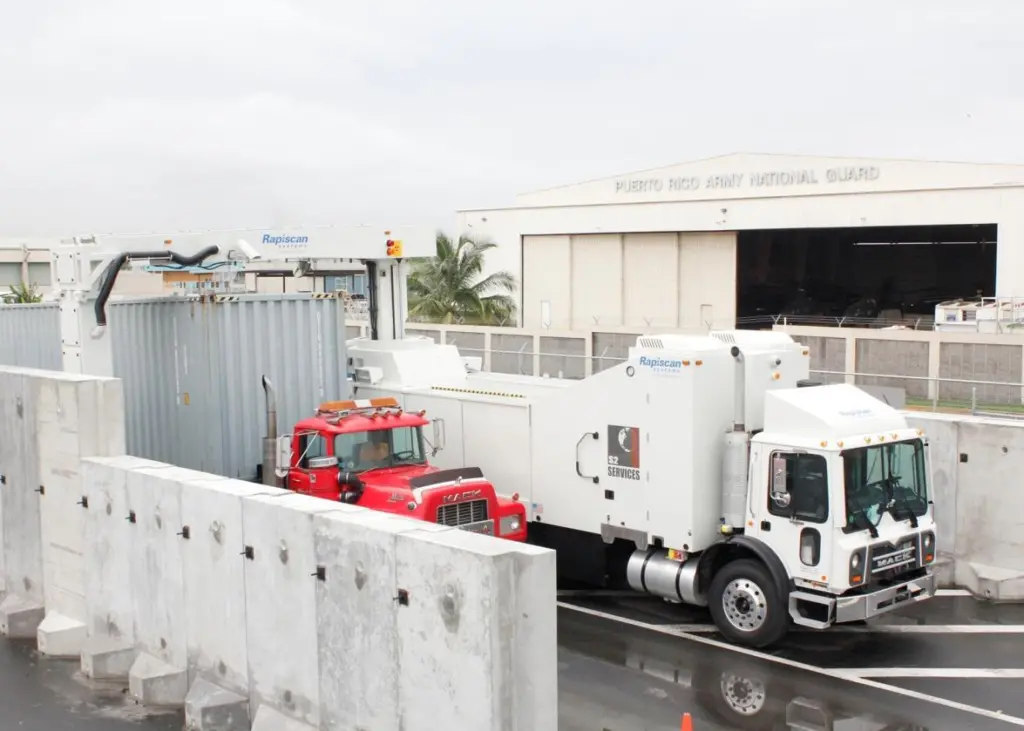
An early taker was the Puerto Rico Ports Authority, looking for a solution for the Port of San Juan, which encompasses eight cargo terminals. The port authority didn’t have a comprehensive cargo screening programme, or the resources needed to open a 100% screening operation, so it put out the entire operation to tender.
Rapiscan is providing the solution, based around its Eagle M45 mobile cargo screening system and also including staffing, personnel training and maintenance of the screening checkpoints. The system is integrated with the port’s own data, so any discrepancy between manifest and cargo scan can be quickly analysed.
“We have had some very exciting feedback from our customers as a result of having very well trained operators and state-of-the-art inspection technology, providing some very significant increases in throughput and operational efficiencies,” says Mr Goldsmith.
“The big differentiator for us is that we can give customers access to leading edge technology – and give them options to update the technology during the lifetime of the contract. It is a future-proofing approach.”
Related Articles
 TERMINAL OPERATIONS
 TERMINAL OPERATIONS
 CONTAINER & CARGO HANDLING