![PortStrategy[GreenPort]](https://www.portstrategy.com/wp-content/uploads/2026/09/PortStrategyGreenPort.svg)





Writing the hydrogen rulebook
Industry is taking notice of hydrogens potential as a squeaky-clean fuel. Stevie Knight reports
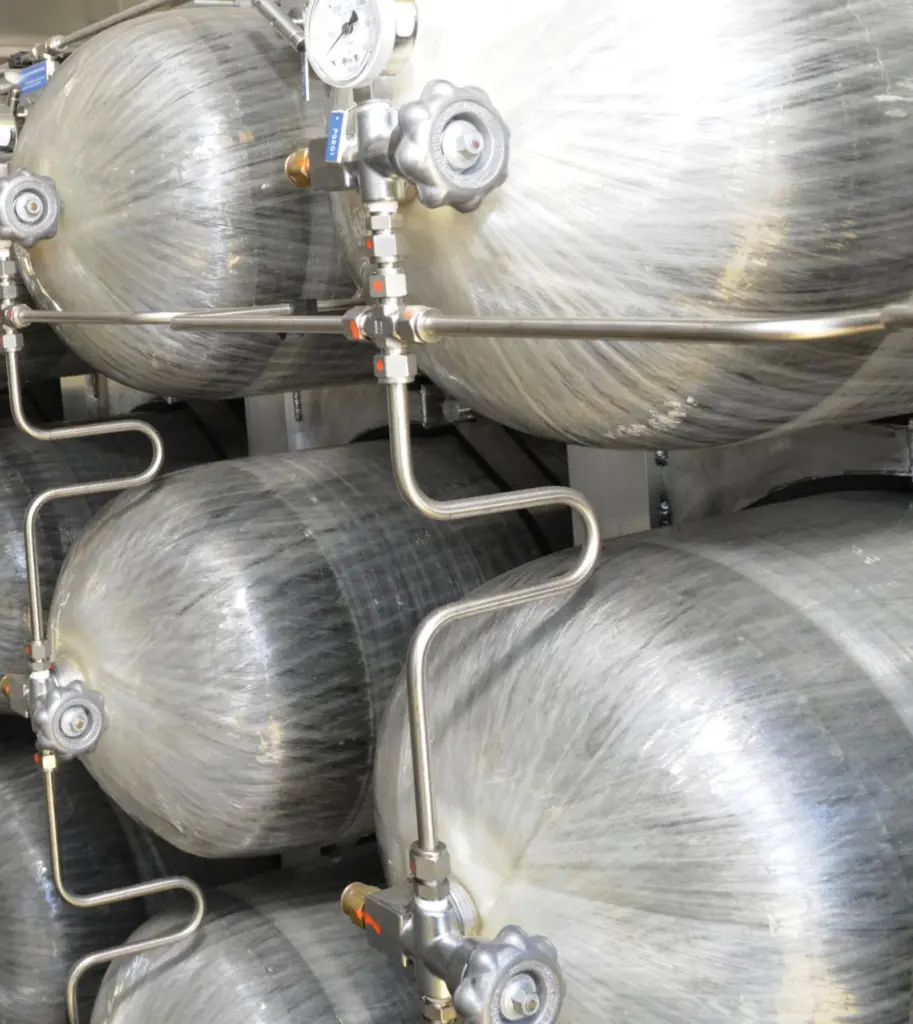
Gaseous hydrogen (H2) “will be very useful for port handling equipment and trucks in the future”, predicts Rosie Mercer, the Ports of Auckland’s very own hydrogen development manager. “Heavy machinery isn’t well suited to battery power because of the low range and long charge time, whereas hydrogen offers fast refuelling, a long range and high power output.”
Likewise, the Zero Emissions for California Ports Project, a collaboration between the Port of Los Angeles, Toyota, Kenworth and Shell, is developing ten hybrid electric-H2 on-road trucks and a brace of fuelling stations to move cargo throughout the Los Angeles basin and inland to Riverside County, the Port of Hueneme and eventually to Merced.
Valenciaport, too, is interested in exploring the opportunities, “especially for cargo handling equipment” says energy and safety director José Giménez. The port is currently developing pilots for both reachstacker and ro-ro yard tractor operations: an external supplier will refill a mobile station (delivering 300-350 bar gas ramped up from a 200 bar source) as the fuelling point will need to move around the facility.
Regulatory hurdles
But, what about the regulations? After all, as Mr Giménez adds, as there’s “no experience in the use of hydrogen in ports … we will need to study how this new situation may interact with current regulation or safety procedures”.
Alexandru Floristean of Hydrogen Europe echoes this point, and adds: “While hydrogen has been handled on an industrial level for decades, using it as a fuel means moving it away from its typical setting. It could mean putting it in a port for example, or right next to another fuel like diesel, or even close to urban areas. The essence of the challenge is a lack of experience.”
He points out that apart from big projects (such as Japan’s plan to ship H2 from Australia to Kobe) compressed hydrogen seems a likely choice for many facilities. But even if it’s not cryogenically stored, things can still get a little complicated for first movers as “there are myriad rules to study and apply”.
There is a way through. Mr Floristean points to Germany’s approach. “Private actors, working together with authorities, have put a number of hydrogen filling stations in place based on the closest generic laws … and built up their experience before the supporting regulations and best-practice guidance was decided.”
In the UK too, hydrogen refuelling is becoming a reality. Charles Purkess of ITM Power says: “There’s been a lot of work to get hydrogen into the UK’s ‘Blue Book’, the established technical guide for fuel storage and dispensing.” This is a big breakthrough “and means that there’s now a plug-in facility on an ordinary forecourt”, he says, with several more to follow.
Other organisations are also smoothing the path. Mr Floristean explains how the HyLaw project – managed by Hydrogen Europe – is clearing the way for those that will be tackling “multiple layers of regulation”. This work centres on a publicly-accessible database that brings together the relevant legal and administrative processes for 18 European countries, highlighting best practices, legal barriers and policy recommendations. “We are making it as simple, but as comprehensive, as possible,” he explains.
Watery concerns
However, while the forecourt refilling element is making good progress, ports also have the waterside to think about.
Despite being a smallish, mostly ro-ro port group, Scotland’s Orkney experience is particularly interesting.
Shapinsay and Eday islands have a surplus of green power, but with Community Energy Scotland’s support they’ve made sure it doesn’t go to waste and they produce hydrogen on the spot. While the resulting H2 has been utilised as a local energy resource and (in partnership with ITM Power) runs a fleet of five hybrid electric-hydrogen trucks, there’s enough left to ship to a mainland fuel cell.
Transportation by ro-ro required a mixture of rule- and risk-based strategies “to fill in the gaps” says David Hibbert of Orkney Ports. They were ambitious in their research: “We even looked at how NASA handled its rocket fuel,” he says.
Inevitably there were issues to resolve. “The roads had a 25t weight limit … but the trailer itself was 18t and we couldn’t get an IMDG – International Maritime Dangerous Goods Code – compliant steel tank that would be able to carry a quarter of a tonne of hydrogen and still come in under the maximum,” he explains.
The answer was the procurement of carbon-fibre wrapped alloy tanks that fitted with European road carriage standards. Mr Hibbert adds: “Extra safety systems for low-flashpoint fuels on the trailers gave us the certification we needed to carry the trucks in ‘freight-only’ mode.”
Moreover, the fuel cell stations which turn hydrogen back into usable electricity, also meant “we had to develop the training to run and maintain these stations at the same time as the physical infrastructure”. Luckily the local technical college was interested, so “it turned into a real win-win” he says.
Drawing on experience
Orkney is also working on a H2 ferry which is throwing up yet more challenges as there are no ports, as yet, engaged in bunkering.
Experience with other gases could help. Paul Davies of Lloyd’s Register – which has been assisting Orkney – says “regulation … will likely reflect the developing practice for bunkering LNG”. However, he adds “a safety zone is essential, but this may be far larger than stakeholders are expecting. This could impact on surrounding port activities, and so is a crucial aspect to be addressed”.
It’s a point echoed by Lars Petter Blikom of DNV GL, who explains that as with bunkering other low flashpoint fuels such as methane, there are two ways to tackle it. Firstly, there is taking a deterministic approach which “calculates … the maximum distance from the bunkering activity at which a cloud … could still be flammable”. This usually leads to relatively large safety zones as no safeguards are included in the analysis. A probabilistic approach “assesses the maximum distance to flammable concentration of each possible release scenario as well as its likelihood”. As a result, while it’s a longer process, the latter considers the effects and likelihood of various scenarios, including safeguards – so it could be more useful to ports where there’s limited space.
Mr Blikom adds that “the safety distances will be much farther because of the characteristics of hydrogen – both probability and consequence of an incident will inevitably be larger than for methane”.
Safety zone question
The issue is also more complex as there will be various amounts stored at different facilities: while ITM Power provides ‘on the spot’ refuelling by creating hydrogen as needed, others may be reliant on being able to store it. Mr Floristean says that in this regard, the Seveso Directive for the safe handling of dangerous substances has “helped create a framework, because although it doesn’t talk directly about safety zones, certain obligations apply above and below 5t of hydrogen”. A number of countries are aligning their rules with the directive to be consistent.
It will take time to sort out, but if the shore-side has managed to get it onto a forecourt, despite some authorities initially demanding a 50-metre safety zone, then there’s reason to believe that bunkering too could arrive at a workable agreement.
There are advantages to helping shape the rulebook, but as Mr Hibbert adds, there is a danger that “even though we’ve done all this work, it could be that the eventual regulations will ask for things we didn’t envisage”.
“The reality is that the first in the field will have to put in a lot of effort on mitigation measures,” says Mr Floristean. “But they should not just think in terms of ‘this project’ alone but realise they’re building the regulatory foundations for the next one.”
AVOIDING COLD FEET
While most hydrogen ports will begin modestly on compressed H2, really large projects – whether focused on longer-range vessels or domestic supply – will eventually call for a more energy-dense form but this could be available without cryogenics.
The marine industry is considering the possibility of using a ‘carrier’ liquid such as ammonia or toluene to hold the H2 stable. These liquids have roughly 5/7ths of the energy density of chilled hydrogen and furthermore they are liquid at near ambient temperatures.
Forward-looking ports might even find themselves setting up a processing facility where the H2 is released from its bonds and the carrier is recycled, ready for the next batch.
Related Articles
 TERMINAL OPERATIONS
 TERMINAL OPERATIONS
 CONTAINER & CARGO HANDLING