![PortStrategy[GreenPort]](https://www.portstrategy.com/wp-content/uploads/2026/09/PortStrategyGreenPort.svg)



Electrification & Automation
Electrification and automation are high on the terminal tractor development agenda. Latest initiatives highlighted
Market analysis: Batteries and automation are the key drivers
Electrification and automation are the main areas driving new developments within the terminal tractor sector. As the company-by-company review below highlight, the latest models being launched are mainly using battery propulsion, while several projects involving ports, terminal tractor manufacturers and other technology providers, are trialling automation. Moving from diesel power to battery power allows ports to decarbonise their cargo handling operations and meet emissions requirements, as well as reap benefits including the higher torque delivered by electric motors and reduced maintenance. Terminal Tractor Market Report 2026 singles out the importance of fast battery charging technology: “Major companies operating in the terminal tractor market are focusing on developing innovative solutions, such as fast charging technology, to minimise downtime, increase operational efficiency, and enable continuous heavy-duty yard operations with zero-emission electric vehicles.” Automation of electric terminal tractors is still at an early stage but advancing rapidly. As the below highlights, APM Terminals Maasvlakte II is moving toward a fleet of 30 autonomous vehicles. Like battery power, autonomous tractors are said to help cut emissions and boost energy efficiency. Advancements in communication technologies, such as 5G, are expected to help autonomous systems build further momentum.
Data analysis: Batteries, automation, trials and new orders
Capacity Trucks: Capacity Trucks has debuted a new terminal tractor cab design and showcased its latest alternative fuel technology. The US-headquartered company used ACT Expo, in May, to highlight its LPG powered TJ 5000 terminal truck featuring a newly redesigned cab, engineered to improve operator comfort, visibility and functionality. The updated cab includes a redesigned HVAC and temperature control system, improved ergonomics with more intuitive access to controls, and at least 32% more clearance for easier entry and exit. Integrated technologies — including Bendix® Intellipark®, D Cams and a smart diagnostic dash gauge — are designed to enhance safety and simplify daily operation. The LPG powered TJ 5000 is powered by a spark ignited, naturally aspirated engine delivering 265 horsepower and 553 foot pounds of torque, offering diesel like performance while helping reduce preventive maintenance and total cost of ownership.
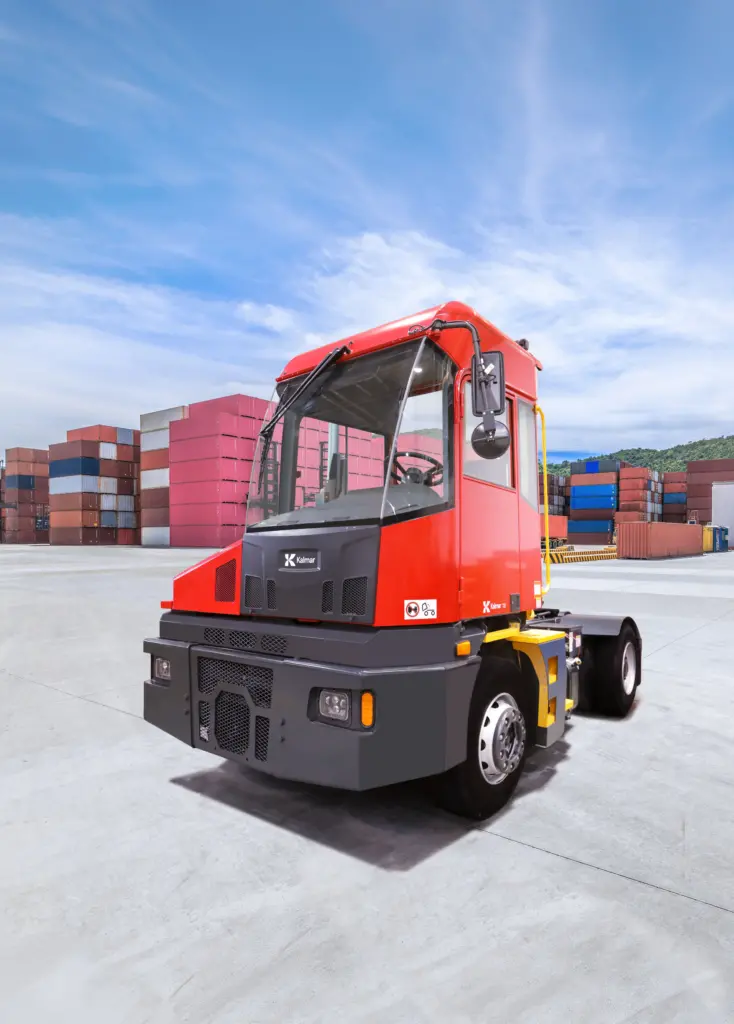
Kalmar: The Finland-based company has launched the fully electric version of the Kalmar TT7 terminal tractor, the TT7 EV, in Europe. Specifically engineered to meet the growing demand for zero-emission solutions in the European market, the TT7 EV joins the newly released TT7 series, with sales starting in May this year at TOC Europe in Hamburg, Germany. Kalmar TT7 EV has the re-engineered chassis of the TT7 series, which was developed based on extensive customer feedback regarding durability and ease of maintenance. Kalmar explains that by using a heavy-duty galvanised steel frame and reinforced axles, the terminal tractor provides the structural integrity required for demanding European shunting operations. To simplify repairs, the front bumper is constructed in three sections, and the electric drivetrain reduces the number of mechanical components requiring service. Updated ergonomic features in the cabin include improved suspension and climate control. Thor Brenden, President, Terminal Tractors at Kalmar states: “…We have focused on combining the practical robustness of the TT7 series with a sustainable drivetrain. It is a reliable and efficient solution for those looking to reduce their carbon footprint without compromising on the essential power and visibility required for daily operations.” Elsewhere, Kalmar has also launched an upgraded version of its T2i terminal tractor, to boost operational efficiency with what it says are enhanced modularity and superior ergonomics. It provides a modular platform with expanded capacities offering three lifting capacities (28, 32, or 36 tonnes) to match varied load profiles. The updated version features a redesigned ROPS/FOPS certified cabin and a “significantly bolstered” chassis architecture.
MAFI: MAFI, Eurogate and autonomous driving solutions company Embotech have carried out a second pilot project for Autonomous Terminal Tractors (ATTs) at Eurogate’s Hamburg terminal. Deploying Germany-headquartered MAFI’s T series as a base vehicle, powered by Embotech’s Level 4 AV-Kit, the six-month pilot started at the end of January this year and builds on the successful technical feasibility pilot completed at Eurogate Wilhelmshaven. While the Wilhelmshaven pilot validated the technical maturity of Embotech’s autonomous tractor solution across landside and waterside operations, the Hamburg pilot shifted the focus to operational performance. Key to the pilot has been autonomous tractors carrying out container transport moves between the railway terminal and the container terminal via straddle carrier interchange zones, covering a critical segment of horizontal container movement. Performance is being assessed through: throughput; availability, and process stability under day-to-day terminal conditions.
Orange EV: The ports of Los Angeles and Long Beach have boosted their ongoing decarbonisation efforts with the acquisition of electric terminal tractors. In June this year, the Port of Long Beach celebrated the addition of 15 zero emissions Orange EV tractors, at SSA Terminals’ Pier C facility. The new vehicles are part of an award of $37.8 million for zero-emissions cargo-handling equipment at Pier C under the SWIFT program. “The equipment we’re celebrating today will reduce emissions, result in improved health for local neighbourhoods and ensure our city’s port builds on its place as global sustainability leader,” said Long Beach Mayor Rex Richardson. And just weeks earlier APM Terminals in Los Angeles announced that it had expanded its electric terminal tractor fleet with a 40-unit Orange EV contract. Orange EV will provide 40 HUSK-e® XP battery-electric terminal tractors to Pier 400, bringing the terminal’s total electric terminal tractor count to 60 units. The expansion completes the electrification of the terminal’s on-dock rail drayage fleet — the first container terminal in the Port of Los Angeles to reach that milestone. Pier 400 has deployed 40 Orange EV electric terminal tractors since April 2025, which have accumulated 42,000 zero-tailpipe emission operating hours with an average uptime rate of 98.8%, displaced more than 40,700 diesel equivalent gallons, and avoided an estimated 427 metric tonnes of CO₂. “This procurement is grounded in 12 months of real-world performance data,” says Jon Poelma, Managing Director of APM Terminals Los Angeles. “Our operators ran these trucks hard, and the results earned this expansion.” With 60 electric terminal tractors anticipated in operation by January 2027, Pier 400 will have converted approximately 60 per cent of its 101-unit terminal tractor fleet to battery-electric. The vehicles employ a 310 kWh lithium iron phosphate (LFP) battery, the largest available battery pack in the Orange EV lineup.
SANY: China’s SANY has seen interest in its electric terminal tractors gain momentum after completing some large deliveries this year. Terminal operator ICTSI announced in June that Contecon Manzanillo (CMSA) is integrating Sany’s electric terminal tractors into operation at the Specialized Container Terminal II in the Port of Manzanillo. The new tractors are powered by rechargeable batteries, eliminating direct tailpipe emissions while supporting uninterrupted operations through on-site charging infrastructure. ICTSI notes that the acquisition forms part of a broader programme that will see the terminal gradually increase its electric tractor fleet over the coming years as CMSA focuses on operational efficiency while reducing its environmental footprint. Elsewhere, in April it was announced that SANY had delivered a batch of SM4602T0BEV electric terminal tractors to a customer in Thailand. According to SANY, the SM4602T0BEV is equipped with a rapid battery swapping system. Each swap takes less than five minutes—and can be completed in under two minutes. Powered by a 282 kWh battery pack, the vehicle achieves a range of over 120 km and has a maximum traction capacity of 75 tons. To date, SANY has delivered over 2000 electric terminal tractors worldwide.
Terberg Special Vehicles: Terberg has unveiled its latest generation of electric terminal tractors with the launch of the new Terberg YT201EV and the enhanced Terberg YT203EV. Produced at Terberg’s Pasir Gudang facility, the next-generation YT201EV is designed for East and South global markets and has scooped over 250 orders ahead of launch. Terberg said that the YT201EV has been “comprehensively redesigned with a next generation engineering architecture that enhances performance, serviceability and operational reliability in demanding terminal environments”. The larger cabin offers improved visibility, refined ergonomics and a modernised driver interface, supporting operator comfort, safety and productivity. Both the YT201EV and YT203EV feature a 310 kWh battery system, with Terberg noting that this upgrade for YT03EV represents a step forward in energy autonomy. A 155 kWh battery option for both models is aimed at applications with lower energy requirements. Both electric models include the Terberg Connect telematics system for preventive maintenance and fleet monitoring. Order update: APM Terminals Maasvlakte II, together with Embotech and Terberg Special Vehicles, has inaugurated five additional electric, automated terminal tractors at the terminal. They comprise the third batch delivered to the site. With this addition, the deployment now includes 10 electric automated terminal tractors, as the partners move toward a planned fleet of 30 vehicles, which is expected to become one of the largest automated terminal tractor deployments in Europe. The tractors recently completed Factory Acceptance Testing (FAT) and will begin Site Acceptance Testing at Maasvlakte II in the coming months.
Related Articles
 OPERATIONS
 PORT & TERMINAL NEWS