





THE RIGHT WEIGH
John Bensalhia reviews recent trends and innovations in container weighing systems supply

From the beginning to the end of the cargo loading process, overloaded containers can cause many problems: injuries to personnel; damage to handling equipment and, in the event they are loaded onboard a vessel, stability problems as well as damage to other containers. Such instances can have signifi cant costs associated with them but even without these sort of problems an overweight container can have substantial cost implications as a result of penalties incurred.
For instance – CMA GCM, in the latest of a series of announcements regarding the application of overweight container surcharges, advised that from 15 September 2021 an overweight surcharge for containers being ferried from North West and South East India to North Europe and the Mediterranean will apply, with this amounting to USD750 per 20ft dry unit (all types) where the unit is found to exceed 18 tons gross weight.
VERIFIED GROSS MASS
As the UK P&I Club highlights in its useful “Guide to Overweight Containers:”
“The International Maritime Organisation (IMO) has amended the Safety of Life at Sea Convention (SOLAS) to require, as a condition for loading a packed container onto a ship for export, that the container has a verified weight. The shipper is re-sponsible for the verification of the packed container’s weight. This requirement became legally effective on July 1, 2016. After this date, it became a violation of SOLAS to load a packed container onto a vessel if the vessel operator and marine terminal operator do not have a verified container weight.
“The Verified Gross Mass (VGM) is the weight of the cargo including dunnage and bracing plus the tare weight of the container carrying this cargo. SOLAS requires the shipper to provide VGM in a “shipping document,” either as part of the shipping instruction or in a separate communication, before vessel loading.”
While this important regulatory requirement is in place, the day-to-day reality is, however, that all major and secondary container trade routes regularly encounter the problem of overweight containers. Some containers arrive at terminals with no weight verification and another ongoing problem is the under declaration of weights. Under-declared containers can lead to a variety of problems for the carrier, including but not limited to the overloading of vessel lashings and container frames and/or stack loads being exceeded.
In short, there are many compelling reasons to ensure containers are not over-loaded and with this in mind there has, in recent times, been significant innovation from within the weighing system supply sector aimed at ‘providing the tools for the job’ to cargo shippers, freight forwarders, marine terminals and other parties in the container export supply chain who are impacted by the issue of container weight.
A DECADE OF CHANGE
Hayden Johnston, Marketing Co-Ordinator, BISON Group, says that over the past decade, the logistics industry has seen the emergence of weighing technologies including onboard weighing systems, portable container scales and software solutions for data collection and distribution. “Harnessing these technologies,” says Johnston, “has allowed operators to improve the flow of cargo, record and verify container weights more consistently and improve business efficiency/profitability in the long run.”
Coupled with this trend there has also been a general increase in expectations regarding ensuring operational efficiency and safety, and integral to this conforming with SOLAS requirements. Specifically, system supplier Tamtron identifies this higher level of consciousness as influential in setting new demands for the cargo weighing process and the management of weighing data.
“When time and knowledge is money, it is essential to choose the weighing solutions that will deliver reliable weighing data and support the company’s processes the best.”
“High-quality scale is the foundation for accurate and reliable weighing data, explains Markus Ritala, Sales and Marketing Director, Tamtron. “But how the weighing is integrated into the operational processes, as well as how the weighing data is stored and shared to support the customers’ business, is how we as a weighing solution provider can help our customers best.”
“Recently,” elaborates Ritala, we have focused on improving the usability of our scales and their integration to customers’ TOS systems to offer real-time and remote access to weighing data as well as new digital solutions to replace paper receipts and documents.”
THE RIGHT DATA
“Professional weighing equipment with solid connectivity and data management will help operators to meet the demands for transparency, traceability and ever-growing reporting liabilities. Reporting between partners becomes easier when the required information is available on one system, easily and reliably,” Ritala emphasises.
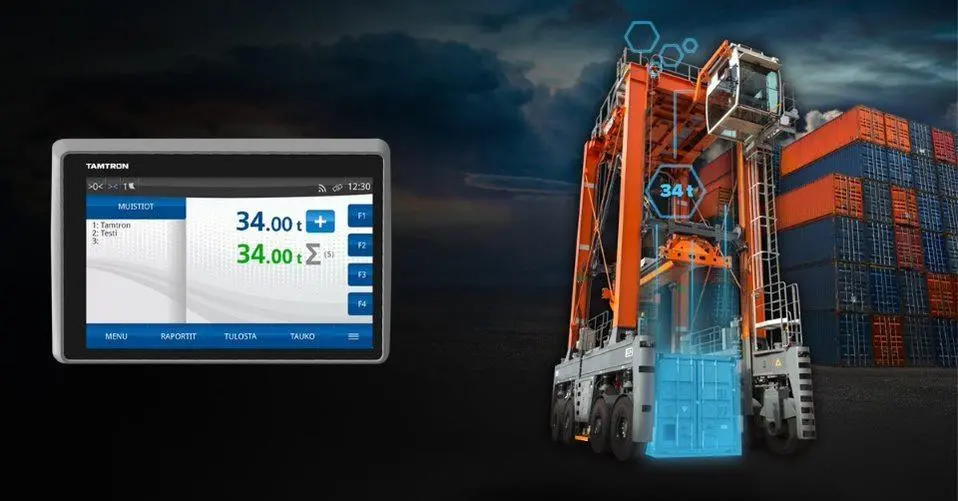
Tamtron offers what it describes as complete weighing solutions: type-approved; accurate, high-quality scales and modern weighing information management that ensures real-time access to weighing data, reports and operations monitoring.
Tamtron One Power Container Stacker, One Power Straddle Carrier Scale and Scalift Forklift Truck Scale all weigh Verified Gross Mass (VGM) of a container during container transit and loading operations, meeting the requirements of the SOLAS regulations. “In addition, with our One Power Container Stacker Scale and One Power Straddle Carrier Scale container VGM and ID can be combined, and the information uploaded to a company’s ERP, TOS, or other system through integration to provide real-time access to reports and operations monitoring,” says Ritala.
The weighing information transfers from Tamtron scales to operational use in real-time through connection to the weighing information cloud service or through integration into TOS, ERP or other systems.
Griffith Elder’s purpose-built Container Weigher system is cited as easy to use, with containers loaded on to the weighing platform and the weight identified in a digital indicator. When the target weight is reached, the operator is informed either by a visual or audio alarm. In the case of excess weight, a two-colour alarm system relays this warning.
COMMON AND INTELLIGENT OPTIONS
“From our experiences with working with port-based businesses/operators, traditional weighing methods like weighbridges tend to be the most common option for verifying cargo weights before export, as they allow for a continuous, efficient flow of containers through a port/freight hub,” says Hayden Johnston. Another common weighing method is load cells and weighing systems that are integrated into the port’s container lifting equipment spanning mobile harbour cranes, reach stackers, straddle carriers and forklift trucks (FLTs).
Strainstall’s SOLAS compliant Container Weighing System can reportedly be swiftly and simply integrated/retrofitted to existing port equipment. It offers real time data when automatically weighing containers during port stacking cycles. The weighing process is completed in 30 seconds, thus saving operators considerable time.
Johnston adds that as more modern technology emerges within the logistics industry, there are new products shining through that offer versatile and intelligent alternatives for recording and verifying container weights and digitising the data that is collected and required for export (e.g. Weight, Contents, Seal ID, Container ID). “For instance, BISON Container Scales provide a portable, timely solution to weighing cargo. They give port operators the ability to move the weighing system, not the container itself, meaning that more containers can be weighed and verified, in a shorter amount of time,” he notes.
Trend lines: integration with terminal operating systems, real-time remote access…
Other parties have also responded to the requirement to identify overweight problems. Australian terminal operator Patrick Terminals has launched its Pondus solution as a means of helping to spot wrongly declared weights. Essentially, Pondus statistically samples containers for weighing, and in the case of any discrepancies, customers are automatically informed.
Konecranes (supplied by EIE Group in South Africa) has introduced a digital static weighing system solution now used in South African ports. Lenny Naidoo, Key Accounts Sales Manager, EIE Group Heavy Lift Division, notes that: “The Static Weighing System allows reach stackers to hydraulically measure the weight of lifted containers, with full-scale accuracy achieved in less than five-seconds.”
Along with data on gross container mass, the Static Weighing System provides supplementary information including precise container ID, time/date stamps and container location.
Generally, as well as innovation in weighing system design, to perform the basic function of accurately recording container weight, there is a discernible shift towards systems that can harness the power of weight data and thus play their part in optimising diverse terminal functions right through from planning to invoicing.
Related Articles
 LEGAL, RISK & INSURANCE
 NEWS
NEWS
 PORT & TERMINAL NEWS