![PortStrategy[GreenPort]](https://www.portstrategy.com/wp-content/uploads/2026/09/PortStrategyGreenPort.svg)





Full house
After much deliberation and no doubt plentyof sleepless nights, PD Ports has joined the chosen few in the circle of UK deepseacontainerport development granted planning permission.
In February, PD Ports’ two-year battle to get its plans taken seriously against southern UK competition and a confused political process was vindicated by the Secretary of State’s approval of its Harbour Revision Order for its container terminal at Teesport in the North East of England.
Up against three similar development projects for ports on the south coast – DP World’s London Gateway, and Hutchison’s Bathside Bay and Felixstowe – PD Ports was rightly worried from the onset that its plans would get short shrift.
It heavily criticised the UK government for its inability to look at the bigger picture for port demand in the country, preferring instead to take port planning decisions on a case-by-case basis. When the Government confirmed it would make a decision on the three southern ports ahead of its review of ports policy in early 2006, PD Ports described it as a missed opportunity to look at the development of both northern and southern ports.
And when the final hurdle to the Northern Gateway proposal was removed in September – Hutchison Port Holdings (HPH) withdrew its outstanding objection to the application for a Harbour Revision Order – PD Ports still faced an agonising five-month for the decision.
Now, with the Harbour Revision Order and accompanying Transport & Works Act Order approved, the project has gained all the necessary statutory consents in order to push on with development.
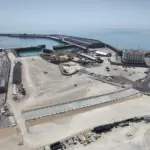
Adding 1.5m teu to existing capacity, 1,000 m of new quay, dredging the channel to a depth of 14.5 m, when complete the Northern Gateway Container Terminal – to give it its proper name – will have three berths capable of 10,000 teu ships. Built in phases, the £300m project promises to create up to 5,500 jobs in the Tees Valley.
PD Ports has long espoused the view that as up to 50% of deepsea containers arriving down south are destined for the UK’s north, a hub in the North East makes financial, environment, and plain common sense. With the approval of the Northern Gateway proposal, the UK government has clearly come round to that view.
But why has the planning process for the UK’s containerport expansion plans been so fragmented, only to arrive at the decision that all proposals on the table would get the green light? PD Port’s £300m investment in the deep sea container terminal on the South bank of the River Tees is surely positive for the north – certainly the logic of the positioning is infallible – but can we say the same for the three Southern containerports, all effectively vying for the same pot of business? With the Northern project approved it may well be a case of three’s a crowd down south.
Related Articles
 OPERATIONS
 INSIGHT & OPINION