

Who do you believe about the fortunes of the container liner industry in 2020?
Getting consensus on this appears as problematic as forecasting with certainty the result of the forthcoming US election or knowing if the UK will crash out of the EU?
What we do know is that through the second quarter of 2020 the main liner operators have agilely managed capacity, implementing many void sailings to keep the demand-supply balance right, and following on from this that spot freight rate records have been broken in key trades on a regular basis.
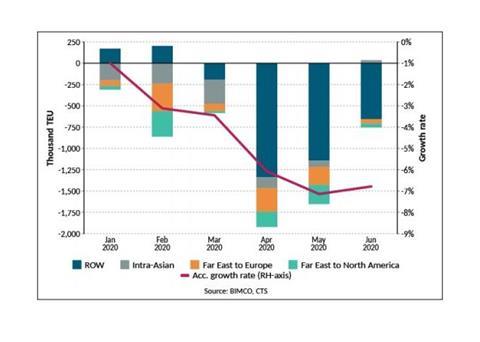
In truth it has come as a surprise to many market participants to see the container liner sector so astutely lift freight rates at a time when it is facing a volume drop of anywhere between 10 and 20 per cent.
No more rate wars or battle for market share just what looks like sound operational management leading to profitability. Key first half year/second quarter results speak for themselves:
- Evergreen: A net profit of US$108million in the second quarter.
- Hapag Lloyd: First half EBIT of US$563m, up from US$440m a year earlier.
- Huyundai Merchant Marine (HMM): KRW 28.1bn (US$23m) profit compared to a loss of KRW200.7bn in the same period in 2019.
- Maersk Line: 25 per cent EBITDA increase to US$1.7bn compared to US$1.4bn in the same period in 2019.
- Ocean Network Express (ONE): First half 2020 profit of US126m.
- Zim: Net profit of US$23.5m in Q2 2020 compared to US$5.1m in Q2 2019.
- Wan Hai: US$57m net profit, up over 100 per cent on its performance in the second quarter of 2019. So what lies ahead? Well there are plenty of views but little consistency.
So what lies ahead? Well there are plenty of views but little consistency. If you listen to analysts Sea Intelligence Maritime (SIM) then the view is that it is a sector profit in the order of US$9bn upwards in 2020, if current healthy rates can be maintained.
Having said this it should be noted that there is a caveat to this statement, namely; “if current rate levels can be maintained". If not and for example old habits kick in and a freight rate war commences then SIM suggest sector losses could be in the order of US$7 billion.
A party not persuaded that the Liner sector will enjoy a bonanza year is the Blue Alpha Capital consultancy based in New York. Blue Alpha suggests that carriers ability to protect freight rates as a result of reduced volumes will be limited and as a result forecasts a base line estimate of a loss of US$10.6bn for the sector in 2020. Blue Alpha’s best forecast is a loss of US$5.4bn and worst case scenario of US$15.9bn.
Another proponent of the positive view is Bluewater Reporting of Jacksonville USA which takes this view subject to strong spot rates remaining in place. Bottom line, however, given the potential for volume fluctuations and for the intrusion of so-called normalisation initiatives regarding rates – such as those undertaken by China’s Ministry of Transport - can the march to profitability be maintained? Only time will tell!