COMMENT: This is the era of breaking with convention. Look at the incumbent sitting in the White House defying the law of gravity! writes Mike Mundy.
In a surreal way, are we now living close to the fictional stories depicted in the movie Contagion or in Stephen King’s gripping book, The Stand? The Pandemic is a catalyst to breaking the old rules, conventional wisdom is frequently out the door.
Many more of us now shop online and the smartphone has emerged as the main device by which we achieve this. Despite many of us being in lockdown or furloughed at home, smartphone use has risen, with specialist apps for shopping being a main driver of the trend. Will ravaged high streets and shopping centres ever see a return to normality? Chances are it will be a new normal not the normal of old.
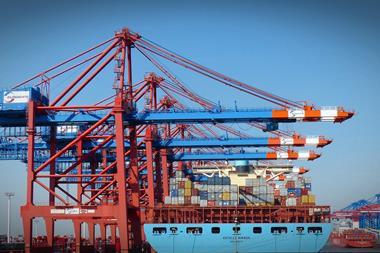
COVID-19 has shown its ability to severely disrupt supply chains, generate massive peaks in demand, imbalances in container supply and force choking congestion on many ports and terminals.
All the signs are that supply chain logistics will change fundamentally going forward. Dependence on China as a source of manufacturing will reduce – a tactic which for some will represent an acceleration of earlier thinking, as other locations offer competitive cost profiles, and for others it will be directly as a result of the Pandemic throwing the spotlight on the pitfalls of ‘placing too many eggs in the same basket.’ Expect nearshoring to increase significantly.
An expanded role for fulfilment centres and warehousing is also foreseen – buffers against disruption to supply chains. There is widespread recognition that critical goods such as ventilators, alcohol sanitiser, face masks and an array of other products will require storage closer to home to guarantee prompt and uninterrupted access. For some ports and terminals with a logistics bent this presents an opportunity.
Also in an upside context, it is hard to ignore the much improved fortunes of shipping lines who are benefitting from the resulting surge in demand following manufacturing lockdowns coupled with the “normal” exceptional factors such as peak season demand.
Clearly the lines, the majority of whom are reporting exceptional profits on a quarterly and ongoing basis, have navigated the current crisis much better than the 2008-09 financial disaster. Yes, they have benefitted from other factors such as lower fuel prices but without doubt a key factor in their success is what Soren Skou, Chief Executive, Maersk Line has described as their greater agility in terms of adjusting capacity to demand.
The big question is, will the lines be able to sustain such an approach post trade volatility? One technological trend that is progressively the recipient of a boost from the pandemic is the increasing emphasis on digitalisation.
Digitalisation is a hot topic and its inherent advantages – increased performance, reduced operational costs, ease of data analysis, safer storage in the Cloud and the reduced possibility of human error – will combine to deliver what can be seen as an entirely new dimension via which greater levels of efficiency can be achieved, not least in the port and terminal sector which fulfils the role of the interface between different transport modes.
As 2020 draws to a close, a year to forget for many, it is unlikely that the events that have shaped it and consequences of these – especially those flowing out of COVID-19 – will fade away. Diverse old conventions are being broken and a new-normal looms!