


MAINTENANCE OUTSOURCING
John Bensalhia takes a look at how independent specialists provide container terminal maintenance services and are adapting to the automated age.
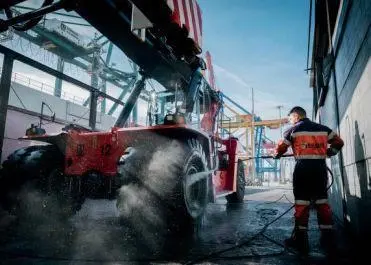
The smooth and effi cient running of daily terminal routines requires reliable and well-maintained equipment. To achieve this, key questions must be answered such as, is the equipment functioning properly? Are the vehicles running smoothly? Is the environment safe?
The scope of port maintenance spans large cargo-handling specialist equipment, vehicles, yard equipment, quays, hardstanding in yards, computer systems…the list goes on.
CONTRACT OR ON-CALL?
The first question for a port or terminal considering the outsourcing of maintenance services is whether to choose between a contract or an on-call option. Kalmar is a good example of an independent specialist providing both types of service.
Svante Alverönn, Vice President, Contracts & On Call, Kalmar and Mika Seppä, Vice President Customer and Project Services, Kalmar, jointly explain further. “Our range of maintenance contract solutions are framed in the Kalmar Care programme, ranging from Essential Care, including preventive maintenance to Complete Care including preventive maintenance, predictive maintenance and corrective maintenance.”
The past 12 months has seen growth in new maintenance clients for Kalmar. The signing of a comprehensive software maintenance and support agreement with Australian terminal operator, Patrick Terminals, was announced at the start of 2020. This deal covers the automated equipment systems at the company’s Brisbane and Sydney AutoStrad terminals, with effect from November 2019.
In April 2020, Kalmar finalised an agreement to supply comprehensive preventive and corrective maintenance services to Wallenius Wilhelmsen Ocean (WWO) at Manzanillo International Terminal (MIT) in Panama. The three-year Kalmar Care service contract covers ro-ro handling equipment on the operator’s North and South American routes, centralised at MIT.
Kalmar established a dedicated service team at this port location, combining its existing local service organisation, with technical experience and manpower to guarantee onsite resource availability, stability, flexibility and long-term cooperation with WWO.
In addition, Kalmar provides WWO with spare part planning and follow-up support as needed via its web-based MyKalmar platform. The aim here is simple – effective, transparent collaboration.
SCOPE FROM THE DIGITAL AGE
The digital age allows for greater scope in the field of maintenance. Terminals can have access giving up-to-date status reports. Verifavia Shipping-IHM is a god example, with its three-way Plug and Play IHM Maintenance Dashboard.
This dashboard is inserted into a procurement system or suppliers’ portal via an Application Programming Interface, and relayed live on the Hazinvent-M survey record tool.
With up-to-date information relayed, this provides a number of advantages – constant, automated preparation for any potential inspections, avoidance of penalties and bans on entering EU ports and an easy, convenient source of information on regulations relating to hazardous materials.
For automated terminals, Kalmar offers a wide range of services targeting design and analysis, testing and optimising, as well as outlining operational readiness of the automated solution.
Seppä explains further. “We provide software maintenance and support services and other remote services to ensure the lifetime support of the software systems and guaranteed availability of the automated solution at a terminal.”
Kalmar Insight and Kalmar Pulse are the main services based on connected equipment for maintenance support. “Kalmar Insight enables remote monitoring of technical information in real time and the maintenance scheduler module is the tool for effective planning of equipment availability in the terminal,” says Alverönn, before explaining other benefits.
“Kalmar Insight includes operational data for identification and understanding of work cycles, frequencies, productivity, driving behaviour, etc… which enable adaption and enhancement of a preventive and predictive maintenance programme for specific applications.”
Seppä adds that the Kalmar Pulse service automates the ordering process of maintenance and material needed at the point in time when it’s required. “It keeps track of the intervals and ensures execution in time, same time reducing administration efforts.”
NEED TO BE FLEXIBLE
Flexibility is a key consideration understood by maintenance companies, which provide services tailored to each client’s needs. Trent Port Services, which operates in a wide-range of locations, including Singapore, Australia and Hong Kong, offers solutions to each terminal’s specific requirements.
Whether a one-off or full-time deal, Trent’s maintenance and repair solutions reportedly include the procurement of spare parts and the assessment and development of staff skills in maintenance proficiency.
The ability to give port customers a turnkey solution that can lower both time input and costs when seeking assistance with maintenance is in demand. The announced partnership between Trent Port Services and iSpec creator Remy InfoSource has resulted in a combined service solution that enables ports to use a single Capital Expenditure Budget for the sourcing of equipment, third party inspections and project management.
Staying with the theme of flexibility, Alverönn confirms that the objective for all maintenance planning is to provide required production capacity in a defined schedule of need. “The need is always in some way specific for each terminal and the maintenance setting must be adapted to meet the defined need. Safety and effectiveness must develop and in order for the port to progress, standardised processes for execution of maintenance are essential. Kalmar Care is our modular programme where standardised services are configured to design the solution for a specific need.”
Seppä explains further. “As the automated solutions at terminals tend to be bespoke solutions, the related services are often bespoke. However, as automation is becoming more widely accepted in ports and terminals, we are gradually moving towards more standardised maintenance services also for the automated solutions.”
Maintenance services require co-operation between provider and client. In some cases, the company will use their staff to carry out the required tasks.
Portunus’ maintenance and equipment inspections are performed by fully-trained technicians. The company conducts detailed examinations of port machinery in accordance with up-to-date industry standards, health and safety regulations and customer needs and presents conclusions to the terminal that highlights the need for any possible intervention.
SAFETY AND DIGITAL SUPPORT
One of the most important considerations is, of course, safety. “Everyone working in the industry must continue to work hard to improve safety,” says Alverönn, before warning, “The environment for our colleagues executing maintenance in port terminals is highly risky and the number of incidents is still higher than in other sectors.”
Digital technology can support a safer way of working, according to Alverönn, who explains that digitalisation will further drive efficiency and effectiveness as development continues towards self-correcting systems by IoT. “Even with today’s technology, we are able to get more value just by enabling applications and changing our behaviour. This is already happening, with new capabilities that are being introduced, step by step.”
While the electrification of mobile material handling equipment is not new, electric forklifts with heavier lifting capabilities are new, with Kalmar introducing an electric version that can lift up to 18 tons.
“The next step in the electrification of mobile equipment is to electrify the heavy range,” says Alverönn. “This step means more change from a maintenance perspective, high voltage and lithium-ion technology. Terminals are, in many cases, quite well experienced in the area of electrified equipment, as rail mounted cranes have been electrified as long as the container industry. However, maintenance teams must be divided between cranes and mobile equipment, as the competences are quite different.”
He explains further. “For the industry it means that new competences need to be added to maintenance teams and processes will change in accordance with the new technology.”
Moving forward, Alverönn foresees an increasing demand for flexible service solutions: “Traffic flows and market demands are changing more rapidly in the world of globalisation and drives actors in the chain to models for quick adaptation to a new environment. Although the current situation with the COVID-19 pandemic generates ideas on more regional supply chains, the need for flexibility will most probably remain a strong trend.”
Instant remote support
One of the latest additions to Kalmar’s maintenance off erings is Kalmar OnWatch, a remote operations and IT support service.
“Onwatch enables Kalmar specialists to provide instant remote support for the customer’s automated solution from wherever the world’s best specialists are located,” says Seppä.
Kalmar’s OnWatch solution was originally designed in collaboration with TraPac in Los Angeles, USA. The TraPac terminal was the first to automate in the Los Angeles port complex and uses a hybrid layout combining Kalmar Automated Stacking Cranes (ASCs), automated electric and hybrid Straddle Carriers, automated truck handling and Kalmar equipment control systems.
The development necessitated conversion from existing manual operations based on Rubber-Tyred Gantry (RTG) cranes and reachstackers. Due to the complexity of the system integration and testing, Kalmar’s constant presence was required, but real-time remote access and connectivity to the terminal’s systems made this possible. The OnWatch solution enables Kalmar to provide instant real-time support from anywhere in the world, at any time.
Portek’s Maintenance Management System is another example of technology that monitors and manages all fields of equipment maintenance. With the provision of a database, the system can report on equipment performance, inform of the maintenance tasks needed, schedule the workloads involved, and monitor the orders of required spare parts.
Related Articles
 EQUIPMENT
 EQUIPMENT
 EQUIPMENT