![PortStrategy[GreenPort]](https://www.portstrategy.com/wp-content/uploads/2026/09/PortStrategyGreenPort.svg)


Port Hedland marks DUKC milestone
Port Hedland is marking three decades of Dynamic Under Keel Clearance (DUKC) operations, a technology that has profoundly reshaped how the world’s largest bulk export port moves ships in and out of its narrow tidal channel.
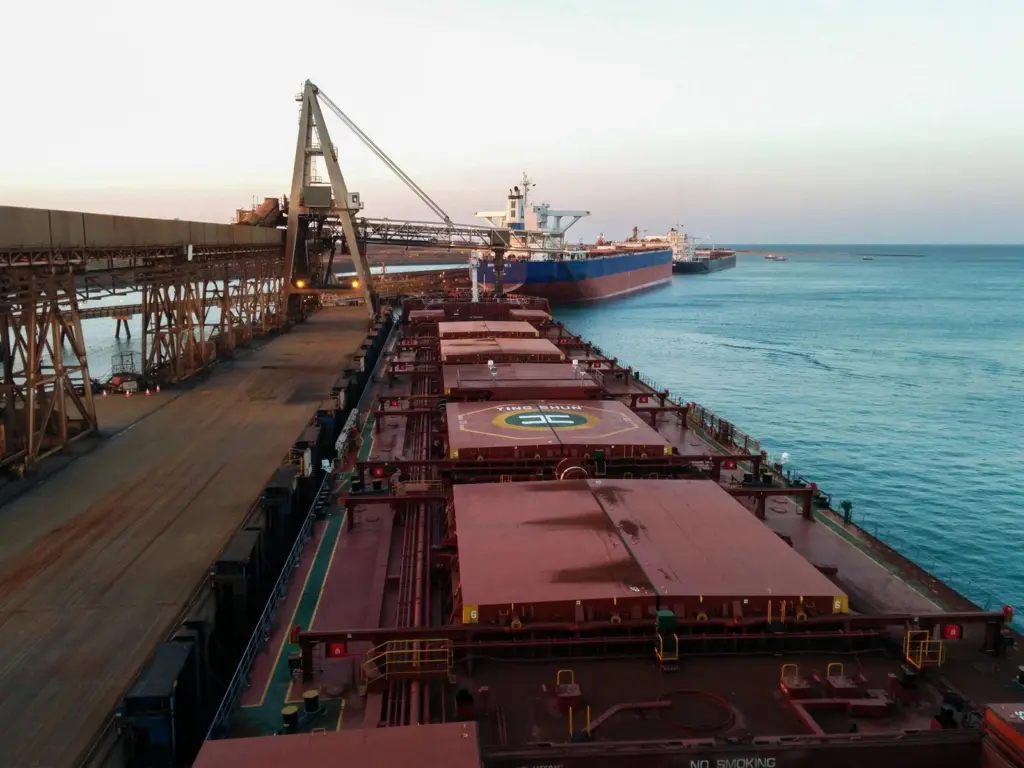
Introduced in 1995 and built by Melbourne-based OMC International, the system calculates safe vessel drafts in real time, letting deeper ships load more without increasing risk.
READ MORE: Mega ship manoeuvring
Local crews still recall the shift. One longtime mariner at the port said the early trials ‘felt like someone had finally switched the lights on’, because decisions were suddenly based on live data instead of broad, conservative rules. Within months, the port set a world record: 499,123 tonnes exported on a single tide in February 1996.
Since then, the system has been credited with enabling more than five billion tonnes of exports. OMC chief executive Peter O’Brien said the partnership with Pilbara Ports ‘has been an integral part of our growth journey’, adding that the port is ‘recognised worldwide for world’s best practice operations’.
The technology has evolved along with port demand. In 1994/95, Hedland handled roughly 1,000 vessel movements; in 2024/25, that number reached nearly 7,000. Tools such as the Dynamic Port Capacity Model and PortWeather now sit alongside DUKC, helping planners squeeze more throughput from the same channel footprint.
A major test of that approach came during the Channel Risk & Optimisation Project. By modelling dredging impacts with DUKC, Pilbara Ports avoided digging an average 0.63 metres of additional depth, an uncommon win for both capacity and environmental impact.
Pilbara Ports chief executive Samuel McSkimming said the system has ‘empowered vessels to safely and efficiently navigate our port’s channel’, crediting it for record-breaking tides that now routinely top one million tonnes.
Related Articles
 EQUIPMENT
 OPERATIONS
 OPERATIONS