![PortStrategy[GreenPort]](https://www.portstrategy.com/wp-content/uploads/2026/09/PortStrategyGreenPort.svg)






Tanger Med, a Global Maritime Hub Reaching a New Milestone in 2025
The year 2025 stands as a defining milestone for Tanger Med — a year that more than ever confirms its position as the leading port in the Mediterranean and Africa, and one of the most efficient logistics hubs worldwide.


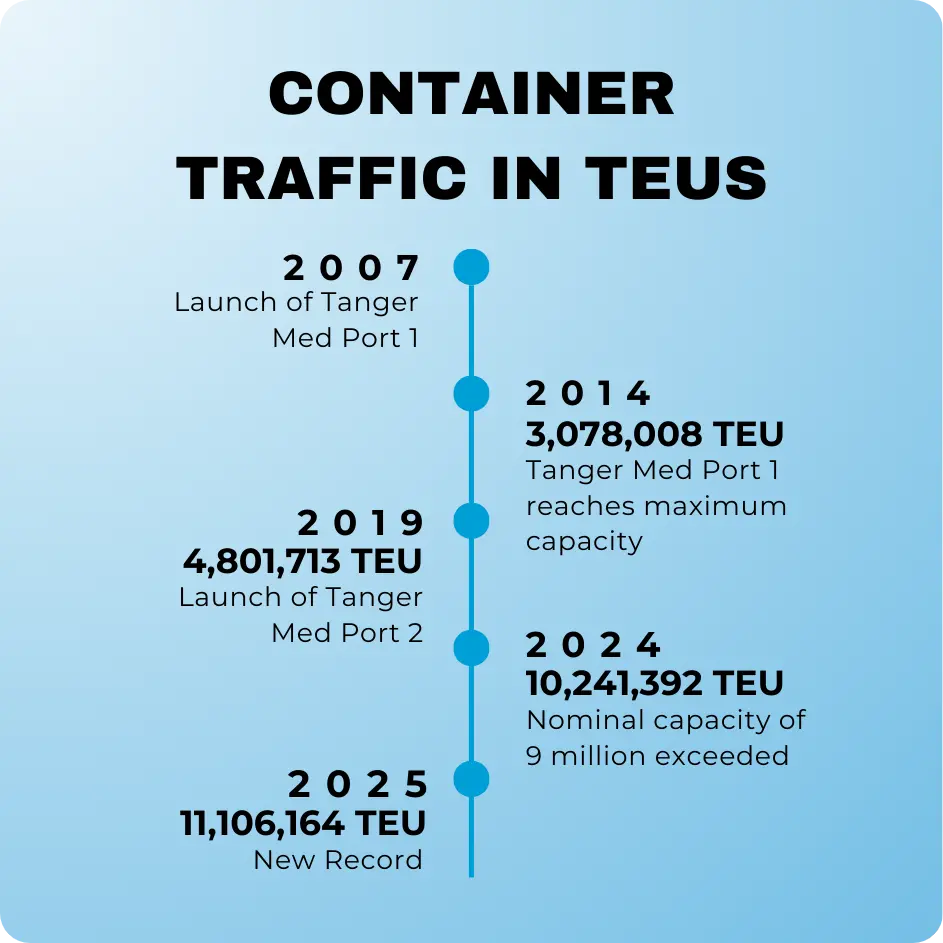
The complex’s four container terminals handled 11,106,164 TEUs (twenty-foot equivalent units), representing growth of 8.4% compared with 2024. This performance was notably driven by the commissioning of the latest extension of Terminal TC4, operated by APM Terminals, further strengthening the port’s capacity to accommodate growing global trade flows.
Truck traffic also maintained a positive momentum, reaching 535,203 units, up 3.6% year-on-year. This growth was mainly supported by exports of industrial goods (+4.8%) and agri-food products (+4.3%), confirming Tanger Med’s strategic role as a key export gateway for the national economy.
Passenger traffic continued its upward trend, with 3,220,422 passengers and 895,341 vehicles handled in 2025, reflecting respective increases of 5.7% and 5%. The Marhaba campaign was conducted under optimal conditions, notably thanks to the full deployment of the firm-ticket system, which enabled better flow regulation and smoother crossings aligned with the actual capacity of the fleets.
Regarding bulk traffic, dry bulk reached 522,493 tons, down 11%, mainly due to the postponement of cereal imports compared with 2024. Conversely, liquid bulk recorded strong growth, totaling 8,641,481 tons, up 13%, largely driven by hydrocarbon traffic.
Vehicle traffic reached 526,862 units in 2025, down 12%, reflecting cyclical adjustments in production rates and the reconfiguration of global automotive flows. This volume includes exports from national industrial plants as well as a share of transshipment traffic, confirming Tanger Med’s integration into global automotive value chains.
Overall, across all activities, the port complex handled 161 million tons of cargo in 2025, representing year-on-year growth of 13.3%, illustrating both the robustness and the diversification of its traffic.
Finally, the port recorded 16,686 vessel calls in 2025. While this figure shows a slight decline, it is mainly explained by changes in the RoPax segment, with a shift toward higher-capacity vessels. At the same time, 1,319 mega-ships exceeding 290 meters in length called at Tanger Med, up 8.4%, highlighting the port’s growing attractiveness to the world’s leading shipping lines.
The Foundations of Sustainable Success
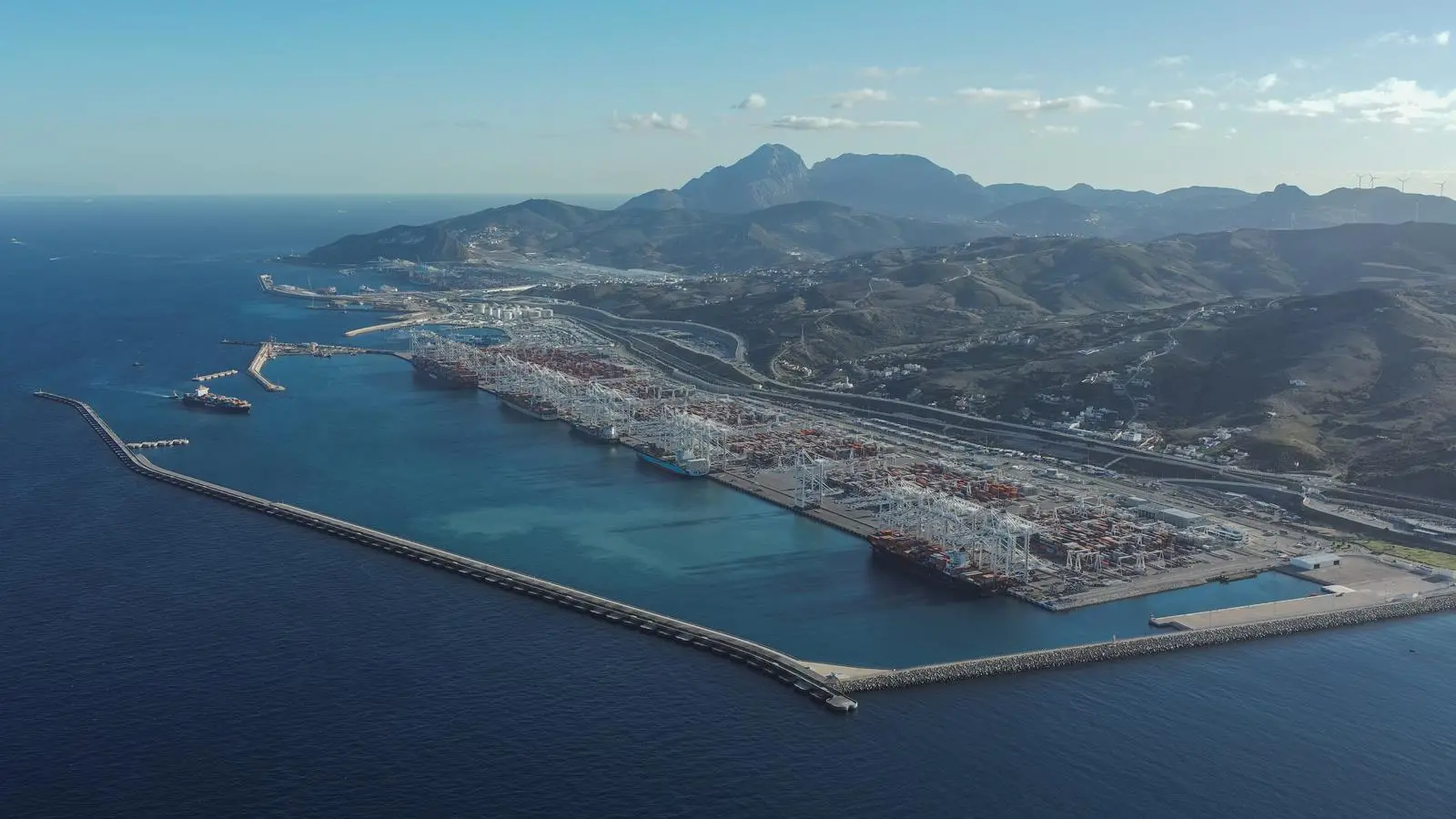
These results are underpinned by a long-term strategic vision, first and foremost based on an exceptional site selection. Located at the Strait of Gibraltar, at the crossroads of the main East–West and North–South maritime routes, Tanger Med benefits from a unique geographical position linking Europe, Africa, the Mediterranean and the Atlantic.
Just 14 kilometers from Europe, the port acts as a natural maritime bridge, facilitating import-export flows and the movement of goods, vehicles and passengers between the two continents.
This positioning is reinforced by state-of-the-art infrastructure, designed to accommodate the world’s largest vessels and handle high traffic volumes under optimal conditions of safety and fluidity. The renewed confidence of major global operators, who have chosen Tanger Med as a key transshipment hub, attests to the robustness and reliability of the platform.
Performance is also driven by a high level of productivity, resulting from close coordination between terminal operators, harbour master and pilotage teams, and all port services, enabling optimized vessel calls and continuous improvements in service quality for shipping lines.
At the same time, Tanger Med is rolling out an ambitious digitalization strategy, positioning the complex as a reference smart port, serving operational efficiency, operator competitiveness and smoother logistics chains.
A 100% Green Port, Looking to the Future
Since the beginning of 2025, Tanger Med has been operating on 100% green energy, marking a decisive step in its energy transition pathway. This achievement is fully aligned with the Group’s overall strategy to reduce its carbon footprint, support the decarbonization of maritime transport, and offer operators more sustainable port solutions.
Related Articles
 EQUIPMENT
 OPERATIONS
 OPERATIONS