![PortStrategy[GreenPort]](https://www.portstrategy.com/wp-content/uploads/2026/09/PortStrategyGreenPort.svg)


PODCAST: The future looks greener for dredging
GreenPort talks to Jake Storey, executive director, Haven Dredging Company, about why the company’s innovative new dredging technology could save on high costs and also be better for the environment.
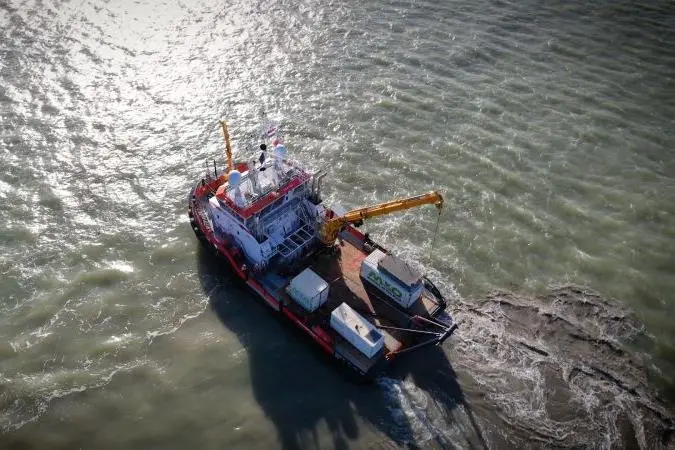
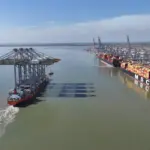
Harwich Haven Authority is one of the Haven ports which lies on the south bank of the River Stour, opposite the Port of Felixstowe.
“We’re not a large port authority, normally our revenue is around GB£30 million per year. But we’re heavily dependent on traffic coming to Felixstowe, so, we have to make sure we have the appropriate sea access which forms part of our statutory responsibilities,” says Mr Storey.
So, developing its own dredging technology came through force of necessity.
Mr Storey says that the port was spending about 25 to 30% of its turnover on maintenance dredging, but a few years ago it was looking to undertake a major capital project to deepen the harbour which would ramp up costs considerably.
Currently, there is 14.5 metres of sea access, as of August 2023 the port will have 16m.
That means the dredging costs will increase by roughly 20%, according to the models.
“Added to this, we have a high degree of siltation about 2 to 3 million metric cubes per year, which is quite high for a UK facility.”
And the offshore disposal site is 16 miles away.
“So, it’s not only expensive because of the volume of material, but also the distance. If our disposal site had been a mile offshore, we may not have even thought about this because it wouldn’t have been such an issue from a financial perspective.”
A no-brainer
One day in 2019 Mr Storey was having a conversation with a harbour engineer about what could be done to reduce dredging costs. It turns out that the engineer had been trialing a dredging concept which works just by using the tides and the currents in the harbour.
Harwich has a tidal range of three or four metres, depending on the cycle and just below one knot of current.
The engineer had used a trailing suction hopper dredger and side-casted the sediment to see where it would go after disposal. He saw that it actually travelled out of the harbour on the current.
Then he thought he didn’t actually need a dredger and came up with a design which was then developed into the Tiamat system.
This went to trial on one part of the harbour in March 2020 and achieved the same results at disposal.
The technology’s second trial in October 2020 involved Natural England, the Environmental Agency, HR Wallingford to produce the documentation/hydrographical reporting and Royal Haskoning to do an EIA.
One concern they had was that there are mud flats and two rivers that come into the harbour – the Orwell and the Stour. A previous capital dredge from 1998 found that beneficial placements had to take place at these two rivers to ensure that the mud flats don’t get depleted.
“We had to show that using the Tiamat would not deplete or saturate the mud flats. The trialing proved that this wouldn’t be the case and that Tiamat would naturally do what we had been doing by trailer anyway,” says Mr Storey.
“At the moment we have two small trailers that go up both rivers to do these placements, so now the longer-term plan is to get rid of those.”
The trials also showed that dredging by Tiamat would not create additional silt or mud that travels onto beaches, or anywhere else.
Silt either stayed in the harbour in certain areas or went out on the tide to the North Sea.
Tiamat was developed to reduce the cost of dredging but also to enable Harwich to make significant impacts on reducing its greenhouse gas emissions.
Harwich Haven is an unusual port authority in that it doesn’t have any land assets so all of its greenhouse gas emissions come from either pilot launchers or from maintenance dredging.
In fact, 80 to 90% of emissions have previously come from dredging so there are plenty of savings to be made there.
Removing the need for a disposal site saves on a like for like basis about 65% of greenhouse gas emissions because there is no need for big vessel which is heavily laden traveling out to the North Sea on a 32-mile round trip. Instead, Tiamat technology only calls for the use of a small workboat of about 20m.
Clever bit of kit
But how does it work and how is Tiamat unique out there on the market?
“It’s very simple, so simple, I often wonder why someone else didn’t think of it,” says Mr Storey.
Tiamat dredges using the tidal current – dredging with nature, as he calls it.
“The product has 85 patents granted already and it has also applied worldwide for more patents. There’s nothing out there from a similar technological perspective that has already been patented.”
The Tiamat is a clever piece of kit, it leverages off what a water injector does but it’s fundamentally different in terms of its configuration.
On a standard dredger all the pumps and the equipment is on the vessel, with Tiamat the water injector pumps are on the device underneath the vessel. This means that a standard workboat, eg a shoal buster or a multi cat, can be fitted up with ease to do the same job.
“You don’t need a large vessel to go down to the depths that we need to and you don’t a great deal of configuration to the work boat,” explains Mr Storey.
Another big difference is the flume and the process of pumping up the water column. Unlike a dredger, you’re not reliant on a density current or trying to find deeper water when it may not be available or the deeper water could be the berths which you want to keep clear anyway.
Tiamat uses a flume of about 8m. Different locations can use different sizes, it really depends on the job to be done.
Market niche
Having said all this, Mr Storey explains that the Tiamat will not replace trailer dredging, Harwich will still use trailers.
Historically the Haven has conducted four or five trailer campaigns per year and this could go up to six with deeper water.
But post channel deepening, Harwich will only need to use trailers two or three times per year, interspersed with use of the Tiamat which can take the sediment down to about 50 pascals – which is very navigable.
“Tiamat has found a gap in the marketplace which for some reason or another hasn’t been filled,” says Mr Storey.
“I think partly that is because it is very hard for ports to innovate. In any type of business when you’re focused on delivering results and performance and KPIs, it’s very hard to come away and say I’m going to design something new which could potentially undermine your existing technology.”
It’s also a combination of having a CSO who is willing to take a risk and invest combined with a good idea from a harbour engineer.
Added to this, there are no permitting issues. Harwich is a trust port which has the power to dredge without formal approval from anyone else, making it quite easy for it to innovate in its own back garden.
Greener dredging
The unique position that Tiamat occupies over other dredging solutions though, is perhaps its environmental benefits, which are seven-fold.
Replacing trailer campaigns with the use of a smaller workboat is one benefit, but added to this, this should allow the Haven to still be within a decent cost envelope of say using a transition fuel like HVO.
Harwich uses recycled HVO on its pilot launchers and the port authority is looking at doing trials later this year with Tiamat onboard HVO powered vessels which will reduce greenhouse gas emissions by up to 95% on a like for like basis.
Then there is the beneficial placement benefit. Instead of employing a dredger which comes from the continent of another part of the UK to take sediment up the rivers, the Tiamat can be used on a flood tide to do the same job.
Thirdly, as Mr Storey explains, there is the future proofing aspect. You’re more likely to get a carbon neutral dredging operation through using smaller machinery, ie hybrid, electric, these fuels tend to be easier to supply when there is a lower level of fuel consumption.
Knowledge is wisdom
“My advice to port operators would be to look longer term. We did take a bit of a risk with developing this new technology, but it was a small, calculated risk,” he says.
The first trial of the technology cost Harwich £440,000 so if it failed, the harbour authority failed small and failed quickly, so that was important.
“For us dredging is so significant as a cost expense that the tradeoff between failure and success was asymmetrical in a positive way. If we got it right, we could save millions.”
“I think being able to drive at our own speed, was also fundamental, we looked and moved quickly.”
The two trials took place within seven months of each other and the technology was reducing maintenance dredging costs at the same time as it was being validated so Harwich was never out of pocket.
So, what next for Timat?
At the end of 2022, Rotterdam and Hamburg were conducting trials to try and solve different dredging problems. They have found that where there was strong tidal flow Tiamat will move sediment, which reinforces what has been found at Harwich.
It also indicated in all locations where sediment was left behind, the chemical bonds of the silt were dismantled by the water injectors.
Further trials will take place in Rotterdam later this year and there will also be trials of Tiamat at other UK ports in the autumn.
As the commercial arm of Harwich Haven, Haven Dredging is also engaging with the US market. The US Corp of Engineers is visiting Harwich in the autumn to see Tiamat in action. Haven Dredging will be setting up a US entity this year and looking to enter into its first arrangement with an American dredging company.
The goal is to open up the possibility of using Tiamat technology in the US market in some circumstances.
Tiamat is also going through a technical review with the Chinese Dredging Association.
One of Tiamat’s major assets is that it’s adaptable for a variety of uses. It can be scaled up or down depending on the job at hand and the water depth, but the principle remains the same.
Mr Storey is optimistic about Tiamat’s future.
“It’s a new piece of dredging toolkit that can sometimes do better than water injectors or a trailer,” he says.
“It will not make other forms of dredging technology redundant, but it will make it greener, more cost efficient and more effective in some instances.”
The future certainly looks greener for dredging.
Related Articles
 CONTAINER & CARGO HANDLING
 CONTAINER & CARGO HANDLING
 EQUIPMENT