

Proactive supply chain can tackle congestion
Proactive responses across the supply chain will be vital to tackle port congestion as a result of the COVID-19 pandemic.
“Port congestion is a highly visible symptom of the wider imbalance across the global supply chain, which has been warped by the COVID-19 pandemic and the recovery from the pandemic,” said Eleanor Hadland, Drewry’s senior analyst for ports and terminals, in the maritime research consultancy’s latest recent Quarterly Port Sector Briefing.
Proposed solutions
Drewry suggests proactive responses to keep cargo moving. This includes 1. increased visibility of port performance indicators, 2. earlier cargo re-routing, and 3 earlier schedule adjustments.
1. More transparency on performance and capacity of all parts of the supply chain is needed. This needs to be regional rather than at a port level to facilitate better decision making. To address hidden performance data, Drewry has developed a new port efficiency monitoring service.
2. Cargo re-routing needs to be proactive rather than reactive. Shippers should be encouraged or incentivised to use alternative routes to the market. Shippers would however need to decide early on the costs of rerouting, v. the unknown cost of using usual port which may or may not become congested, depending on how many shippers reroute.
3. Carriers should look to minimise their cut and run responses when faced with this type of demand led congestion and work more closely with their terminal network to introduce congestion-linked schedule adjustments much earlier. This could help avoid the worst of the grid lock. Adjusted liner schedules early on to help control the flow of cargo into terminals would help avoid the yard congestion cycle. This is anticipated to be highly challenging to accommodate, given the fixed weekly schedules of deep-sea trades, however the industry is better placed to handle this type of adjustment now.
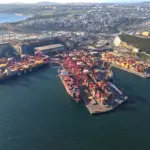
San Pedro Bay congestion
The number of vessels anchored outside US ports is continuing to grow. With high levels of demand, US market imports are contending with labour supply issues due to COVID-19, which are impacting terminal, trucking and warehouse operations.
“It’s difficult to see when the terminals will get the breathing space they need to recover.”
On 3 March there were 32 vessels anchored in San Pedro Bay, outside the Port of Long Beach and Port of Los Angeles and the waiting time that had been incurred was incredibly high, noted Hadland.
“The carriers have far greater agility than the rest of the supply chain to adjust capacity to meet demand , but they’re now incurring rapidly rising costs, with these vessels facing increasing levels of delay,” she said.
Carriers exacerbated congestion
Hadland said Drewry’s analysis “shows that carrier responses to the rebound in demand and the growing congestion crisis may have actually exacerbated the problem for other parts of the supply chain”.
To address demand during yard congestion, carriers deployed additional capacity into the strongest growing markets. Larger ships or additional loaders were deployed in the transpacific trade and the Asia-North Europe trade, but this couldn’t be matched “step by step” with an increase in either terminal capacity or landside transport capacity.
This is because the assets of the landside elements of the supply chain are geographically fixed and it takes a long time to procure equipment or recruit and train additional labour to increase capacity for these elements of the supply chain, said Hadland.
Landside operations have been seeing above average levels of absenteeism due to COVID-19 in their workforce and COVID-safe working practise has impacted in productivity at warehouses and ports. As demand ramped up quickly, landside supply chain capacity was squeezed, and was already lower than it would usually be at this time of year.
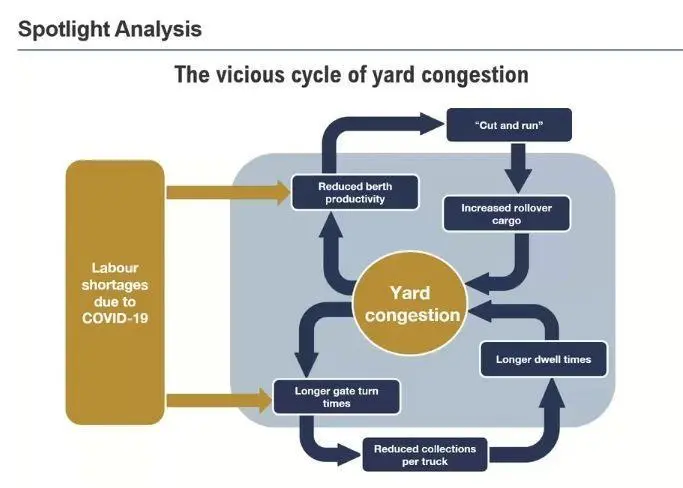
Hadland explained: “Once terminals were struggling to maintain productivity, then not surprisingly carriers reverted to their standard operational responses. A cut and run strategy to maintain schedule integrity and ensure an on-time arrival at the next port, but this quickly resulted in a build-up of empty containers in the container yards which quickly became over full and that meant that berth productivity fell further which led to more ships cutting and running, which led to more rollover of cargo and so the cycle continues.”
She added: “Terminals also refused to accept any more inbound empties for subsequent export, which meant that truckers were forced to make separate stops for container drop off and collection.
“The congested yards were making truck service times longer and queues were building up at terminal gates. These measures have led to a reduced capacity at the landside transportation network. Trucks previously able to do two turns a day were down to one and a half turns a day. That’s squeezed capacity back along the transport chain.”
UK and Europe impact
She noted that the UK also experienced severe congestion in the run up to Christmas. Port efficiency had started falling as early as week 32 in 2020. Increased demand only partly accounts for this. By the 4th quarter of 2020, UK ports were receiving fewer mainline calls each week than they were in he fourth quarter of 2019. However, performance stayed low. A higher proportion of the calls were from ultra large vessels, but the concentration of cargo on fewer larger vessels doesn’t help yard congestion, rather larger vessel exchanges put additional pressure on yard capacity, especially when they’re already full.
Proximity of mainland ports in Europe and spare capacity has enabled cargo diversion to ports such as Dunkirk and Zeebrugge, where UK cargo has been offloaded for feedering into the UK market. Though this has reduced vessel queuing, there has been significant delays and increased costs for UK shippers.
Data sharing for effective planning
“Drewry’s assessment is there’s no double that improved data sharing across the supply chain would enable better planning of cargo movements to minimise the costs associated with port congestion. However, even with better visibility, we doubt that there’s currently sufficient financial incentive for individual supply chain players to act for the common good.”
Related Articles
 BULK HANDLING
 BULK HANDLING
 PORT & TERMINAL NEWS