



BCT upgrade advances
Gdynia’s Baltic Container Terminal is advancing a comprehensive terminal upgrade. Mike Mundy unveils the key steps which will deliver a significantly enhanced service offering
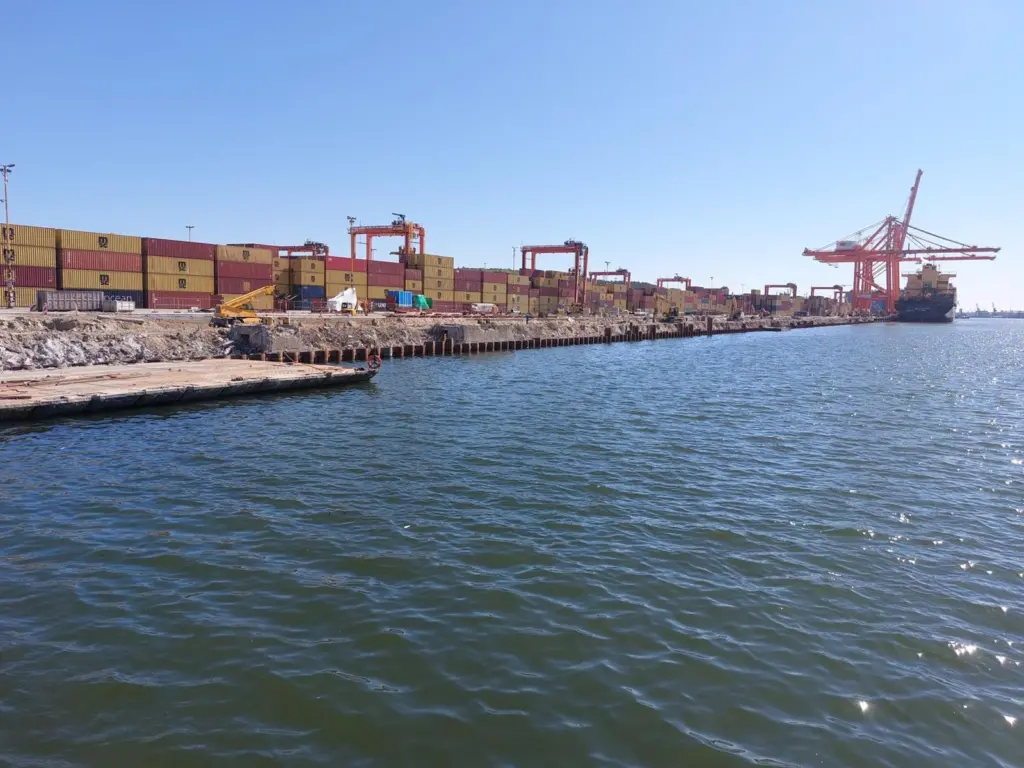
Gdynia’s Baltic Container Terminal (BCT), an operating unit of Manila-based International Container Terminal Services Inc., is the focus of a major investment programme designed to proactively meet user needs over the long term. Comprehensive investments are being undertaken by both the Port Authority of Gdynia and BCT with support from the European Union.
A key goal of the development programme is to provide access for higher capacity container vessels and with this in mind the Port Authority of Gdynia, at the end of 2022, commissioned Jan de Nul to implement a comprehensive dredging programme to deepen the Approach Track and Inner Basins of the Port of Gdynia. This has now been completed and following the completion of extensive terminal upgrade works at BCT, the terminal will be able to accept vessels with an LOA of up to 400m and draught in excess of 15m. In particular, this is designed to complement BCT’s established role of handling direct deep-sea services as well as serving extensive short-sea/feeder services.
The main construction work at BCT centres on the upgrade of the terminal’s Helskie Quay which is being re-developed to offer a 15.5m draught over 770mand the installation of a new third rail designed to facilitate the introduction of larger ship-to-shore (STS) cranes. These new generation cranes will provide a greater lift capacity, the ability to serve up to 25 rows of containers on deck and possess a span between the legs of 30.48m.
The final leg of the Helskie Quay, adjacent to the ro-ro ramp in the inner area of the dock, offers another 30m of quay with a draught alongside of 12.7m.
There are also supporting construction works underway which include a new intra-port road connecting the Helskie II Quay – which extends on from the main Helskie Quay for 176m – with a new logistics storage yard scheduled to come into operation in early 2026. The latter is a joint investment by the Port Authority of Gdansk and BCT. There is also a new 9ha BCT staging area, again expected to come on-stream early in 2026. Going forward, there is also the prospect of additional terminal areas being added.
Wojciech Szymulewicz, CEO, BCT notes: “We are pleased to partner with the Port Authority of Gdynia to upgrade Gdynia’s container handling capacity and performance to meet the new needs of shipping line and other clients going forward. We recognise that the terminal development works have been challenging for liner clients sincerely believe that the ‘prize will be worth the pain,’ notably our ability to serve higher capacity vessels and offer enhanced service levels on both the quayside and landside.
“We expect,” Szymulewicz elaborates, “diverse benefits to flow from the implementation of the latest Navis terminal operating system and our comprehensive equipment acquisition programme. Also in the pipeline, together with new generation STS cranes, are new rubber tyred gantries (RTGs), 15 tractor and semi-trailer container sets and other mobile equipment including reach stacker and heavy-duty forklift units.
“Once the overall development programme is fully bedded in, we anticipate an improved performance across the board, spanning all key areas: ship side operations; at the terminal gate, consolidating and expanding our already successful intermodal rail activities, yard operations and in conjunction with customer support functions.”
STRATEGIC ROLE
The upgrade of the Port of Gdynia and BCT is also important in the context of TEN-T system development with Gdynia representing an important component of the Baltic Sea-Adriatic Sea (BSAS) European Transport Corridor (ETC). This corridor is the subject of ongoing development with plans foreseeing the completion of the core network for BSAS by 2030 and 2040 for the extended core network.
Recent times have also seen BCT fulfilling an increasingly important role in the handling of special military equipment, much of it destined for use by Ukraine in its war with Russia. BCT meets the stringent security requirements set by the Polish army and its NATO allies.
Related Articles
 PORT & TERMINAL NEWS
 PORT & TERMINAL NEWS
 PORT & TERMINAL NEWS