Structural market changes, the impact of new technology, the greening of supply chains, the role of the port all came into focus at the recent Coastlink Conference held in the port-city of Bilbao. Anne-Marie Causer presents the highlights
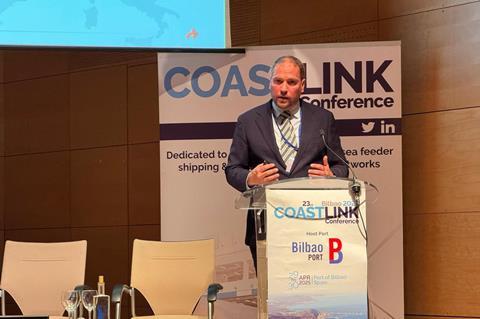
In the words of Nick Lambert, Conference Chairman, Coastlink and Co-Founder and Director, NLA International Ltd: “Despite facing one tumultuous event after another in this industry, Coastlink is still here, shipping is still here and so are all the people that make it happen.”
The Conference, hosted by the Bilbao Port Authority, took place over two days and featured a strong focus on the potential and role of short-sea shipping as well as the barriers to full system exploitation.
OPPORTUNITY AND CHALLENGES
Nathan Alemany, Senior Marketing Manager, Peel Ports Group, UK, took up the latter point and explained how although there’s plenty of opportunity in the market, it may not be possible to take advantage of it, certainly in the UK.
He identified the chief obstacle for short sea operations as cost and highlighted the reality that cargo owners often have no choice when selecting shipping routes but to choose the cheapest option often involving multiple modes of transport.
“We need a level playing field with emissions taxation applied equally to all modes of transport, including rail and road, in addition to the costs of funding infrastructure.”
Then, he elaborated, there is the impact of the UK’s Emissions Trading Scheme (ETS) which he said could be working negatively to encourage the transport of freight by road and rail. The ETS is a cap-and-trade system designed to reduce greenhouse gas emissions by placing a price on carbon. The suggestion was it may dis-advantage short-sea shipping.
Public policy, it was also noted, has also had an impact on the structure of short-sea operations - notably five years ago, there was a marked switch to unaccompanied freight driven by the Covid pandemic.
Despite these impediments, Mr Alemany argued that coastal shipping is still a great opportunity for the UK.
He said that British interests could look to the example of how the Rhine in Germany is used for short sea shipping.
“Supporting maritime services and routes to grow and develop when they offer emission and economic advantages will allow the sector to flourish,” he said.
Also speaking in the opening session of the Conference, Johan-Paul Verschuure, Director, Rebel Ports & Logistics, Rebel, noted that for the last two to three years, demand for short sea shipping has been on the up with an indication that the sector is experiencing healthy demand. The sector, he suggested echoing the theme of the morning session, is experiencing something of a renaissance.
“For the last few decades, the market has been relatively stable,” he explained, “but the last two to three years have seen the market moving with healthy demand – there are now new vessel orders to replace the ageing fleet. Countries are also providing subsidies to green the short sea segment.”
Short sea infrastructure developments were also picking up pace - Mr Verschuure pointed to the new Ro-Ro facilities in Immingham UK and CLdN buying the Broekman terminal in Rotterdam as two good examples. Particular impetus is provided to the short sea option when major cargo shippers look to harness short-sea shipping for regular use in a dedicated supply chain as well as via common user services. Interest, he reported, is building on both fronts with some interesting projects in the pipeline.
Despite the positives, however, there was also agreement with Mr Alemany’s comments that there are still barriers to overcome.
In particular, a new era of tariffs may have an impact.
“There is spillover from US tariff issues, cooling macro-economic conditions and incoming fuel regulations to be aware of,” said Mr Verschuure.
But nevertheless with challenge he said, also comes opportunity.
Although Eurozone goods are being put under pressure from US import tariffs, there is the potential for rerouting via Canadian/Mexican ports or transshipment options in the Caribbean with European orientated feeder operators.
This of course could be beneficial in creating new trading partners (if the tariffs stay in place) said Mr Verschuure, while the shift to domestic production rolls along slowly in the background.
PIVOTAL TIME
One of the main concerns is what will happen with blank sailings during the so-called ‘tariff war’.
Blank sailings cause imbalances in the sector with redeployment, but how efficient will redeployment be at following shifts in demand or sailings at low utilisation levels?
Mr Verschuure said that regulatory framework will play an increasingly important role in shaping the sector over the next few years, especially with the impact of rising fuel costs.
Fuel EU and IMO carbon intensity measures will increase costs for renewable fuels but will be offset by compensation for using greener fuels, which should help to lower costs.
But still, new and existing regulation will impact the market heavily and mitigations need to be made to reduce fuel costs wherever possible.
Mr Verschuure said that renewable fuel availability in ports will become a differentiator as shipping lines rely on it to reduce penalties.
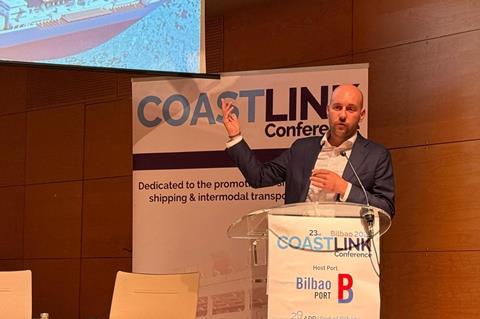
As such, larger investments will be required in the production, supply and storage of these fuels for bunkering and new novel ways will have to be developed to overcome port space constraints.
“Other measures for reducing fuel costs, such as OPS, wind assisted sailing and friction reducing measures will become even more interesting and ports need to be able to facilitate them effectively,” said Mr Verschuure.
Perhaps the final consideration to make is that the push for greener short sea vessels will require additional shipyard capacity and new knowledge skills for every stakeholder.
The next few years will be pivotal for sure.
COLLABORATION - PARTNERSHIPS
DAY TWO of Coastlink saw Maurice Delattre, Regional Director (Europe), Port of Amsterdam, explore how strategic partnerships have been accelerating the energy transition at the port.
Green corridors and the development of green value supply chains are central to the port’s ambition to decarbonise.
“The next phase in green corridor development is all about collaboration,” he underlined.
“Because if we can’t tackle the fuels transition then we’re going to be much less relevant than we are today.”
For the Port of Amsterdam, one of its main focuses is to transition its industrial cluster including the steel industry, away from fossil fuels and towards alternative fuels, with a particular focus on green hydrogen.
THE WAY FORWARD
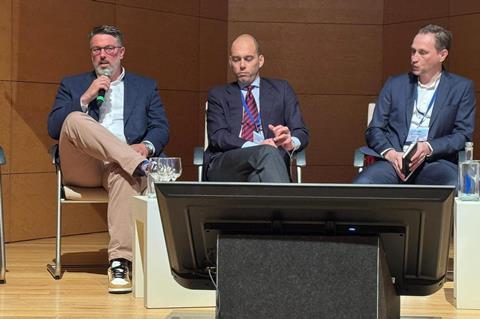
The second panel session and the last session of Coastlink 2025 focused on developing sustainable multimodal logistics networks.
Shippers are working diligently towards greening their own value chains, but the question put was what do they need from ports to grow further?
Stefan Krattiger, Business Development Leader Global Ports, Ikea Supply AG, Alexander Prahl, Head of Sales and Contracting Trade Management at Tailwind Shipping Lines and Blasco Majorana, Line manager, Finnlines, talked delegates through their respective successful business models.
The shippers’ viewpoint
For Ikea, the emphasis for its supply chain is on sustainability.
“With two million shipments per year by land and ocean and a global footprint on supply and demand we have a global operation with ports in 61 markets,” noted Stefan Krattiger.
“Ports are hubs, we are convinced that ports can contribute to decarbonization solutions for both our ocean shipping and land transportation needs.”
For Finnlines, part of the Grimaldi Group, short sea is core to its business as an operator of ro-ro and passenger services in the Baltic and Celtic seas.
“Creating awareness is key to solving the challenges that we are facing in the sector now and going forward,” said Blasco Majorana.
“You cannot have the European supply chain without short sea, you cannot move everything by road. Short sea has the vital infrastructure we need to do business.”
The Port’s role
A question from the floor asked what shipping operators want from port and terminal operators to help them build greener shortsea networks.
For Tailwind Shipping – the answer is about provision.
“Firstly, have a short sea terminal, if the infrastructure isn’t there, shippers can’t use it. The structure should be there and there should be a choice,” said Alexander Prahl.
Finnlines pointed towards more communication and collaboration.
“The level of cooperation between shippers and ports is key when it comes to integrated intermodal connections – that is the integration of sea, rail and road. All modes of transport need to work in the same way,” said Mr Majorana.
Ikea wants to work more closely with ports to enhance the sustainability of its ocean cargo movements.
“The port’s role in decarbonisation cannot be underestimated. They are a meeting point for stakeholders so shippers want to be able to better use that playground for matchmaking and meeting market requirements,” said Mr Krattiger.
Summing up, Mr Prahl said the outlook for short sea shipping is bright with the EU continually working to push it forward as a main mode of sea transport.
The consensus from the panel and indeed from the body of attendees at Coastlink year was that short-sea has untapped potential with the time right for exploitation.
Coastlink 2026 heads to the Humber
Associated British Ports (ABP), the UK’s largest port operator, has been selected to host the Coastlink 2026 conference taking place on the Humber in the UK.
The two-day conference in May will feature industry-leading speakers, thought provoking discussions all in the heart of ABP’s cluster of four ports in the Humber.