

Proud to go it alone
Jakartas rising star isnt looking for state handouts to fulfill its aspirations. Stevie Knight reports
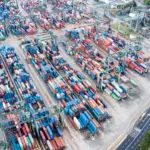
Tanjung Priok Port in Jakarta seems set on pulling itself up by its bootstraps, with little help from anyone else. Not that any help has been offered.
Although state operator Pelindo II is responsible for a dozen ports in the area, Tanjung Priok Port (TPP) accounts for around 90% of its revenue. It has to be said that while the port used to be a rising Asian star three decades ago, it’s been dogged by inefficiencies and congestion problems that are now really becoming a serious hindrance.
Indonesia’s gross domestic product expanded 6.5% last year, with increases over 6% this year boosted by a healthy export balance, and the middle classes and their growing aspirations, but the infrastructure just isn’t keeping up – the Indonesian Logistics Association has estimated this costs the country between 25% and 30% of the country’s GDP.
It doesn’t help that the government occasionally plays politics with the ports. For example, it recently reduced the number of entry points for imported fruit “in order to stop contamination” – a measure viewed as protectionism for the home grown market.
So, the pressure is on – last year alone TPP’s container volumes grew by around a quarter to 5.8m teu, pushing it well over its advertised top capacity of 5m, according to Pelindo II statistics. This, says chief executive Richard Joost Lino, is bound to affect efficiency, and he’s been quite pointed about the lack of forethought by his predecessors: “They were more profit-oriented… They sacrificed service and expansion for profit as a result,” he has remarked to the press.
In fact, it’s been noted by Indonesia’s government that Tanjung Priok needs to more than triple its container-handling capacity in the next seven years if it is going to keep up with the expected growth in Southeast Asia’s largest economy. Despite this, the government seems set to stay on the sidelines with its hands in its pockets: Trade Minister Gita Wirjawan has said that the ‘private sector’ will assist with development without offering further details.
So, in order to ramp up TPP’s efficiencies the operator has made significant investments in both a set of nine gantry cranes, data-sharing management software and a real-time vessel tracking system that will reduce congestion and improve safety on the water when it’s completed.
However, there are plans to help take the pressure off TPP by opening up a location to the east of the main facility, but again the government’s actions haven’t exactly helped. It first offered up the proposed Kalibaru area development as a public-private partnership, then realised it didn’t want to find the Rp3tr ($330m) needed to keep its own end of the bargain, controversially finally handing it over to Pelindo II to develop.
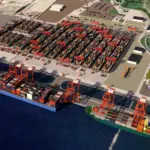
The project is a 3.5 sq km port that will eventually have six box terminals totalling 6.5m teu as well as three more quays dedicated to gas and oil, although the first phase will open in 2014 with a single box berth of 1.5m teu capacity. The dredging and infrastructure development will cost Pelindo II about Rp10tr ($1.1bn) in total while other parts of the project will be offered up for joint operations.
Since it isn’t getting financial support from the government it helps that Pelindo II is actually able to find finance for a large amount of its planned developments itself: after all, it is seeing a continued projected growth of between a quarter and a third this year, and expects this to carry on for the foreseeable future so it’s in a healthy position. The company made Rp1.7tr ($185m) in earnings last year and this year it is expecting earnings to grow to Rp2tr ($218m). With these kinds of returns it can borrow up to five times its earnings – enough to cover its dredging and other major works.
Despite the fact that the total investment has risen to Rp17tr ($1.9bn), a 45% hike on the previous estimate, it is still worthwhile. The new development will double channel access to 300 metres and offer 20 metre drafts alongside – plus it will have both road and railway access, so it looks as if the only loser will be Singapore.
Related Articles
 CONTAINER & CARGO HANDLING
 TERMINAL OPERATIONS
 CONTAINER & CARGO HANDLING