
The sluggish global economy, ongoing supply chain restructuring, and rise in geopolitical risks stress-tested the capabilities and resilience of the global shipping sector in 2025.
Over the just-finished year, Taiwan International Ports Corporation (TIPC) realized steady, stable growth in its core business and continued progress in efforts related to business diversification and smart sustainability. Total revenues for the port group topped NT$23.53 billion in 2025, reaching an all-time high. Furthermore, the 690 million revenue tons (R/T) of total cargo throughput and 13.55 million TEU of containers handled through Taiwan’s international commercial ports this past year demonstrates the critical role played by TIPC in bolstering the resilience of the nation’s maritime and shipping sector.
In terms of capital investments and construction, the 18 major project bids completed by TIPC in 2025 will bring in some NT$8.903 billion in new investment to TIPC ports in projects covering container shipping, offshore wind power, the green energy sector, and warehouse / logistics. Concurrently, in line with the national five year planning scheme, TIPC is steadily improving infrastructures and supporting facilities across the port group, paving the way for handling significantly larger commercial vessels, setting up emerging industry operations within TIPC ports, and supporting national energy transformation efforts as well as fueling expansion in port-service and industrial-carrying capacities.
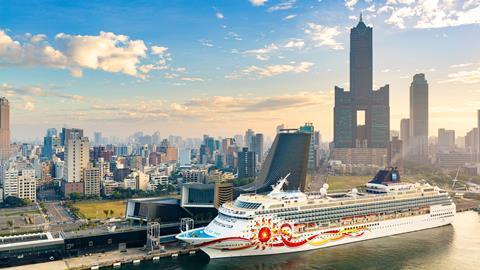
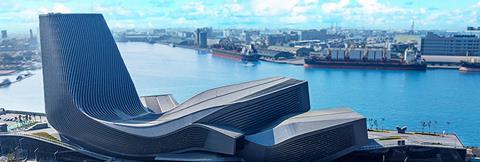
The cruise ship and travel markets continued their post-pandemic rebound. Benefitting from cruise ship call incentives and discounts, overseas marketing campaigns, and active cooperation with cruise lines, TIPC ports recorded 567 international cruise ship visits carrying some 1.15 million passengers in 2025, achieving numbers on par with or better than pre-pandemic numbers. Port of Keelung has successfully secured new homeport agreements with several new international cruise lines, while Port of Kaohsiung’s new state-of-the-art Kaohsiung Port Cruise Terminal, beyond setting a new high bar for cruise passenger service and reception facilities, has become the centerpiece attraction for Kaohsiung City waterfront tourism and a powerful engine of port-city prosperity.
In terms of digital and smart-port transformation, TIPC launched a number of key initiatives under the Trans-SMART 2.0+ Plan in 2025 covering port security monitoring, wharf operations management, port business management, and innovation trials. Operations Command & Control Platform, integrating data on vessels, cargo, weather, and operations, instituted a “central nervous system” that, in concert with AI-driven vessel image detection, port bridge monitoring systems, and improvements to critical wharf infrastructures, has facilitated faster decision-making and overall port resilience, ensuring the stability of everyday port logistics.

In the realm of sustainability, all seven international commercial ports under TIPC administration currently operate under ecoport certification, with the ports of Keelung, Suao, Taichung, and Anping passing all required recertification procedures in 2025. Also, work to install solar power collection and storage facilities interlinked via a smart microgrid at Port of Kaohsiung was completed last year. Furthermore, TIPC has continued to upgrade environmental resilience and sustainable management efficiency at all of its ports via the installation of energy-saving upgrades and enhancements, implementation of greenhouse gas inventories, and promotion of carbon reduction measures in ongoing TIPC engineering projects. These and other TIPC sustainability initiatives have been recognized in three consecutive Taiwan Corporate Sustainability (TCS) gold awards for sustainability reporting and the 2025 TCS category award for transparency and integrity leadership, underscoring the significant strides made in governance integrity, information transparency, environmental sustainability, and social responsibility.
Since taking the helm, TIPC Chairman Yung-hui Chou’s leadership of TIPC has centered on achieving the medium-term goals of strengthening port operations, fueling tourism, and enhancing smart management to build long-term sustainability, while emphasizing the importance of pursuing a well-balanced development strategy for the entire port group. This approach reflects the need to, on one hand, stabilize and strengthen TIPC’s core business while enhancing overall operational efficiencies and, on the other hand, pursue key digital transformation and sustainability objectives as well as opportunities for cooperation with local government, industry, and academic institutions to elevate ports beyond hubs of trade into incubators of industry innovation / enhancement and port-city development.
In 2026, TIPC will continue ongoing efforts to enhance critical infrastructure and services, improve roadway and other links with inland transportation networks, upgrade the quality of cruise passenger and port tourism services, and expand the implementation of smart systems and AI-enhanced applications. Also, TIPC will pursue advanced energy and carbon-reduction strategies to keep all of its subsidiary ports in close alignment with international sustainability trends as well as a subsidiary specialization strategy designed to ensure each TIPC subsidiary port has a unique role to play in the overall TIPC strategic blueprint. Finally, TIPC will continue to enhance the international competitiveness of its port group as part of national efforts to enhance Taiwan’s global profile and visibility.