

REALISING THE POTENTIAL
Oliver Andrews and Reuel Andrews from Africa Finance Corporation look at one successful way that potential can be realised in Africa.
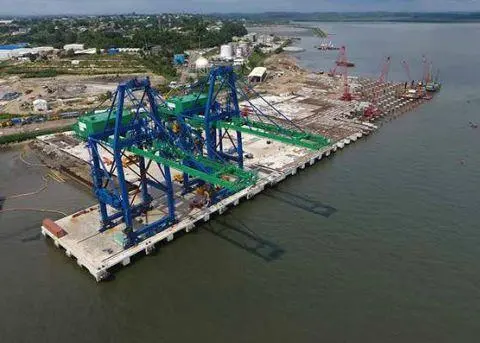
As a vital part of the supply chain, ports are key to Africa’s development especially in the wake of COVID-19 and the opportunity for Africa to take a prominent place within the global supply chain.
Ports are not only as a way of delivering and transporting resources and finished goods around the continent and world but also a conduit for attracting foreign direct investment and building self-sustaining ecosystems around them.
Out of 55 countries in Africa, 16 are landlocked which is why ports are an essential conduit to act as access to the significant variety of resources Africa possesses.
While ports hold much promise, they do not yet attract a lot of capital. Yearly investment into African infrastructure only amounts to approximately US$62 billion but requires between US$130- 150 billion each year, representing a significant funding gap.
In the past few years, 42 per cent of infrastructure funding has gone to the transport sector but, ports, which are one of the key subsectors, have lacked enough investment to develop appropriately. As a result, this has fed into the difficulties Africa has faced in fulfilling its potential within the global economy.
Now is the ideal time for Africa to focus on improving the quality and quantity of ports, thereby encouraging more trade and transport of goods globally. There are innovative financing options emerging, but the most impactful form of financing is the public-private partnerships (‘PPP’) model, which is ideal for the continent’s development and the overall need to stimulate the global economy post coronavirus.
WHY ARE PORTS UNDERDEVELOPED?
Despite the high volumes of goods that require transport, the development and integration of ports in Africa remains uneven. Some lack facilities, while others lack reliability or efficiency, which makes African countries less competitive than they should be when it comes to maritime trade or the production of African goods.
Moreover, in the past, focus has been on investing on other parts of infrastructure (such as roads) to transport goods to the ports, but that is where investment has ended.
Ports were just seen as a means of extracting revenue, an end point as it were, not as the gateway of trade to the rest of the world or a means of reducing the overall cost of producing local goods.
With a lack of investment leading to poor reliability and efficiency, the ports that do exist haven’t been used to their potential.
According to PwC, US$2.2 billion per annum could be saved in logistics costs if the average throughput at the major ports in Sub-Saharan Africa doubled; imagine the benefits if these saved costs then flowed into the economy instead?
Thankfully, the perspective is now changing with port investment requirements being defined through the impact of global shipping line strategies and port integration into dominant logistics chains.
This integration creates value exponentially. First, it attracts new investors who are not traditional port investors, creating a more liquid, stable and valuable market, and connects the port to other parts of the development.
It also encompasses a more holistic view of the projects and how they aren’t just gateways to global trade but also have a social impact, with the investment in the area increasing, enabling an ‘ecosystem’ to develop.
As part of raising the appeal of ports, it has been key to look at innovative ways of filling the investment gap. One solution that has emerged is the PPP model, which entails local and national governments working with private investors to finance, develop and/or operate a project.
PPPs have become a means to manage port operations more effectively, bringing not just investment from private investors but also their expertise – bringing together the best of both worlds.
This therefore helps solve the problems of funding, as well as insight, to help improve their offering which has hindered their competitiveness globally.
WHY HAVE PPPS NOT BEEN USED MORE TO DEPLOY CAPITAL FOR PORT DEVELOPMENTS IN THE PAST?
The World Bank states that many countries fear that more private-sector involvement complicates regulation and increases the risk to a country of not achieving its development goals.
From an investor’s point of view, there are worries of political issues, policy uncertainty, weak regulatory environments and law enforcement, especially when working in emerging markets.
At Africa Finance Corporation (‘AFC’), a multilateral African development financial institution providing project structuring expertise and risk capital to address Africa’s infrastructure development needs, we feel these concerns are unwarranted, as thankfully with time, improvements have been made and best practices adopted, allowing PPPs to flourish.
More and more countries, particularly in the developing world, are now enacting legislation to permit private investment infrastructure, and alongside these safer regulatory environments that protect the country and the investor.
It is also essential that changes and improvements for PPPs to work better are encouraged by industry players such as ourselves at AFC. Along with other similar investors such as the Africa Development Bank and the IFC, we work together to bridge the gap between governments and foreign investment and can promote a better PPP model through encouraging transparency as well as enabling the scaling of investment.
We particularly play a role to help PPP investors understand the environment in which they are investing. In a continent like Africa, a private investor will need persistence and resilience with a long-term view of the project success.
In addition, a deep local knowledge of each target market and each local environment, and dynamics is essential to ensuring projects aren’t derailed.
As with most things in life, a good track record and successful projects have created more trust and interest in this type of financing for these projects.
TIMES ARE CHANGING
One successful example is the Gabon Special Economic Zone (GSEZ), which comprises several components including an international seaport, minerals seaport, airport project and water and electricity projects.
The overall goal of the GSEZ was to accelerate Gabon’s economic transformation through diversification from oil and an increase in overseas and domestic investment – and it succeeded to such an extent, AFC, alongside its investment partners, are seeking to replicate it elsewhere in Africa.
With funding from a PPP, the GSEZ multi-purpose port has improved efficiencies for the export and import of containerised and bulk goods and it is equipped to cater for grains, liquid products (e.g. palm oil) and petroleum products.
So far, the GSEZ has led to a 600% increase in palm oil exports as a result of the general cargo port and 4.8 million metric tons of manganese exported thanks to the minerals port.
Of the 4,600 jobs created, 97% have been filled by residents. This demonstrates something we see as the ‘ecosystem’ creation. Not only did investment into these ports improve efficiency, and impact its trade competitiveness, but also improved job creation and the local economy has thrived.
With this success, it has now attracted further foreign investment, highlighting the opportunity there is through the investment of ports in Africa. Now known as ARISE P&L, its next focus is to replicate this through investment in the Multipurpose Industrial Terminal of San Pedro in Cote D’Ivoire and the Nouakchott port in Mauritania.
In particular, the Nouakchott port will directly contribute to resilient infrastructure, promote inclusive and sustainable industrialisation, growth. The aim is to create 500 direct and indirect jobs and create a future regional port hub of the sub-region; just like the ports in Gabon, this will use PPPs with investors realising the full potential of ports and their contribution to the local ecosystem.
As we see this initiative to replicate the model, this should also put pressure on the more established ports in Africa to improve their offering. If all goes to plan, this new momentum of investment from PPPs, encouragement from institutions like us to attract foreign investment, and continued progress with government policy, ports are once again being put on the map as gateways to the development and future for Africa.
Oliver Andrews is Executive Director and Chief Investment Officer, and Reuel Andrews is Director of Transport and Logistics at Africa Finance Corporation.
Related Articles
 PORT & TERMINAL NEWS
 PORT & TERMINAL NEWS
 PRODUCTS & SERVICES