


Seeing through the fog
Fog dominates East Asias figures in more ways than one, writes Stevie Knight
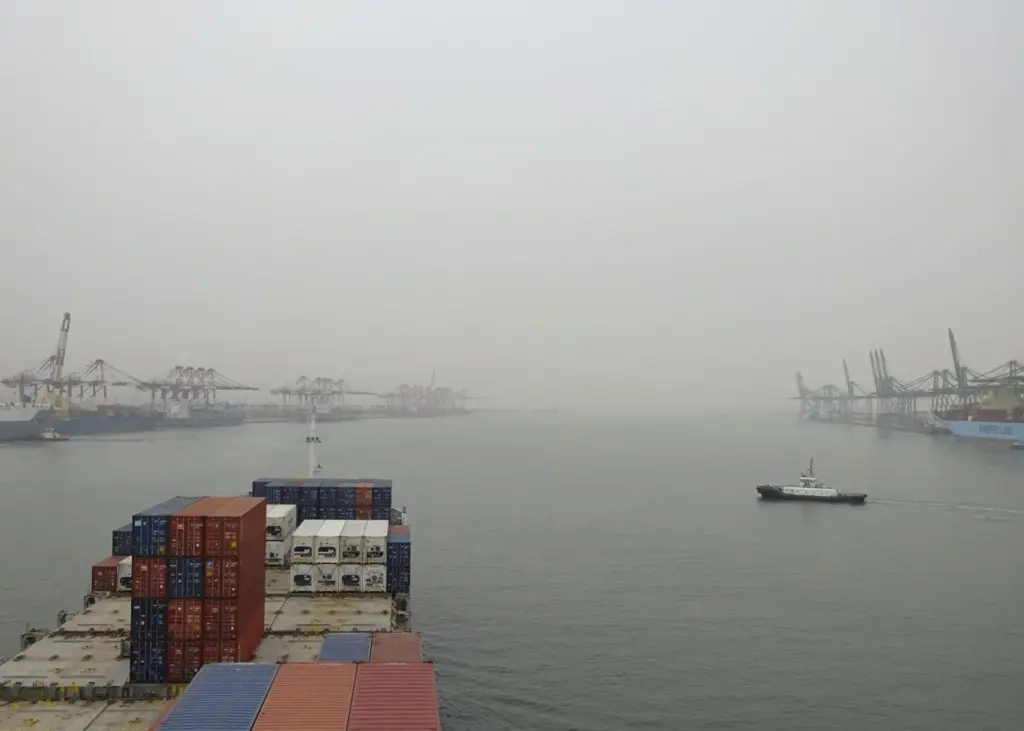
“While it might sound like a joke”, explains Jason Chiang of RHDHV, China’s Bohai Rim, home to the Beijing administration, needs an external transhipment point because four months a year it’s smothered in fog. “The larger ships, in order not to get stuck, prefer to tuck into Busan, Korea, and use feeders to tranship into the Bohai Sea.”
This geophysical characteristic “makes Busan transhipment a useful barometer of northern China trade”, says Mr Chiang, because any analysis of Chinese port figures has to deal with other forms of fog.
According to some industry sources, China’s Bohai Rim ports figures are being toyed with: inflated import values have been a way for private wealth to move its money offshore: it’s a big enough issue that despite a crackdown the practice is still muddying the figures.
It’s not helped by China’s longstanding practice of keeping the Yuan artificially low. While this came at a cost to its domestic consumers’ buying power, it helped Chinese manufacturing keep the edge over other economies’ products. While its own domestic consumption slowed, the big northerly ports of Qingdao and Dalian continued pumping in ore and coal and pushing out cut-price steel, flooding the international market like there was no tomorrow.
However, tomorrow has finally arrived. A change in policy, forced at least in part by a barrage of protection measures from the US, Europe and India have meant that China is now pulling back on the north’s steel manufacturing and closing down many of its plants. As a result, Mr Chiang expects Qingdao and Dalian’s cargo to be impacted – along with Tianjin’s container volumes.
Masking the truth
But, a recent flurry of activity has camouflaged the overall trend. It’s been driven by China’s willingness to play on its own: its stockpiling suggests it’s barricading itself against spikes in prices, especially where the market can be prodded into retaliation for China’s transgressions around the South China Sea.
And of course, the recent peaks have been given impetus by the Trump presidency and his tough talk around trade. Whether or not it is anything more than just “talk”, Mark Yong of BMT Asia-Pacific notes that there’s been a commodities splurge: “People have been rushing to buy up raw materials before Trump can levy a high-duty tax, so while the container trade is still dire, ports have seen bulk shooting up.”
All this has a roller coaster effect on the ports which are dragged along in the wake of these initiatives and the accompanying, speculative buying sprees. The end of the party often leaves the ports with huge stockpiles to deal with: according to the media, the end of November saw ore facilities’ inventories climb to the highest seen since September 2014.
While Chinese reserves now cover a broad spectrum of commodities – it’s now sitting on two-and-a-half years’ worth of oil – it’s still vulnerable to grain prices. “China makes everything… apart from enough food,” explains Mr Chiang, adding that the recent, blocked attempt by Chinese investors to buy up one of Australia’s huge grain co-operatives for around $250m is an indicator of how far they are willing to go: “Food security has become a big issue,” he adds. Therefore, grain facilities may well come under the spotlight soon, although he adds “it won’t make up for the dip in steel throughput”.
Look south
Meanwhile, the old industrial powerhouse in the south of China is changing.
First of all, Dr Yong explains that the Pearl River Delta region has been slowly, steadily losing its lower value goods like garments and footwear to places like Vietnam, Cambodia and Bangladesh “where wages haven’t yet risen dramatically”.
Does China care particularly about the slow bleed of low-cost manufacturing? Not at present says Dr Yong. This is because the area has steadily moved up into technology items like Foxconn’s iPhone components, but growth is slowing and both he and Mr Chiang point out the change in cargo will eventually knock the ports – after all, these prestige goods just aren’t as bulky as the previous output, and that will make a difference to the volumes even if the values keep rising.
Hong Kong’s downturn, however, has been more dramatic. Not that long ago it was one of the top three busiest container ports in the world and the only real transhipment facility for the Pearl River Delta. Unfortunately, it got a name for congestion and then suffered horribly from a long series of strikes. As a result, much of its cargo was rerouted – some to Shenzhen – and just didn’t come back. Dr Yong adds that while recent figures have seen a rebound at one point “a few Hong Kong operators said that they saw container volumes fall by as much as a third”.
And the future holds yet more challenges for Hong Kong: there’s the potential lifting of the mainland’s cabotage restrictions which up until now has handed the port a distinct advantage, worth, some say, around 2.4m teu in transhipment volumes. However, it’s not just a higher cost stopover than Shenzhen, some people have also noted that Hong Kong has fallen behind on ‘ease of business’, a much more intransigent issue.
Power of Pearl
Having said this, both Shenzhen and Hong Kong have lost cargo to vessels calling direct to the Pearl River Delta’s chief ports like Guangzhou, says Mr Chiang. Guangzhou has been opening up to direct calls for a few years now and since the port is closer to the region’s manufacturing base than either of the other two, competition is heating up.
Guangzhou, which has been growing at something like 5% compared to the negative figures recorded by its neighbours, is also now looking at a US$415 fairway project and raising capacity to make its Nansha box terminals more attractive to international shipping. Moreover, it’s headed for public listing to accelerate development.
However, there’s a potentially bigger, broader issue boiling away on the back burner. Both Dr Yong and Mr Chiang point out that while China’s economy is still growing – and at twice the rate of the rest of the world if the figures are to be believed – it may suffer a “corrective”.
“China has something of a bubble problem,” explains Mr Chiang, and, he adds, it looks a lot like the situation in the US just before the sub-prime mortgage collapse. It’s a situation fuelled by a dearth of real investment opportunities – and although the economy survived the last dramatic stock market collapse a year ago, he adds that if it involves the housing market the effect this time could be far more traumatic.
And though a crash might not go ‘the whole 2008’, the fall would certainly bring China’s port volumes toppling down.
BUSAN DOWN, BUT FAR FROM OUT
Busan port’s winning streak, along with Korea’s self-image, recently took a sizeable knock: “This year is the first time we’ve seen the port of Busan’s figures drop in a very long while,” says RHDHV’s Jason Chiang. In fact, 2009 aside, the port’s had an unbroken run since 1980.
But then came the explosive issues surrounding Samsung’s Galaxy Note 7 – the firm that holds the largest slice of Korea’s national pride. This was closely followed by the Hanjin Shipping collapse, which, says BMT Asia Pacific’s Mark Yong, left around $14bn’s-worth of cargo “scattered all around the world”. The resulting financial earthquake shook both the port and Korea’s economy as the line accounted for over 500,000 teu of Busan’s throughput, prompting some local commentators to predict large-scale layoffs.
It was bad timing. Busan had been focusing on weaning itself away from reliance on Chinese gateway traffic, especially when it became apparent that the big ‘powerhouse economy’ next-door was losing impetus: certainly, Korean exports to its largest market have been in decline for over a year now.
Further, while Busan rolled out a number of incentives to other customers, according to the Korea Maritime Institute (KMI) these haven’t necessarily had a huge impact. KMI also warned 356,000 teu of Busan’s volumes could soon fall foul of the new OCEAN and THE Alliance reorganisation, not including the drop if 2M and beleaguered Hyundai Merchant Marine also leave, although this seems less likely.
However, KMI is clear neither port nor government is out of ammunition by any means, and both could work together to “reabsorb” some of those lost volumes – and it seems others agree. December saw DP World unexpectedly increase its share of Busan Newport (responsible for around a third of the port’s throughput) to 66% by getting Samsung’s slice for $250m.
Related Articles
 CONTAINER & CARGO HANDLING
 TERMINAL OPERATIONS
 EQUIPMENT