





Continental’s super elastic solid tyre
Tyre manufacturer Continental has added recovered carbon black (rCB) to its newly produced Super Elastic solid tyres at its tyre plant in Korbach, Germany.
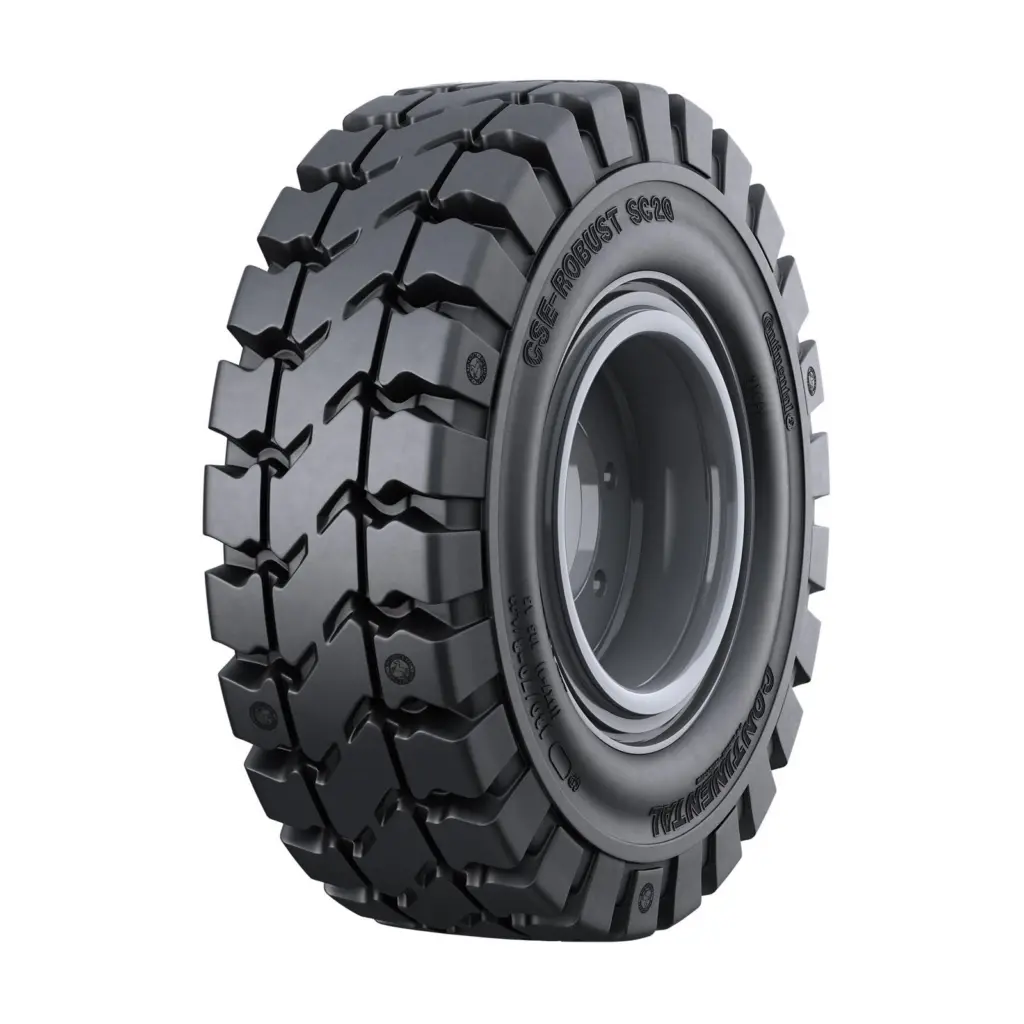
This process reduces the use of fossil raw materials and CO2 emissions, which means solid tyres such as Continental’s SC20+ utilise around 60 per cent renewable and recycled materials thanks to a naturally high rubber content.
The recovered carbon black is supplied by Pyrum Innovations, one of Continental’s partner companies. Pyrum breaks down end-of-life-tires into the individual components in industrial furnaces using a special pyrolysis process. This allows valuable raw materials contained in end-of-life-tyres to be extracted and recycled.
Moreover, solid tyres have a high load capacity and are extremely stable, puncture-proof, maintenance-free and highly economical. This means they are ideally suited to be used in material handling applications in conjunction with forklift trucks, heavy transport vehicles, side loaders, platform trucks and other port equipment.
Matthias-Stephan Müller, Product Manager for material handling tyres in Continental’s Specialty Tyres business area, offers further insight: “Sustainability is becoming increasingly important in the specialty tyre segment. Our Super Elastic solid tires combine low rolling resistance, long service life and a comparatively high proportion of sustainable materials.”
Many forklift trucks are powered electrically. The range and charging times of the battery employed are therefore important. Tyres with a low rolling resistance can help to keep the energy consumption of electrically powered forklifts low and thus contribute to improved vehicle range.
The rubber compound is crucial for high energy efficiency and therefore low rolling resistance, as valuable natural resources can be saved and the energy consumption of special vehicles reduced.
Müller elaborates: “Our customers want to make their operating processes even more environmentally friendly, resource-saving and efficient. Forklift trucks, for example, are required to do more work in the shortest possible time. This means moving heavier loads and traveling further distances at higher speeds. This is where Continental comes in with its customised tyre solutions.”
This latest move is part of Continental aiming to use 100 per cent sustainable materials in its tyre products by 2050, at the very latest.
Related Articles
 TERMINAL OPERATIONS
 DIGITAL
 DIGITAL