![PortStrategy[GreenPort]](https://www.portstrategy.com/wp-content/uploads/2026/09/PortStrategyGreenPort.svg)


FUTURE FUEL PROOF
Interest in clean fuel terminal tractors is building fast. New designs, ongoing R&D and extensive testing are all part of the picture as John Bensalhia reports
“We believe there must be alternatives as even if the technology in electrifi cation is in place, there are still operations, locations and situations that need alternatives without compromising eco-friendliness.”
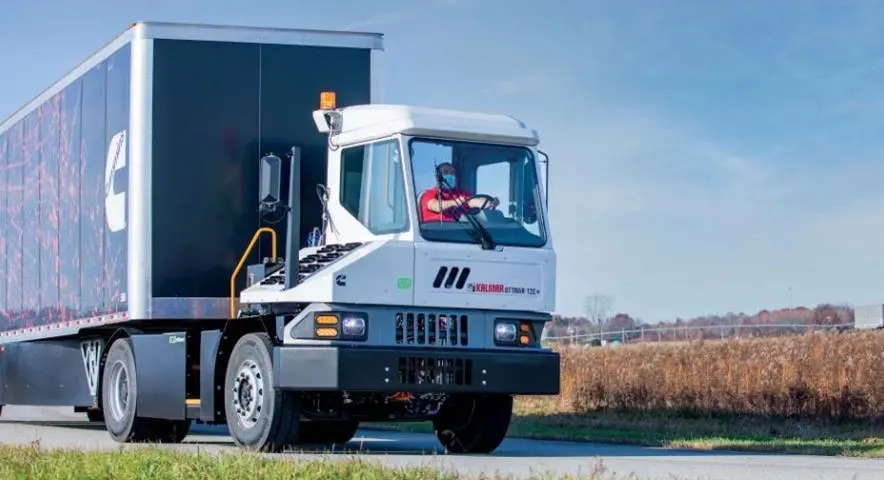
Niclas Samuelsson, Product Manager, Terminal Tractors, Kalmar, explains that Kalmar’s offering roadmap always looks ahead. At the present time, the company is preparing terminal tractor concepts in several areas spanning from natural gas solutions, alternative lower CO2 traditional fuels as well as fuel cell technology.
Kalmar’s clean fuel ethos is one example of modern manufacturers providing environmentally-friendly terminal tractor alternatives to conventional fuel.
Kalmar Terminal Tractors have been providing clean fuel alternatives for a number of years. Following on from the first-generation electric terminal tractor, launched in 2018, in 2021 the second generation was introduced with several improvements.
“Prior to the fully electric alternatives, we had different offerings including natural gas alternatives,” notes Samuelsson. “In addition to this, we offer competitive fuel guarantees to our existing heavy range classic diesel-powered units.”
The growing popularity of zero emission electric vehicle choices is further highlighted in Gaussin’s ATM 38T model. This recently passed the one-million-kilometre milestone since its launch. It is reportedly particularly seeing increased usage in European and American locations.
The engine supplier sector is also ‘putting its shoulder to the wheel.’
Cummins Inc. has recently unveiled its PowerDrive 8000 terminal tractor EV powertrain system, which will go into production in early 2023.
“We introduced this product in December 2021, and we’re working diligently with OEMs to bring it to market,” says Katie Zarich, Director, On-Highway Communications, Cummins Inc.
Cummins has also begun demonstrating a field test unit with Kalmar, and reports that field testing with TICO will begin soon. “The purpose of these tests is to verify that our power systems are working reliably and are capable of handling the duty cycles and demands of the terminal tractor application,” underlines Zarich.
CLIMATE GOALS
Terminal operator Hamburger Hafen und Logistik AG (HHLA), is a prime example of a cargo handling business that aims to achieve climate neutrality.
HHLA has set itself the target of achieving this by 2040 and is pursuing the introduction of a number of new generation equipment designs as part of this. In the terminal tractor sector the company is to take delivery of a Hyster design later this year powered by Nuvera fuel cells. This will run on hydrogen fuel produced locally at the HHLA Hamburg Green Hydrogen Hub.
Georg Böttner, Head Executive Board Projects, HHLA, explains that the results of the Clean Port and Logistics Programme (a joint initiative of HHLA and other European companies) will be the basis for a possible scaling up of further zero-emission hydrogen-powered port equipment.
“This is a part of our ‘H2Load’ project that was selected by the German government as one of the Important Projects of Common European Interest. This initiative is a further step as we help lay the foundation for a strong hydrogen economy not only in Hamburg, but elsewhere in Germany and Europe,” explains Bottner.
No less enthusiasm is shown for the modern alternative of the electrified powered platform by Cummins
“EV powertrains have zero-emissions and instantly reduce the carbon footprint in busy port, terminal and distribution sites against their diesel counterparts,” says Zarich. “EVs are also significantly quieter, enhancing driver comfort and reducing noise in busy environments and localities where people work and live,” she points out.
In terms of efficiency, the EV has immediate power and instant torque compared to a traditional engine transmission. “This combination gives operators the ability to move loads/get work done faster.”
“Terminal tractors spend a significant portion of their time engine idling, which is mostly wasting fuel. An electrified powertrain will make the vehicle more energy-efficient.”
The Kalmar fully electric battery powered terminal tractor is a direct drive solution with no gearbox. Samuelsson points out that this means considerably fewer moving parts and allied maintenance.
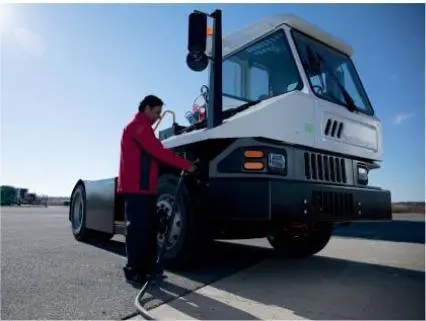
“With one robust electric motor in the electric powertrain, we cover most existing duty cycles and applications without compromising productivity or performance. With two different charging solutions available, with charging capacities of 24-180kW (152kWh or 184kWh batteries), we can optimise the charge pattern to meet the customer’s needs. With the DC fast charge system, there is also the opportunity for really fast charging to not interfere with daily routines.
“The maintenance cost is lower and productivity the same, while improving the driver comfort with silent and clean operations.”
EXTENSIVE TESTING
Modern day clean fuel tractors are being put through their paces in extensive trials. Terberg, for example, has trialled its hydrogen-powered terminal tractor at both the Ports of Rotterdam (October 2020) and Antwerp (May 2021). Rob van Hove, Managing Director, Terberg Benschop, notes that the ultimate goal is to “offer excellent performance for heavy duty applications combined with favourable Total Cost Of Ownership (TCO).”
“We want to support our customers in achieving their sustainability goals. Our strategy is focused on providing flexibility to our customers, so they can adapt to their changing market environment,” he adds.
Gaussin’s first hydrogen-powered heavy-duty tractor, the APM H2 75T was tested at the Montoir-based Multipurpose Cargo and Container Terminal (MCCT) in Spring 2022.
“Our mastery of hydrogen technology enables us to tow 75 tons of goods while consuming about 10kg of hydrogen per day, for the first time in France,” notes Christophe Gaussin, CEO, Gaussin. “We are proud,” he adds, “to carry out this test with Terminal du Grand Ouest, which is emblematic of French port activities, and we look forward to rapidly deploying this technology on a large scale.
”From a cost perspective it is widely acknowledged that the first cost of clean-fuel terminal tractors is higher than existing diesel solutions. Against this reality, however, Samuelsson makes the point that lower maintenance and running costs are major attributes of the new clean fuel alternatives that go a long way towards compensating for the higher initial investment. Further, this reality prevails while the machines generate zero emissions over their respective lifetimes. “With next generation technology,” elaborates Samuelsson, “this equation will be even more beneficial.”
Kalmar suggests its second generation of electrically powered terminal tractors represents a step forward in terms of helping improve the eco-efficiency of their customers’ operations while maintaining the highest levels of productivity and safety.” In addition to the strong eco-benefits a range of other improvements have been made to the second generation for example charging time is cut in half. “Our first big change has been to incorporate a DC FastCharge System, which has allowed us to cut charging time in half,” elaborates Samuelsson.
“We have also removed the transmission from the driveline, moving to a direct drive solution where the electric motor powers the drive axle, reducing the complexity of the driveline”
Also highlighted is the ability to operate in extreme temperatures. “We have included an Active Thermal Management System, which will allow your electric terminal tractor to operate optimally at full power in extreme temperatures.
”Cummins, from its perspective as an engine producer, speaks in a similar vein. It states it is well-positioned to enable OEMs and fleets to enter the EV space with reliable, competitive EV powertrain solutions. And Zarich points out: “Our EV powertrains for terminal tractors will allow end users to take advantage of vehicle purchase incentives, reducing the initial purchase price gap between conventional (diesel, ICE) and EV solutions. Furthermore, our EV powertrains operate more efficiently and require less maintenance over time compared to traditional ICE solutions, resulting in lower operating costs.”
AUTOMATION INTEGRATION
In an interesting initiative, Hyster has recently teamed up with Capacity Trucks in order to work on terminal tractors that not only run on electricity and hydrogen, but additionally are automation-ready. Prototypes of these were trialled in 2021.
Willem Nieuwland, Big Truck Program Manager, Hyster, notes that the company has been working on unique zero-emissions container handling equipment for ports that incorporate lithium-ion battery and fuel cell technology. “However, we are now ‘extending the family’ and bringing these benefits to more equipment types to support total green operations from ship to store.”
The introduction in December 2021 of the Kalmar Robotic Portfolio is similarly seeing the progressive roll-out of a future range of intelligent, flexible and autonomous mobile equipment solutions designed to improve safety and eco-efficiency without compromising productivity.
“One of the products included in the portfolio is Kalmar RoboTractor – an autonomous terminal tractor,” explains Samuelsson. “Kalmar is developing the RoboTractor solution in partnership with Coast Autonomous, an autonomous driving technology start-up based in California, USA.
“Our ambition is to develop safe and autonomous, self-driven solutions that can operate in mixed traffic where it is not always possible to segregate the working area with fences. The portfolio will eventually be available for different customer segments including ports and terminals, industrial sites and distribution centres. All the above will be integrated into the existing clean fuel terminal tractor designs, as we see a clear benefit combining, for example, electric powertrains with remote control or automated operations.”
Related Articles
 TERMINAL OPERATIONS
 DIGITAL
 DIGITAL