



THE POST COVID-19 NEW WORLD
Andrew Penfold of Mundy Penfold Ltd looks at the current COVID-19 pandemic and asks whether it will ever be business as usual for the container industry.
Economic growth and, indeed, world trade are the driving forces for the port sector. This is especially noted in the consumer and semi-manufactured goods that drive containerisation.
We are now faced with a period of uncertainty that is unprecedented. The container sector that emerges from the crisis seems certain to be quite different from what we have known for the past twenty years.
It seems likely that core assumptions will need to be reconsidered before globalisation is back on track – if this is still a realistic prospect. The potential depth of the downturn remains unclear, but the impact on container trade and, therefore port demand, will be profound – even if we have a V-shaped recovery.
From the current perspective (mid-April), this looks like the ‘Blackest Swan’ event that we have seen.
ANY PAST PRECEDENTS?
There are several ways of looking at this. In strict terms of economics and trade growth it is possible to look at past crises and see how their recoveries progressed and try to assess what this might mean for the COVID-19 situation.
In terms of economic output, the hit remains unclear. Various agencies have placed this at between two and three per cent of global output – but it will be the pace of recovery that is the main uncertainty.
There are two key peacetime situations where a very steep contraction at the global level was noted. These were the first Oil Shock in the early/mid 1970s and – probably more relevant – the Global Financial Crisis.
The current anticipated GDP contraction is much steeper than in either of these cases. The oil shock saw a stagnation and then limited contraction over 1974-75 which resulted in a trade contraction of around 2.7 per cent. Despite the economic dislocation, and resulting inflation, recovery was swift.
The Financial Crisis saw a steeper decline in GDP and a much sharper drop in trade. Here, too, recovery was swift. Prompt policy responses ensured the downturn was V-shaped.
We don’t know how deep the current problems will be – nor their likely duration. Two cases are assumed:
Case A sees a contraction in trade of around 23 per cent this year, with further limited contractions noted in 2021. In terms of global output, 2019 levels will not be reapproximated until the mid-2020s. This is the real nightmare scenario.
Case B assumes a sharp contraction this year of around 11 per cent, with some renewed expansion in 2021. This V-shape entails severe trade damage but looks more like the fallout from the Financial Crisis twelve years ago. These comparisons are summarised in Figure 1.
IMPACT ON CONTAINER DEMAND
Our container model has been revisited under these revised macro-economic conditions in order to provide a general overview of the scale of anticipated impacts. Of course, these will vary on a case-by-case trade basis, but the overall magnitude is of immediate interest.
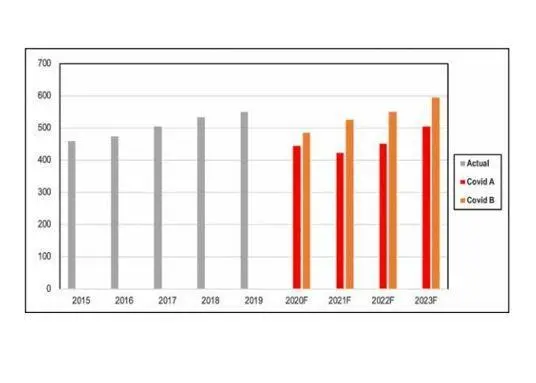
Focusing exclusively on global import/export demand (i.e. netting out transshipment) the COVID-A case sees a contraction of around 19 per cent in global container port volumes this year, as Figure 2 shows.
The depth of the problems spill over into 2021, with further more limited contraction. Renewed growth commences from 2022, but total volumes do not reapproximate 2019 levels (550 million TEU) until 2024-2025. This represents a complete dislocation of the container sector.
The COVID-B case – although still severe – generates a decline of around 12 per cent this year with some recovery noted in 2021. By 2022, total volumes have reached 2019 levels once again.
Initially, negative effects will be focused on the major arterial trades – Transpacific, Asia-Europe and Transatlantic – but all trades will be impacted as the developing markets see lower investment and weaker demand.
CAN WE RETURN TO ‘BUSINESS AS USUAL’?
Aside from these severe volume impacts it seems certain that structural changes will be noted. Let’s take a look at these.
Perhaps most importantly, the supply chain reliance on remote manufacturers will be further re-examined. This was already underway with regard to China ahead of COVID-19 but it is clear that OECD countries will be increasingly reluctant to place supplies of strategic goods in China. Although now well established, Chinese market share will be revised downwards.
At the same time, the advantages of Chinese manufacturers were already under review ahead of the crisis as costs have increased. Attention was turning to alternate suppliers with low cost structures – Indonesia, the Philippines, Vietnam – and it seems certain that these pressures will intensify.
There will be great pressures to repatriate manufacturing nearer to OECD consumption and this onshoring process will accelerate. From this perspective protectionism will be revitalised.
So, two key outcomes will be a reduced reliance on distant trade suppliers – especially in key strategic sectors – and a redistribution of these suppliers away from China to other Asian countries.
IMPACT ON THE PORT SECTOR
Much of the port and shipping investment of the past ten years has been predicated on ‘Megamax’ vessels serving the Chinese export trades to Europe and North America.
If these volumes decline, there will be an overcapacity of large vessels and a lack of suitable port capacity in alternative Asian exporters. It seems likely that in the medium term this will see increased reliance on transshipment hubs in South and Southeast Asia until port investment catches-up in these new suppliers.
The level of uncertainty will remain very high and it will become more difficult to secure funding for port investment. A more fragmented industry is the likely outcome, with the emphasis switching away form the largest scale ports and vessels and a more regional integration of supply chains.
Port investors have become used to regular and sustained increases in demand but the key assumptions driving this will need to be reconsidered. Within a sharply smaller market, optimum investment will become critical as the structure of world trade is revised.
It seems unlikely that the container market will return to ‘Business as Usual’. Although these are early days and the emphasis is now (rightly) on short term survival, it is vital that the current changes are considered at the highest levels and a reappraisal of key assumptions is undertaken.
It is not just a matter of contraction followed by recovery but, rather, an examination of the new world that will emerge from the crisis.
Related Articles
 NEWS
NEWS
 CONTAINER & CARGO HANDLING
 OPERATIONS