Digital twins are rapidly expanding within the ports sector.
SECTOR ANALYSIS: DIGITAL TWINS: “THE LOGICAL NEXT STEP”
While a relatively new concept, digital twins – which are a digital representation of the physical port or terminal - are a way for terminals to achieve increasingly stringent targets, from optimising operations, increasing efficiency and automating, to deploying clean fuels. The below company by company reviews highlight the traction that the sector is gaining right through from the launch of start-ups and the increased focus by established companies on creating digital twins to a range of pilots and government-funded projects taking place in terminals. Many port sector companies have embraced the digitalisation trend, deploying real time data solutions to boost their efficiency and decarbonisation efforts. Maritime data solution company Sinay underlines that digital twin technology is the “logical next step”, taking complex data and making it comprehensible, and therefore enabling ports to act on it. A key component of the ‘smart port’ concept, as the below records, ‘digital twin’ is not just a buzz phrase but has real meaning.
DATA ANALYSIS, PROJECTS, PILOTS AND COMMISSIONS
Aerogility: See previous article in which the company notes: “The potential of digital twins for ports goes beyond immediate benefits. As the technology matures, ports and terminals can expect a wave of sophistication that transforms their respective business sectors.”
DockTech: Israeli-based start-up DockTech has launched digital twin technology to help improve freight movement throughout the global port system. DockTech offers the real-time status of waterway conditions, leveraging artificial intelligence (AI) and dynamic data, by creating a digital twin. By collecting and aggregating dynamic data from existing sensors located on tugboats and harbour vessels, the company can show real-time operational insights about the waterway concerned. Some of the benefits DockTech is said to deliver for ports include a reduction in dredging costs by helping decision makers understand both when and where they need to survey and when and where they need to dredge in order to reduce maintenance interruptions. The digital twin also has a role in critical decision making regarding draft restrictions. More than 25 ports are using DockTech solutions, including those in Brazil, Columbia and the US.
DSP Talumis B.V. DSP Talumis B.V developed its first product in 2021: the GEMINI digital twin. The company was born from the synergy between DSP Data and System Planning SA, Switzerland and Talumis B.V., the Netherlands. GEMINI is a digital twin capable of mirroring decisions and strategies of container terminal operating systems’ (TOS) algorithms and modelling all other sub-systems’ behaviour and worker practices during real operations. A modular solution, it provides data analytics and forecasting, resource demand and TOS algorithms optimisation. The company says that it enables operators to predict and measure resource capacity and demand, allowing them to avoid over or under allocation of resources. The company joined forces with Cosco Shipping Ports (Spain) Valencia Terminal to cooperate in building the digital twin. Gemini Predictive Analysis supports the port operation’s decision making in resource assignments and analysis results. GEMINI is also used by DP World as an online tool for yard planner training.
Ericsson: Ericsson has worked with partners in the maritime industry to improve efficiency since 2016. One of these projects involves Italy’s Livorno port terminal, which now serves as an experimental area covered by a live 5G network. The data collected through 5G feeds a digital twin engine, developed and deployed by Ericsson, which provides a virtual replica of the port area in real time. Having the port area and the general cargo freight cloned in the digital twin makes it possible to provide operators of the terminal with smart virtual reality (VR) and augmented reality (AR) applications. The VR application allows operators to virtually navigate inside the digital twin model. Ericsson has also deployed a specific algorithm which makes it possible to achieve an automated and optimal sorting of freight and enable a quality check by inspecting the storage area and yard virtually from a remote site. This pilot is expected to bring significant benefits including reduction in the average execution time of moving an object with a forklift as well as a decrease in the unloading/loading times of a general cargo ship.
GE Vernova: GE Vernova’s Power Conversion business, as part of the UK’s Clean Maritime Demonstration Competition, has been working on reducing emissions at ports by helping to manage power and energy more efficiently. With project partners PD Ports Ltd, Connected Places Catapult and Teesside University, Power Conversion’s cloud-based, integrated digital concept aims to improve situational awareness on energy supply and demand. PD Ports’ data has enabled the team to create operational scenarios to carry out testing using an emulated digital twin platform. Andy Cooper, UK Managing Director, Power Conversion, notes: “Industry is investing in ‘clean ship’ and ‘clean port’ technology readiness, but it’s really important we work with customers on their operational needs if the path to net zero is to be viable.” Digital energy management is part of Power Conversion’s range of port electrification solutions.
GISGRO: GISGRO was formed on the back of noticing that customers were struggling to use 3D data when it was formerly surveyor VRT Finland Oy. The company realised that its customer ports did not have suitable systems or the expertise to use the data. Therefore, GISGRO was established and its solution was a visual digital twin. As well as a visual and intuitive user interface, GISGRO wanted to develop a cost-effective SaaS software for all sizes of ports and terminals, which was easy and quick to deploy and use even for non-technical employees. All information recorded or integrated on GISGRO, plus the sensor data, can be found by clicking a ‘real-world’ geospatial location on the online digital twin. With Lean visual management, teams can provide a situational view of processes and communicate information across departments. GISGRO sums up: “By making information more visible, teams work more efficiently and with fewer human errors.” From its launch in 2010, in 2023 GISGRO is now in use in 50 ports in around 12 countries.
Huawei: Huawei announced plans earlier this year to collaborate with Tianjin Port Group to build a digital twin of the Chinese terminal. This cooperation builds upon the two companies’ existing partnership, which has boosted the port’s digitalised and automated processes. Tianjin Port Second Container Terminal has used Huawei’s Smart Horizontal Transportation Solution to build a smart port powered by 5G and L4 autonomous driving. The digital twin can build upon the solution and 5G telecommunications structure being deployed.
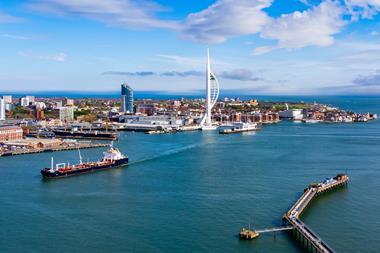
IOTICS: Portsmouth International Port announced in September this year that it has been awarded £19.8 million from the Zero Emissions Vessels and Infrastructure Competition, funded by UK Government to embark on the SEA CHANGE decarbonisation project. At the heart of it is the digital twin concept, created by IOTICS and its partners. The SEA CHANGE project will design, build and operate a shore power system across the three busiest berths at Portsmouth International Port. The digital twin will interoperate existing and emerging data from the port and its activities and gather information from the working hydrogen electrolyser. This data will be leveraged to enhance and optimise operations with decision-support tools. Sophie Peachey, Head of Customer Success, IOTICS explained the digital-twin approach in the project: “We will be looking at the business case for deploying renewable and clean fuels as well as the logistics of how onshore equipment as well as sea-going vessels will be refuelled around the ongoing operations of a busy port.” IOTICS was founded in 2012 and provides interoperable technology, including digital twins.
Moffat & Nicholl: In January this year it was announced that Port Esbjerg had commissioned a digital twin for deploying offshore wind installations. By using the digital twin, the port can triple its annual shipping capacity for offshore wind installations from 1.5 GW to 4.5 GW within three years. “This means that we can increase the pace of the green transition because we use the space we have more efficiently,” says Dennis Jul Pedersen, CEO, Port Esbjerg. Ports and maritime engineering consultancy Moffatt & Nichol developed the digital twin, which is fed data on everything from upland storage space and berth characteristics to the port’s experience with shipping offshore wind installations gathered over the past twenty years. The programme then runs modelling simulations with variables including on and offloading times and weather-induced down times. Moffatt & Nichol has also developed digital twins for other port processes elsewhere, such as container transport.
Sinay: Sinay has partnered with Canadian technology and software company 3D CityScapes to create hyper realistic digital twins and interactive 3D environments for ports and the maritime industry. 3D CityScapes offers the digital twin as a component to Sinay’s technology and sensor data information. Sinay’s data is represented on the interactive digital platform created by 3D CityScapes, providing ports with a visual platform that allows them to see in real-time what is happening throughout the entire terminal.