



The whole solution strategy to pollution
Seabin Project is a clean tech startup with offices in Australia and Europe on a simple and ambitious mission: To help solve the global problem of ocean plastic pollution and ocean conservation, writes Anaïs Le Lan, head of marketing, Seabin Project.
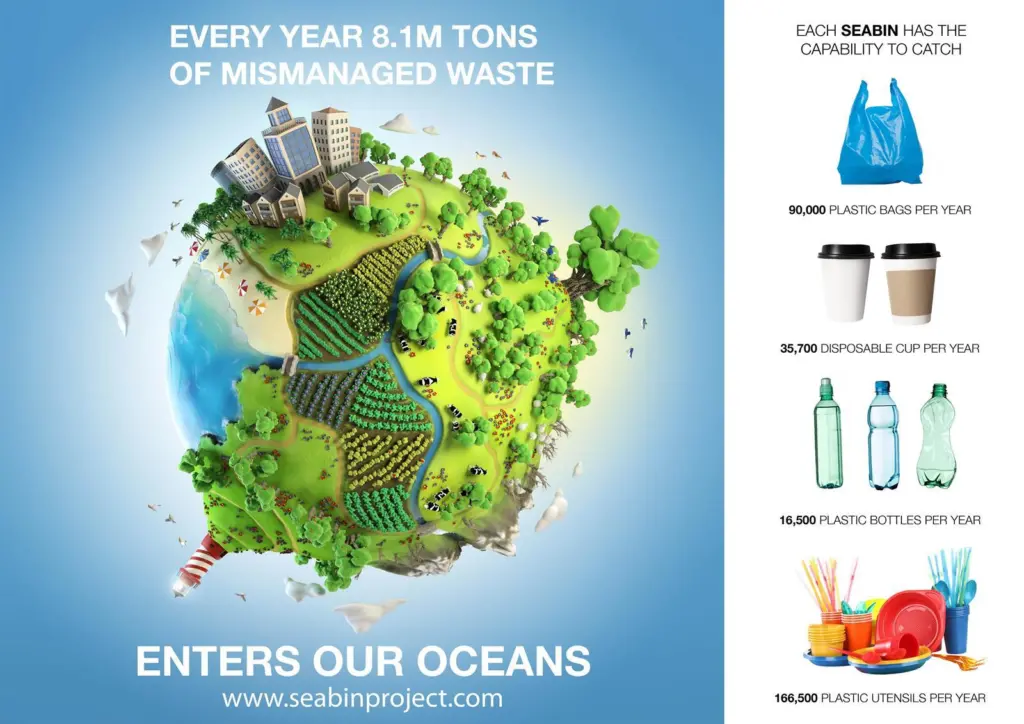
The Seabin Project takes a “Whole Solution” strategy which is a comprehensive approach to achieve sustainable oceans and fight ocean plastic pollution arched around science, technology, education and community.
To help solve the global problem of ocean plastic pollution and ocean conservation, Seabin Project develops innovative upstream solutions for cleaner and more sustainable marinas, ports, rivers, public waterways and ultimately, oceans. Its latest innovation, the V5 Seabin unit, is a floating debris interception device that acts as a marina trash skimmer, maintaining water clean and protecting the environment.
Seabin technologies have the potential to catch mismanaged waste such as macro and micro plastic debris and micro fibres before they have the chance to reach the ocean.
Seabin project
A lot has happened since the Seabin Project went viral in 2015 with over 80 million views of the crowdfunding video accumulated online.
Seabin Project entered the pre-sales phase in November 2017 and so far hasreceived orders from more than 175 countries accounting for more than 2000 units.
The Seabin’s V5 global roll out for pilot partner and crowd funders has already started, and Seabin Project is proud to announce that the Seabin technology is already present in more than 11 countries.
Each Seabin catches on average 1.5 kg per day and with around 2000 units on order, this results in a 3.5 tonne per day reduction of ocean plastics and mismanaged waste in our waterways subsequently being prevented from entering the ocean.
Whilst this is far from the amount of waste entering our oceans everyday, it’s an extremely positive first step in the battle against littering and ocean plastics.
Marine science
The Seabin Project is collaborating with marine scientists. Every Thursday, scientists take water samples and collect nanoparticles and microfibres from Port Adriano in the city of Mallorca where one of the Seabin Project offices is located.
From our pilot partner locations, located in fivedifferent countries, we have been receiving weekly data reports during the six-month trial. “We have a lot of statistics and facts on what Seabins are catching around the world,” says Seabin CEO & Co-founder, Pete Ceglinski.
The most caught item has been cigarette butts, followed by plastic particles and food wrappers. But, there are differences in the catch across countries. For instance, a Seabin in Port Adriano has caught 300 to 500 grammes of debris per day, while a Seabin in San Diego in the US caught five to six kilos of debris.
The team has been trialing oil pads, as well. “After all, Seabin is such a great application to absorb surface oil from the marinas,” says Mr Ceglinski. The initial results have been good, the pads have been collecting oil. Unfortunately, the pads started deteriorating and the team in conjunction with the supplier are working on ways to improve the durability of the oil absorbents.”
New partnership
Mission Blue is a leading advocating a clean, healthy and sustainable ocean for generations to come. Lead by ocean explorer Sylvia Earle “Mission Blue inspires action to explore and protect the ocean.”
The organisation’s award-winning documentary and itssupport for a worldwide network of marine protected areas, inspires an upwelling of public awareness to protect our oceans.
This aligns with Seabin Project’s goals and a new strategic partnership between the two parties will aim at improving the impact of our whole solution strategy, by actively working together in our community, education and research programmes, to work towards cleaner oceans.
Mr Ceglinski says: “We are extremely proud that Seabin Project has partnered with the Mission Blue Alliance, it’s a crucial step for the team as we put great value in any environmental conservation groups input. We will be using this opportunity to further develop the Seabin technology, Educational, Scientific and Research programmes.”
“The Seabins are now successfully intercepting both micro plastics and micro fibres and this is something we need to explore a lot further with groups like Mission Blue.”
Future plans
For 2018, Seabin Project is looking at further applications of Seabin technology and is developing a version that will work on fixed docks and pontoons which will open the door to better plastic capturing capabilities and a wider market.
Furthermore, this will enable Seabins to be installed on canals, lakes and even yachts. Added to this, the project is working towards enabling Seabins to be used in open water by 2025.
The Seabin Project team is currently trialing the use of the Seabin as a sampling method for scientists, so that the waters in ports and marinas can be tested and monitored for their microplastic load.
This has opened the door for the Seabins to capture microplastics; many of them, as microfibres.
After trials are complete, harbours will be able to start collecting microfibres with the project’s new catch-bag.
This comes at a good time as researchers have found Micro Plastics exist virtually everywhere from tap water to table salt and are looking for ways to improve overall water quality.
Related Articles
 EQUIPMENT
 ALTERNATIVE FUELS GREENPORT