


Time to invest in green solutions
Shore-to-ship power is central to helping ports and ships reduce their emissions – as Daniel Radu and Loréne Grandidier from the Shore Connection Team at Schneider Electric Industry investigate.
Tighter pollution regulation
Environmental impact and green concerns are major issues for port communities. Combustion of marine fuels with a high content of sulphur in port areas contributes to air pollution and presents a risk to human health and the surrounding environment. International and local regulations increasingly put pressure on the maritime industries with most focusing on air pollution control. Hence, the International Maritime Organisation has reinforced existing regulations by adding two new tools to the MARPOL6 convention of July 2011 to reduce ships’ CO2 emissions: The Energy Efficiency Design Index (EEDI) and the Ship Energy Efficiency Management Plan (SEEMP).
Both will be mandatory by 2013. In Europe, the debate over the implementation of market-based measures that address maritime transport emissions in the EU’s greenhouse gas reduction commitment has been reopened with the launch of the public consultation in January 2012. In the United States, Californian ports keep investing in shore connection, compliant with the CARB (California Air Resource Board) that impose ships to have this technology by 2014. In Asia, regulations are evolving as well demonstrated by Hong Kong’s Environmental Protection Department wanting consultation studies on the Emission Control Area proposals. China has already included shore connection in its 12th 5-year plan.
Both ship-owners and ports will have to adapt their business and invest in new technologies in order to reduce pollution and be compliant with new regulations. Of the several technologies that are available, the electrical shore-to-ship connection is probably the most attractive seen from both a technical and financial point of view. With this technology, ships can turn off their engines while at berth and use electricity from the grid and so reduce fuel emissions whilst cutting energy bills now that marine fuel oil cost has reached a record high. An international technical standard which will ensure global compatibility for ports and ships is currently being agreed upon.
Meeting the needs of the ports
To meet the new regulations and remain competitive, ports will have to invest in new, green technology that can reduce their CAPEX and OPEX costs. With economic uncertainties and the trend for still bigger ships, port traffic is likely to change. To be able to accommodate the ships of tomorrow, ports will need a modular and upgradeable shore connection solution that can be implemented and operated without disturbing the port’s activities, all the while the technology must be simple and offer improved safety for passengers, ports, and employees.
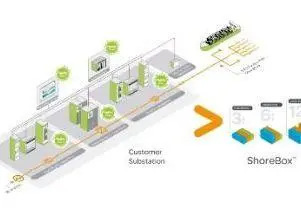
As a global leader in energy management and with over 90 years of experience in the maritime industry, Schneider Electric supports shore connection technology and has developed an innovative solution that consists of a range of standard components designed to meet the constraints of ports and ships. The ShoreBox solution is available with and without frequency conversion technology. All shore connection modules include tested, validated, and documented architectures, as well as products and services.
The ShoreBox solution is installed as a container-housed substation. Several containers can be combined to build a complete and customised solution. Container-housed substations are based on a modular and scalable electrical architecture that is adaptable to the different power needs of the ships and to a variety of port infrastructures.
Our shore connection solution can help reduce ships’ environmental impacts in ports as well as optimise their energy consumption. Energy management solutions track and report all data in real time, giving ports visibility into energy-source selection, forecasts, simulation, metering, and billing. The system also supplies data to improve the environmental performance and calculate the port’s environmental indicators.
Meeting regulations and reducing pollution is often viewed as a constraint. Yet, by choosing the right technology, new regulations can lead to new opportunities. Shore connection systems can lead to fuel, energy, and money savings that will be of benefit to the maritime industry.
As a global specialist in energy management with operations in more than 100 countries, Schneider Electric offers integrated solutions across multiple market segments, including leadership positions in utilities and infrastructures, industries and machine manufacturers, non-residential buildings, data centres and networks, and residentially. Focused on making energy safe, reliable, efficient, productive and green, the group’s 110,000 plus employees achieved sales of €19.6bn in 2010, through an active commitment to help individuals and organisations make the most of their energy.
For further information, please contact your local Schneider Electric representative or go to: www.schneider-electric.com
Related Articles
 ALTERNATIVE FUELS GREENPORT