




YOU WIN SOME YOU LOSE SOME
There was a time in the recent past when South Koreas port of Busan was the regional hub of choice for Chinese export cargo, given a dire shortage of adequate deep water facilities in what is by far the Far Easts most dynamic manufacturing nation. Alex Hughes reports on the shifting dynamics that the countrys ports sector is having to face.
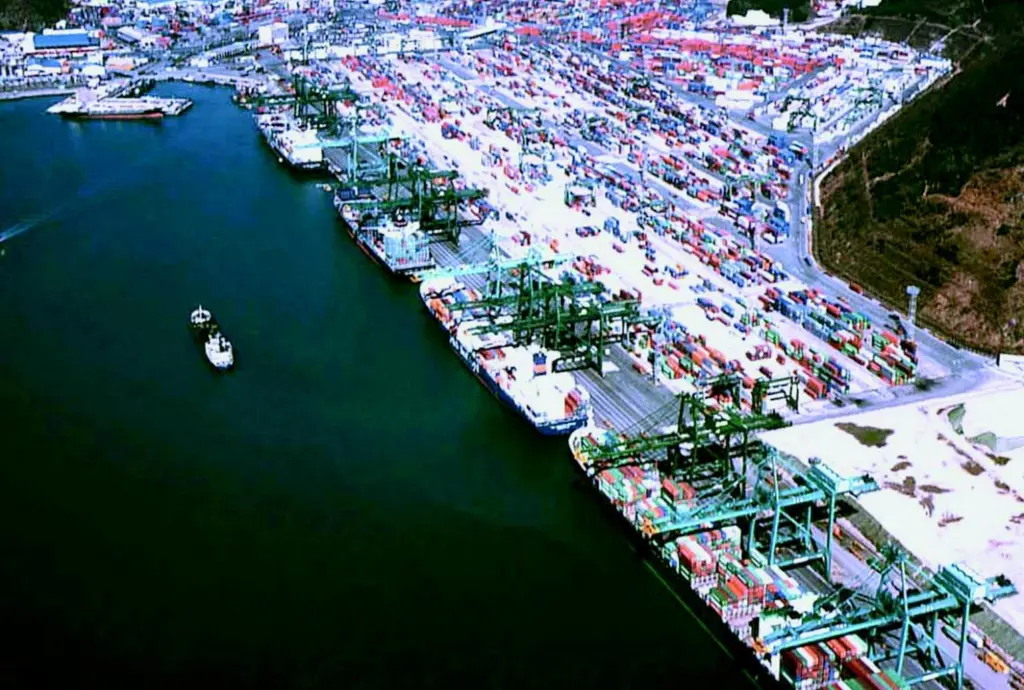
The lure of potential high returns has seen much foreign money being pumped into ports and harbours along the entire Chinese seaboard, bringing infrastructure and service in line with global standards and thereby making it more attractive for carriers to increase the number of direct calls, rather than rotating containers out by feeder to regional hubs.
“The increasing number of direct calls at Chinese ports is undoubtedly having a negative impact on throughputs at Busan, ” concedes H.C. Park, deputy general manager of the port authority’s marketing team, noting that volumes of Chinese cargo handled at the port in 2004 are down just 2% over 2003, although forming part of a very noticeable longer term decline.
“Currently, we are receiving fewer boxes from the deepwater ports of Shanghai and Ningbo, which can accommodate the largest vessels, but trade with the big northern ports of Qingdao, Dalian and Tianjin is maintaining a positive upward trend, ” he observes.
Nevertheless, while Busan may very well see a long term shift towards handling fewer Chinese containers, the port is already positioning itself as a major box gateway for Japan, where an increase of throughput in the region of 25% is being reported in 2004 compared to 2003. This is more than offsetting the loss of trade with specific Chinese ports, since overall transhipment volumes are up 5% on the year.
“Of Busan’s total traffic, 60% is local cargo and 40% transhipment, ” notes Park. “However, of this latter figure, Chinese cargo accounts for 55-60% and Japanese cargo about 30%-35%.
The Japanese are making greater use of Busan because it has proven to be cheaper to tranship cargo through here than make direct calls to mainland Japanese ports. The cost of inland transport in Japan, for example, is very expensive, while current feeder rates out of Busan to Japan are very cheap. Furthermore, the feeder network centred on our port serves no fewer than 60 ports on the Japanese mainland.
As a result, we have high expectations for attracting additional Japanese volumes, which we hope will compensate for the loss of Chinese traffic in the longer term.”
In fact, with worldwide container trade on an ever increasing upward curve, Busan intends to consolidate its position as one of the Far East’s leading hubs. Throughput in 2003 reached 10.36mTEUs, an increase of 9.7% over 2003, while first half figures for the current year indicate 5.7% of additional growth, but with expectations of boosting this to around 8% by end December.
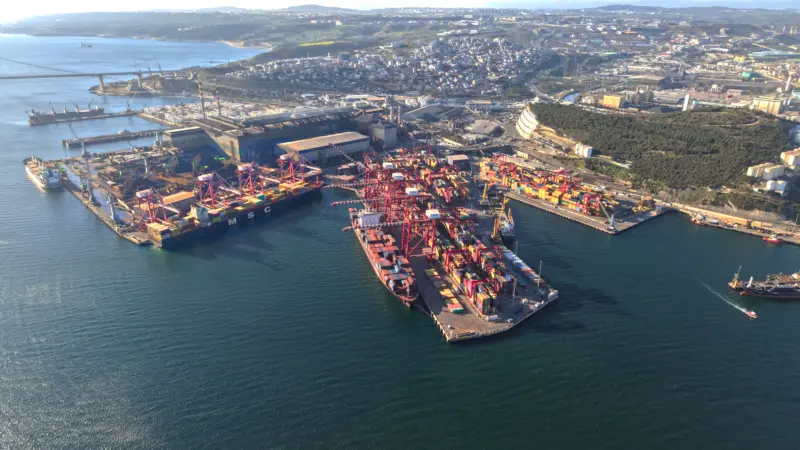
Park insists that currently none of the terminals in the port are suffering from congestion, given that existing infrastructure is capable of handling up to 6.5m TEUs across 21 berths. Productivity is also extremely good, averaging 28 moves/crane/hour, compared to slightly more than 30 at the leading hubs of Singapore or Hong Kong.
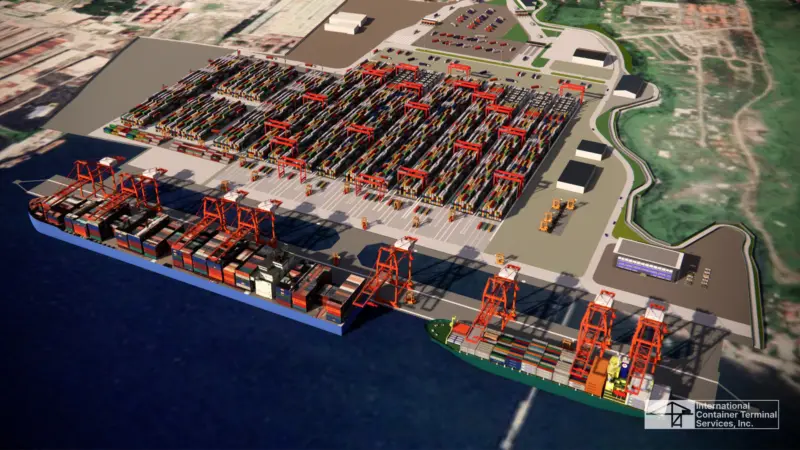
Even in the slightly longer term, Park emphasises that Busan will not become a congested facility. For example, he notes that Shinsundae Terminal is boosting its current quay line through the addition of a 5th berth, which will become available as from 2007, while the construction of Busan New Port goes ahead and should be open in its entirety by 2011.This will have 31,350 metre long berths all of which will be able to accommodate up to 10,000TEU vessels thanks to the availability of a 16 metre draught and the presence of super-post-Panamax cranes capable of spanning 22 rows of on board containers.
“Six berths in Busan New Port will become available as from 2006, with further berths opened in a phased manner in line with traffic growth. The overall capacity of the new facility will be much greater than the existing port, since we eventually expect it to handle much higher volumes, ” explains Park, adding that up to 3m sq metres of logistics and warehousing activities will be accommodated in an adjacent Distripark, which should have a very positive impact on overall transhipment volumes.
Table 1: Busan container traffic by terminal: first half 2003 and 2004
Terminal 2004: 2003: % change Jan-Jun (TEU) Jan-Jun (TEU) Jasungdae (HBCT) 887,002 835,067 6.2 Shinsundae (PECT) 939,079 865,586 8.5 Gamman 1,372,153 1,246,091 10.1 Singamman (DPCT) 437,326 460.758 5.1 UTC 271,417 266.435 1.9 Gamchon (Hanjin) 275,607 250,826 9.9 Conventional piers 1,377,685 1,333,412 3.3 Total 5,560,269 5,258,175 5.7
Related Articles
 CONTAINER & CARGO HANDLING
 TERMINAL OPERATIONS
 EQUIPMENT