

Congestion issues were a thing of the past, but now the North European ports of Rotterdam and Hamburg are experiencing significant traffic, and Drewry says it shows no sign of stopping in the coming months.
The causes of the current congestion are numerous, but poor carrier schedule reliability is high on the list, according to Drewry’s latest Weekly Container Insight.
If ships arrive ‘out of window’, terminal operators may not have a berth available or the necessary number of cranes to handle their cargo efficiently. Drewry says average reliability across all carriers in the Asia-Europe trade lane has declined from 83% on time port calls in mid-2012 to just 51% in the first quarter of 2014.
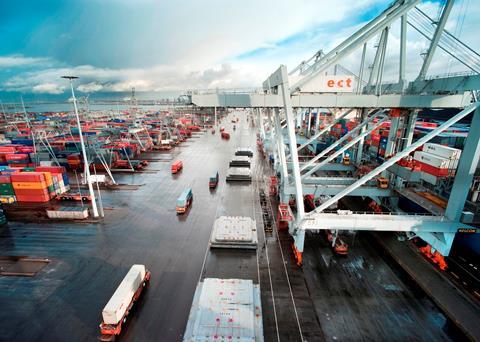
Congestion difficulties are also arising because terminal capacity is being affected by work to infrastructure upgrades, such as installing new cranes at the ECT Delta terminal at the Port of Rotterdam. In general, terminal capacity continues to be strained by much greater peaks in volumes created by larger container ships, says Drewry.
In Hamburg, larger vessels are also causing increased volume peaks, but delays in truck and rail handling are tipping it over the edge. Trucking companies have imposed a Traffic Congestion Surcharge, set at €40 per transport within Hamburg city limits and €80 per transport outside Hamburg city limits. According to the report, the city intends to put a truck booking appointment system in place to control and smooth out demand.
And carriers are reacting. The G6 Alliance is set to move the German call of its transatlantic-transpacific Pacific Atlantic 1 (PA1) pendulum from Hamburg to Bremerhaven due to congestion in Hamburg.
In Rotterdam, feeder operator, Team Lines, has announced delays of up to 48 hours being experienced at the ECT Delta terminal.
But it’s not all bad. Rotterdam has two new deep sea terminals opening later this year, whilst in Germany, Wilhelmshaven remains an under-utilised asset, according to the report.
Now, Drewry says further congestion problems are likely to be seen in North European ports as alliance developments affect schedule reliability. Longer term, it depends on what the “steady-state reliability performance” of the alliances ends up being.