
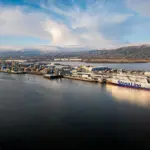

Pioneering solar heat project launched
The first solar concentrator farm in the European process industry has been inaugurated in a port in Belgium.
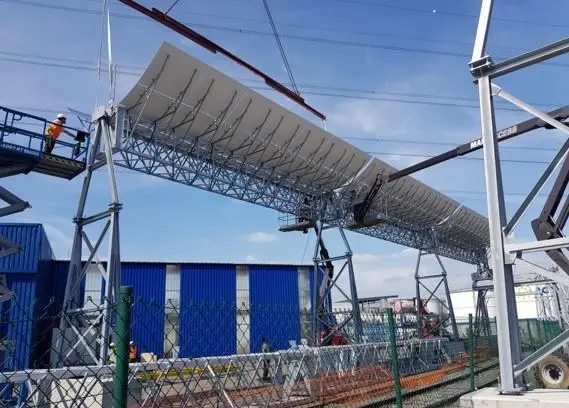
Installed for logistics company Adpo (Antwerp Distribution and Products Operations) by energy company Azteq, as part of a pilot project co-financed by the Flemish government, the farm at the Port of Antwerp will generate eco-friendly heat from concentrated sunlight that can be used by industrial companies. This process is called Concentrated Solar Thermal energy (CST).
Jacques Vandermeiren, CEO of Port of Antwerp, which aims to become a CO2-neutral port, said: “We want to be a testbed for technological innovation that helps us on the way to a sustainable future. I am therefore proud that this promising technology is being tested first in Port of Antwerp.”
Science behind it
CST works by concentrating sunlight by parabolic mirrors and converting it directly to heat. The temperatures reached can be as high as 400°C, thus providing high-grade heat that can be used in industrial processes. The heat can be stored in insulated containers so that it is also available for use at night.
Until now Adpo has used gas to produce the steam that it uses for cleaning and heating tanks and containers. This requires temperatures of more than 140°C, well within the capabilities of CST technology.
The CST farm with 1100sqm of parabolic reflectors will replace 500MWh of gas consumption annually.
The solar reflectors, each 5m long and installed in lines of 120, follow the path of the sun and focus the incident sunlight on collector tubes.
The plant in the port of Antwerp forms part of a project in which three pilot installations with solar reflectors are being set up in Flanders. The three plants in Beveren, Ostend and Genk respectively will generate between 1,390 and 1,260 MWh of eco-friendly heat annually. Between them these plants will cost a total of €1.425m, of which €819,000 is being financed by the Flemish government.
Koen Vermout, CEO of Azteq, commented: “With this technology we aim to decarbonise a significant part of industrial energy requirements by 2030.”
He said that in addition to Flanders there are also plans for projects in the Netherlands, France, Germany, Austria and Spain.
Related Articles
 ALTERNATIVE FUELS GREENPORT
 ENERGY & TECHNOLOGY GREENPORT
 ENERGY & TECHNOLOGY GREENPORT