




Managing dust with design innovation
A terminal at one of Brazil’s busiest ports is successfully managing dust emissions from its grain conveyor system with an innovative transfer chute design.
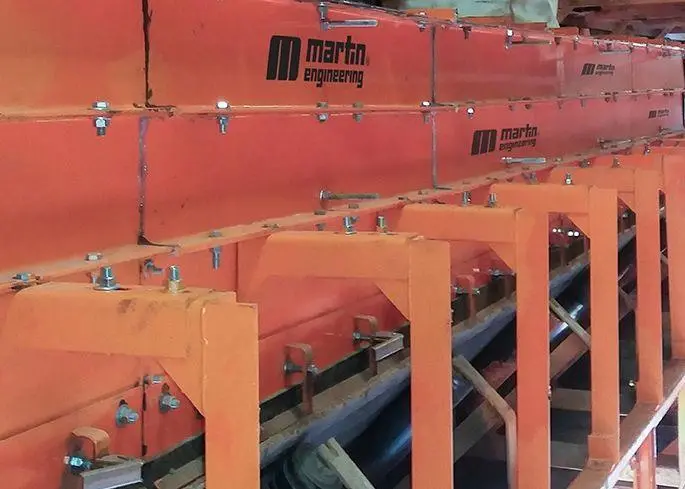
To prevent impacting the local community and adjacent docks with dust from loading and unloading agricultural commodities, the conveyors at the T-Grão Cargo terminal in the Port of Santos were upgraded by Martin Engineering Brazil to control fugitive material and mitigate the release of airborne particles. The result is significantly less dust, fewer complaints, reduced man-hours for cleaning and a lower cost of operation.
“Our dust control efforts have set an example that is now being considered by terminals up and down the port,” said Vinicius Pina, operations director for T-Grão Cargo, which manages the import and export of malt, wheat, soy and maize.
Containment efficiency
Martin Engineering Brazil constructed a longer sealed enclosure with the ability to control airflow and give dust extra space to settle. A heavy-duty impact cradle was installed to protect against impact and friction wear on the belt, which reduces maintenance and prolongs operational life. It features a top layer of slick UHMW polymer moulded to a base of impact-absorbing SBR rubber, all reinforced with a steel support structure able to withstand as much as 17,000 pounds of force.
Other new features include a series of slider cradles that extend from the impact cradle down the length of the settling zone to eliminate sag and prevent spillage; and track-mounted idlers placed in between the cradles to prevent “pinch points” that can damage the belt over time and sag points that allow spillage.
After the belt leaves the settling zone, a belt tracker now minimises belt wander that can be caused by uneven cargo loading. Martin Engineering technicians also installed a primary belt cleaning blade and spring tensioner system designed to remove carryback and keep a tight seal across the blade profile with minimal wear on the belt or splice.
The T-Grão Cargo terminal is planning to install a similar design on several of its other transfer points.
Related Articles
 EQUIPMENT
 ALTERNATIVE FUELS GREENPORT