![PortStrategy[GreenPort]](https://www.portstrategy.com/wp-content/uploads/2026/09/PortStrategyGreenPort.svg)





Capacity tsunami
The issue of adding new UK box port capacity is becoming more complex and the industry itself has contributed to this process. Has it shot itself in the foot or is it about to?
Is the UK Ports industry moving from one extreme to the other in terms of available containerport capacity? And does this emerging new situation add further strength to the argument that government should play a more constructive role in orchestrating the introduction of new capacity?
In 2003 cargo shippers and shipping lines were pointing to congestion in UK ports and arguing that this underlined the urgent need for massive new container port capacity. Proclamations of impending gridlock and pictures in national newspapers and the trade and technical press of truck queues outside container terminals all served to add credence to the view that “something has to be done and fast.” At the same time, port operators – Hutchison, P&O Ports and ABP in particular – were seeking approval for new developments and consequently were happy to climb aboard this bandwagon and add further encouragement to the spectre of problems looming.
Port congestion, however, has proved not to be a problem since 2003. The combination of shipping lines being poor at forecasting demand and terminal operators seeking to maximise profitability through limiting excess capacity appears to have been the root cause of the congestion in 2002/03. The advantage of hindsight tells us that the industry appears to have learnt its lesson and on the back of tariff increases the terminals are carrying a bigger capacity buffer thereby being able to absorb unexpected demand.
More significantly, the total demand for terminal capacity has proved to be much less than forecast. In 2005, for example, the key deepsea trades only grew by 1 to 2% against a forecast of 7 to 10%.
Further, if demand growth since 2000 is analysed then this comes out at an average annual growth in the order of 2.5%. These sort of figures are very hard for major investors in new capacity to swallow and perhaps especially for Hutchison and P&O Ports who have to place them against the backdrop of a combined projected investment in excess of £1.5bn.
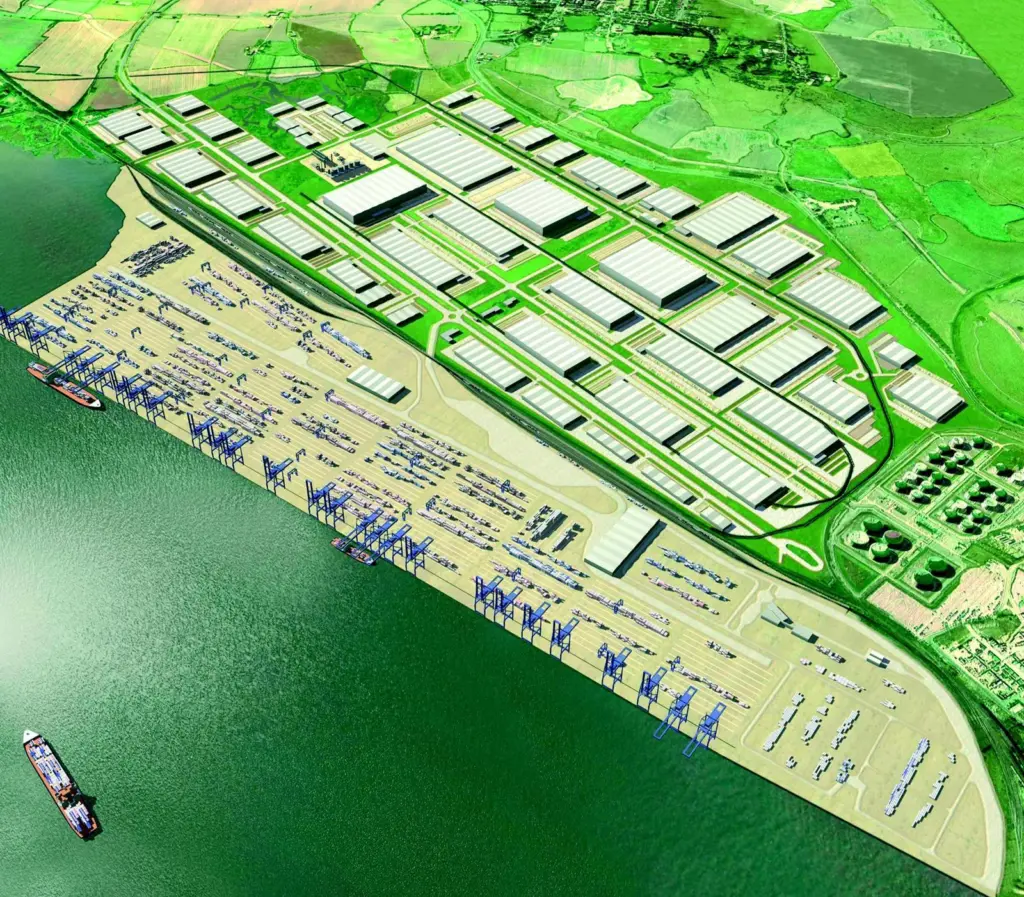
PROSPECT OF PRICE WAR The UK Transport Minister has now signalled approval for new container terminal developments at Immingham, London Gateway, Bathside Bay and Felixstowe – developments that together could eventually deliver a phenomenal 7mTEU/year of new capacity. A figure that doubtless has cargo shippers and shipping lines salivating at the prospect of a price war and ensuing bargain basement prices – a return to the “good old days” just like when Thamesport came into operation and flooded the market with new capacity at a difficult time.
And factor into this equation the reality that the port operators pursuing capacity expansion programmes previously advised the Minister that they could also expand their existing terminals to handle 7m TEU per annum; another 2m TEU and the prospect of happy days ahead for cargo shippers and lines seems even stronger. In theory there could be 9m TEU of new capacity sloshing around!
Critics would doubtless say, “yes but this won’t all happen at once as this capacity will be introduced on a phased basis.” This is true but when, as is the case with the “minded to approve” UK schemes, a large slice of the required capital has to be invested upfront for dredging, reclamation, rail, road and environmental compensation then the ability to generate healthy volumes in the early years and move on to the comparatively less expensive subsequent development stages is what will drive the returns on the investment.
Without a rapid take up of capacity, during both the initial and subsequent stages, these investments will not be attractive to their promoters.
COMES DOWN TO CHOICES An average growth rate of 2.5% on the current total relevant market (principally the southeast terminals) of approximately 5m TEUs, only results in 125,000TEUs of new demand per annum. In boxes that is only about 75,000 containers per annum or about £7m of revenue.
Even the most efficient operation will not result in much more than £3m of cash flow to fund the capital works.
This is not a scenario that the principal players – Hutchison and P&O Ports (including the new owners of P&O Ports) – will be unaware of and as such it is one that may lead them to reconsider their options.
Hutchison and DP World, as the new owners of P&O Ports, as global operators have a choice of where to invest and their eventual preference may be to invest in markets with much stronger growth rates and lower investment costs. Markets where there is much greater potential for a positive return on investment.
UK port users may be left hoping that Hutchison and DP World in particular have more capital than opportunities. And secondly that each of these big players mistakenly concludes that the other, given the very tight development scenario, will drop out of the development race. If that happens and all the capacity is built then this may well deliver the bargain basement climate many port users want.
The value judgement, however, is that given that the investors will need tariff escalation as well as high capacity utilisation to make the investments attractive, then there is a real risk of a number of approvals not being followed up by hard investment. In short, it seems something has to give.
And there is another important factor that could come into play to bring this about. To approve these developments the Minister has had to conclude that the public interest is better served by all of these developments taking place compared to approving fewer now and thereby causing less environmental damage. Given, however, the actual growth rates and the huge excess of capacity approved, such a ruling looks shaky especially in the light of his ability to revisit the need for further capacity in the future. It may well be, therefore, that a legal challenge is mounted to some or all of the Minister’s “minded view” approvals and if so the key question is will the European court disagree with him?
What, after all, is the point of the Habitats Directive? It appears the heart and soul of this has been ripped out of it if it is possible for the Minister to determine that the London Gateway, Bathside Bay and Felixstowe South projects are all necessary in the same time frame.
Is this flagrant overcapacity in the UK ports industry really imperative and in the overriding public interest? Surely the commercial interests of shipping lines, who love the bargain basement prices that come with over capacity, cannot override sensible international nature conservation?
So where now are the likes of RSPB who campaigned so vigorously against Bathside Bay? Perhaps it is simply the case that the legal challenges have yet to be mounted – whether in Europe or the UK – pending the final decisions issued by the Minister.
Perversely the whole process of crying congestion and hyping the demand may yet come back to bite the industry through investors being sensibly wary of investing into an oversupplied market or through the Minister’s decisions being able to be challenged and this process taking several years to conclude.
Related Articles
 PORT & TERMINAL NEWS
 EXPANSION & DEVELOPMENT
 PORT & TERMINAL NEWS