




Cooling it
Alex Hughes turns to the southwest of England and South Africa to discover what makes for a successful chilled fruit terminal operation.
It’s all about the year-round season. The cold store at the port of Bristol was established just three years ago at a cost of £15.8m initially with an 8,000-pallet capacity, boosted to 14,000 pallets in March this year.
However, while Bristol port ceo Simon Bird acknowledges that, in part, rising demand for chilled produce had prompted development of the facility, the vast majority of the traffic now being handled has switched from other ports.
Originally, terminals at the south eastern ports of Tilbury and Sheerness had handled imported perishables, especially fruit. This is because domestic fruit and vegetable production is centred on the neighbouring county of Kent, where local growers have used out-ofseason excess capacity to handle inbound consignments from abroad.
At centres such as Paddock Wood, imported bulk produce would be checked for freshness, then bagged, bar-coded and priced before being placed in chilled storage prior to despatch by road to the supermarket.
Nowadays, supermarkets want to pack at source rather than having this done by processing centres, effectively making some of these third party providers redundant.
Supermarket regional distribution centres (RDC), no longer tied to the south east, have relocated to cheaper, more centrally located zones with good motorway infrastructure links. Around Bristol, for example, no fewer than six RDCs are to be found, making the local port ideal for the importing of produce.
“There is little doubt that the market is changing more in favour of Bristol. However, the handling of chilled produce is a volume business with tight margins; if the throughput is there, then you can sweat your assets very effectively, ” claims Bird. Nevertheless, in order to do that, the importation of produce has to be a year round, globally sourced business.
While the length of the season in New Zealand has remained relatively unchanged, South Africa has managed to diversify sufficiently to justify vessel calls for nine months of the year, while the season in Chile, which kicks off in January, can nowadays last right through until the end of June. Perishables are also trucked in from northern Europe to Bristol for UK distribution, while China, now a significant apple producer in the Far East, has risen to prominence in the last ten years too.
ACTIVE YEAR-ROUND “Our aim has been to develop a business that is active for 12 months of the year, rather than working manically for six months and then ticking over for the rest of the year. As a result, we continue to target new traffic to fill the excess capacity we still have, although our principal cargo remains apples, pears and citrus. In fact, while the cold store can handle anything from -12infinityC to +12infinityC, we cannot handle bananas in the existing store, but see this as a next step as part of a dedicated facility, ” says Bird.
While return on investment was very much predicated on the handling of bulk consignments of perishables carried on traditional reefer vessels, Bird points out that Bristol also sees increasing numbers of reefer containers, for which 200 reefer points are provided.
However, while a lot of produce out of New Zealand is now containerised, this is not the case in either Chile or South Africa.
Nevertheless, things are gradually changing. The weekly Saecs service out of South Africa to Bristol, for example, nowadays conveys 150 40-feet reefer boxes during the height of the season, dropping to around 60 boxes thereafter.
“Last year, we also had 3,000 containers coming by road from Felixstowe, ” Bird recalls, explaining that, previously, the produce in these containers would have been placed in a local chill store prior to being sent to an RDC.
Andre Uys, group information systems and technology manager of South Africa’s Fresh Produce Terminals (FPT), acknowledges that, while FPT’s business plan is very much centred on the handling of breakbulk fruit exports, its four Southern African terminals (Port Elizabeth, Cape Town, Durban and Maputo) receive fewer and fewer calls from such vessels. Nowadays, consignments are being shipped by reefer container, which takes away FPT’s ability to add value through the packing and chilling of export fruit.
Uys emphasises that there are still advantages in continuing to use conventional vessels over container vessels. “If you want to despatch a very large consignment of fruit to a particular destination, for example, it is much easier to load 1,000 pallets into a conventional vessel than split them into a number of reefer containers. Freight rates on container vessels can also be much higher at certain times of the year, ” he observes.
As a result of this market shift, FPT also now operates a container stack operation at its Cape Town terminal as part of its overall strategy. On conventional vessels, while pallets continue to be loaded into the main refrigerated environment, containers are increasingly carried on deck. This has involved the company in investment for new cranes capable of handling both palletised and containerised fruit.
This investment can be justified thanks to developments in the local market. The overall volume of fruit being exported, for example, is growing, although the fact that importers can source fruit from a variety of producers can often result in certain markets becoming flooded with a particular product. As a result, South African producers occasionally prefer to sell to the domestic market, rather than accept lower profit margins abroad. This inevitably has a negative impact on FPC.
A ‘BASKET OF FRUIT’ South Africa’s major producer, Capespan, now emphasises its ability to provide customers with a ‘basket of fruit’ throughout the year, which often sees it shipping via producers in other countries. The globalisation of the industry means that South Africa now competes with New Zealand and Australia as well as countries in South America, for traditional markets in Europe.
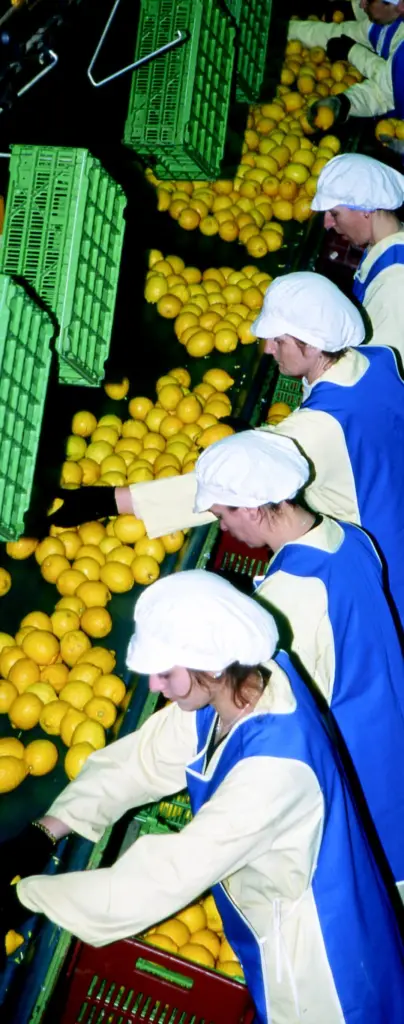
Fortunately, domestic producers have diversified to ensure that there is always some form of fruit available for export. Uys explains that oranges, lemons and grapefruit are by far the most significant export, followed by apples and pears, with stone fruit such as peaches, plums and apricots, helping to extend the season even further. However, FTP does not to get involved in the highly volatile market for bananas. Other more exotic fruit is also notable by its absence, despatched instead by air.
Despite numerous negative shifts in the market, FTP has nevertheless benefited from the fact that South Africa deregulated its fruit export industry about 10 years ago. Previously, there had been only one exporter and one cool chain supplier. Nowadays, the market is mature and features a number of niche exporters supplying specific areas or retailers. Uys notes that, as a result, life has become a lot more interesting.
Related Articles
 OPERATIONS
 OPERATIONS
 PRODUCTS & SERVICES