![PortStrategy[GreenPort]](https://www.portstrategy.com/wp-content/uploads/2026/09/PortStrategyGreenPort.svg)






Soldiering on
Declining Asia-Europe container volumes hardly paint a positive picture for Northern European ports, as Felicity Landon explains
Reporting some downbeat figures on world trade recently, Container Trades Statistics said global economic prospects had once again fallen below expectations – and that the economic recovery, particularly in the Eurozone, remained bumpy.
Europe, says CTS, continues to be afflicted by complicated policymaking targeting national deficit reduction. The prolonged cold weather into March and April had its impact, too, keeping Europe’s consumer spending at lower levels.
A few weeks earlier, the latest edition of Global Port Tracker: Northern Europe gave scant cause for rejoicing. Volume growth at north European container ports would ‘stagnate’ in 2013, with consumers reluctant to spend against a background of weak Eurozone economies, said the report’s authors, Hackett Associates and the Institute of Shipping Economics and Logistics.
Global Port Tracker forecast that any increase in container throughput in Northern Europe would remain limited to 1% this year, although this slight growth could be enough to pass the 40m teu mark for the first time. Within that, however, there were variations. The report forecast predicted that Rotterdam and Antwerp would see growth of 4% and 3% respectively; Hamburg and Le Havre would remain closest to the 1% average growth; and Zeebrugge and Bremerhaven were likely to lose out in the mix.
New entrant
Against this uncertain background, DP World is preparing to open the first phase of its new London Gateway deepwater terminal in the fourth quarter of 2013, while in Rotterdam the first phase of the Maasvlakte 2 expansion is rapidly taking shape, with APM Terminals’ Maasvlakte II and DP World’s Rotterdam World Gateway both due to open in autumn 2014.
“We do hope that by autumn 2014 the market will have picked up a little bit,” says Minco van Heezen, press officer for Port of Rotterdam. “For sure it is not too bad at present – we are on moderate growth, 1%-2%, which is not bad compared to some of our competitors, but of course it isn’t what we expected and it isn’t what the new terminals are being constructed for. The Global Port Tracker report predicted about 4% for Rotterdam and if it is going to be that much, then we are satisfied.”
In terms of overall Northern European volumes, Dean Davison, senior consultant at Ocean Shipping Consultants, says: “I think slow and steady is the best we can hope for. Clearly we are not going to see any big gains in volumes, although we do feel volumes should continue to get better. At the same time, it is getting more competitive out there.”
In the UK, speculation is rife over which shipping line might sign up first for London Gateway, with Felixstowe – current throughput about 3.5m teu – seen as the obvious potential loser. However, Felixstowe has been fighting back. At Multimodal recently, Neel Ratti, general manager of Tuscor Lloyds, told a seminar: “Competition is pretty fierce out there. DP World is just about to open London Gateway. Felixstowe has suddenly become the most responsive port I have ever dealt with in my lifetime.”
He added: “In order to compete in that market, you need to be pretty damn good at what you do.”
Mr Davison agrees: “We have always felt that the major impact of London Gateway would be to raise the bar for productivity,” he said. “I think the real benefits are going to be gained by the shipping lines in terms of better performance.”
Winning streak
Right on cue, the Port of Felixstowe was named the ‘Best Container Terminal in Europe’ at the annual Asian Freight & Supply Chain Awards in May – recognising the ‘high quality of service and levels of productivity’ achieved at the port.
Hutchison Ports UK chief executive Clemence Cheng said: “We are very pleased to receive this award in recognition of our achievements. This would not have been possible without the strong support of our customers and the relentless pursuit of operational excellence and customer service by our workforce.”
Felixstowe’s Berths 8&9 deepwater extension was opened in 2011, taking the port’s capacity to around 4m teu per year, and a second phase expansion would add another 1m teu. This summer the port is opening its third rail hub, the new North Rail Terminal, which will double its rail capacity, enabling HPUK to make the most of ongoing investments in the Felixstowe to Nuneaton rail freight route.
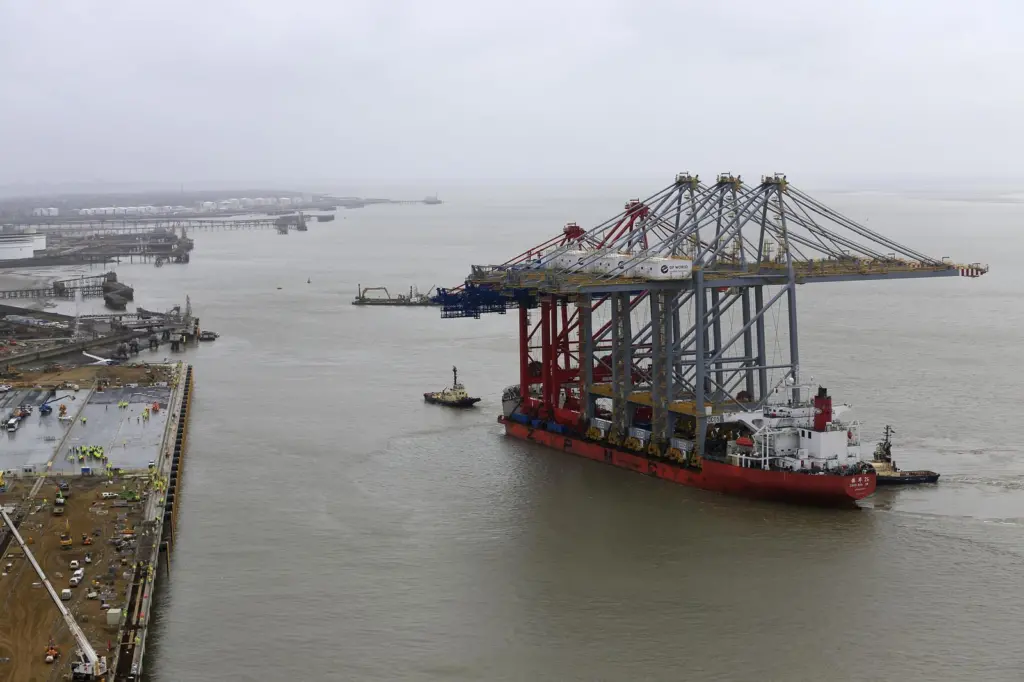
At London Gateway, development work has been progressing apace. In recent weeks, five giant quay cranes have been delivered, along with a range of other quayside and yard equipment.
When complete, London Gateway will have six deepwater berths, with 24 quay cranes and annual capacity of 3.5m teu. Phase one – 1.6m teu – provides three berths, the first opening this year, with the second and third to follow in 2014. Alongside the deepwater port, DP World is developing a 9.25m sq ft warehousing and logistics park, providing warehousing and distribution opportunities.
At Multimodal, London Gateway commercial director Charles Meaby described the building of a new port in the UK as a ‘once in many generations’ event. “The reason we can make justification for London Gateway is because we understand the fundamental requirement – which is location,” he said. “That is our business proposal – get closer to the end markets. There is a reason why London was the biggest port in the world before, and that comes down to location.”
However, Felixstowe is also making the ‘location’ argument, describing the port as ‘near to London but well outside the most congested road and rail networks’. HPUK says Felixstowe is best placed to serve the so-called Golden Triangle, the area defined by the M1, M6 and M42 road network, packed with distribution centres and logistics operations.
Polish ambitions
Competition is equally tough among European mainland ports and major investments in Poland are likely to add to that. DCT Gdansk has announced that it will handle Maersk Line’s Triple E 18,000 teu vessels from August this year. Chief commercial officer Jean-Jacques Moyson says: “Implementation of the first direct deepsea ocean container service to the Baltic Sea truly revolutionised the market and now the deployment of the 18,000 teu vessels confirms it.”
At neighbouring Gdynia, the port authority and terminal operator ICTSI are also investing heavily, making clear their ambition to snatch back market share from ports including Hamburg and Rotterdam, which currently handle large volumes of Polish cargo.
OSC’s Mr Davison says: “One place where we do see some strong growth is Poland, in both Gdansk and Gdynia. Poland has in the past been a feeder market because of insufficient infrastructure, but now you are getting the deepsea vessels calling in there. This will probably impact and challenge Hamburg, which has traditionally serviced some of those markets overland, and also feedered into the Baltic, and I think Antwerp too could be affected. If Poland is served directly by its own ports, that will be a big change.”
While the major alliances with the largest ships look to the major deepsea ports, what is also interesting is the ‘next tier down’ in terms of ship size and ports, says Mr Davison. “These [smaller] ships are obviously not going into these big developments but will be going into smaller, ‘older’ or more niche ports.
“People forget that not everything can go into containers and there will always be a role for the niche ports and other cargoes. Some of the niche ports are relying on niche trades and perhaps their growth will be slower. But we have seen strong interest in bulk operations, which continue on their way and sometimes seem to go under the radar.”
German nous
Hamburg handled 131m tonnes total cargo throughput last year (2012), with general cargo, bulk cargo and overall container throughput slightly below 2011. However, exports were up by 1.9%, which the port said could be explained “by uninterrupted worldwide demand for German products”, among other factors.
And what of Germany’s JadeWeserPort at Wilhelmshaven, which was built with 2.7m teu annual capacity but reportedly handled just 7,000 teu in the first quarter 2013?
“Wilhelmshaven was a greenfield development and what can you expect?” said one industry source. “Wilhelmshaven isn’t a Ferrari – it has to develop and grow, and compete with ports that are already established. There is disappointment in Germany, but maybe expectations were a little bit too high, with politicians promising lots of new jobs.”
Antwerp, meanwhile, reported a 2.8% drop in container volumes in the first quarter 2013, compared with the same period in 2012, but overall a slight growth in cargo throughput. The port handled almost 47m tonnes in the three months, up 1.4% on 2012; liquid bulks were up 37.4% to 14.2m tonnes, a new record, but dry bulks were down 33.2% to 3.55m tonnes, reflecting big drops in coal and ore volumes. Breakbulk, meanwhile, showed an increase of 4.4% compared with 2012, to 2.65m tonnes in the first quarter, including increases in steel, paper and pulp, and non-ferrous metals.
Related Articles
 PORT & TERMINAL NEWS
 EXPANSION & DEVELOPMENT
 PORT & TERMINAL NEWS