![PortStrategy[GreenPort]](https://www.portstrategy.com/wp-content/uploads/2026/09/PortStrategyGreenPort.svg)





Transhipment merry-go-round
The fight for transhipment traffic in the Mediterranean shows no signs of weakening, finds Alex Hughes
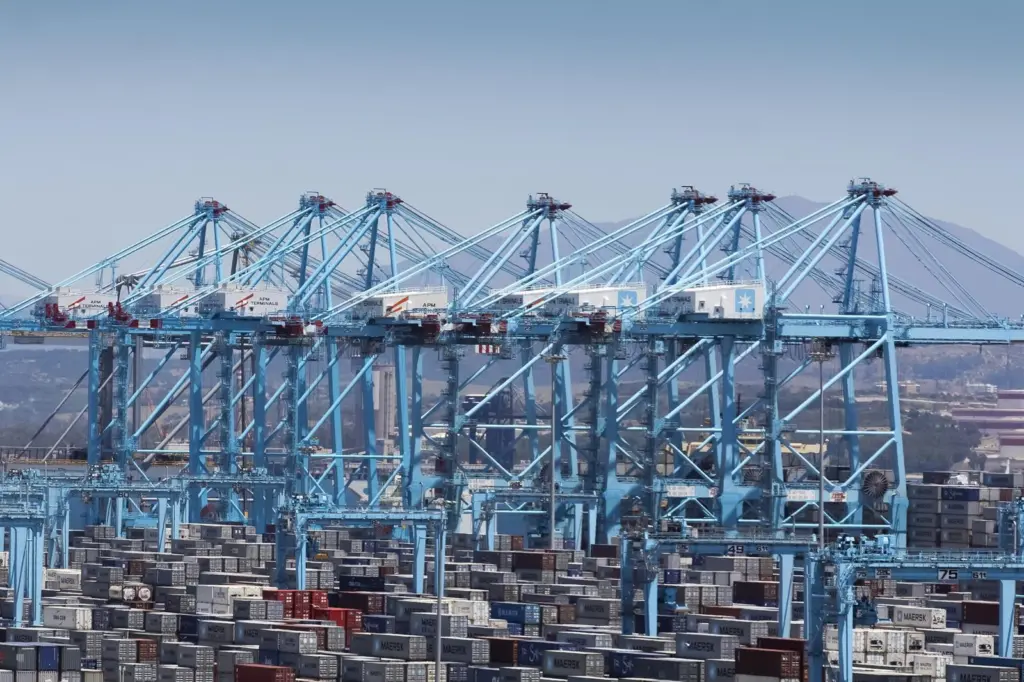
Potentially lucrative container transshipment and relay traffic has proved a catalyst for change across southern Europe, with transshipment hubs investing in a constant battle to retain clients.
Sines’ Terminal XXI, very much the new kid on the block, has posted year-on-year traffic growth over the past decade, boosting throughout from questionably profitable levels in the early years to a much more healthy 931,036 teu in 2013. Port president, João Franco attributes its success to “the terminal’s efficiency, plus the fact that it operates 24 hours a day all-year-round, charging the same rates”.
Part of recent traffic has undoubtedly come from Valencia, where MSC is trying to negotiate down both port authority charges and labour costs. However, Mr Franco does not believe this is the real reason for Sines’ growth, since Terminal XXI has been gaining traffic from different international markets, establishing new services linking Portugal to various parts of the world.
“Sines offers competitive prices and, in terms of productivity, is presently at the level of the top international ports, handling an average of more than 200 teu per hour,” he says.
However, hanging on to major clients such as MSC is not always that easy. In July 2011, for example, Maersk quit the Italian west coast transhipment port of Gioia Tauro, with the loss of 25% of total throughput for that year, putting jobs at risk and asking serious questions about the port’s longer term future in the large scale transhipment market. Crucially, Maesk left the port even though group affiliate APM Terminals held a 33% stake in Medcenter, the container handling facility at the port, whose remaining equity remained with Contship Italia.
Commercial drive
Michael Cashman, Contship Italia’s group commercial director, notes that the decision taken at the time by Maersk Line was purely network driven and had nothing to do with cost. “Up to then, Medcenter Container Terminal had consistently figured high on Maersk Line’s list of internal KPIs,” he says.
Nevertheless, MCT did have to re-group, supported by the port authority, which provided the deeper draft required by ULCC ships. “Being already in advance of its time, there was not much else that MCT had to do, the infrastructure already being considered as world class for many years,” he says.
Nowadays, while MSC is the dominant transhipment client, CMA CGM, CSAV, HSDG, Maersk, SCI and ZIM all rotate boxes in and out by sea, handling both transhipment and local gateway volumes in South Italy, reducing the reliance on a single customer. Indeed, despite the major setback caused by the loss of Maersk, MCT has bounced back, suggesting that transhipment traffic does prefer certain strategic ports.
Nevertheless, Mr Cashman notes that high volume transhipment and relay activity has to be seen as “highly mobile”. “Global shipping lines make their choices when designing their networks. While commercial terms are but one element of that decision making process, albeit an important one, network efficiency is likely the priority for the lines,” he says.
In the last two years, MCT has achieved double-digit growth, handling just over 3m teu last year. Mr Cashman attributes this to “organic growth in the global transshipment market”.
Industry commentators have also suggested that MSC is now switching some of its transhipment traffic to MCT from the Spanish port of Valencia, where the shipping line wants more competitive rates and enhanced workforce flexibility.
Many choices
Contship Italia actually operates two transhipment hubs in southern Italy. So why do some shipping lines choose MCT and others CICT at Cagliari? “Clearly, MCT has reached maturity and is indeed the ‘finished article’, having being ahead of its time for a number of years,” says Mr Cashman. “CICT has not yet attracted ULCC ships, but this will come. Ultimately, it is the global shipping lines who determine their hub requirements based on network design and efficiency.”
Earlier, in 2008, the southern Spanish transhipment hub of Algeciras also suffered a major setback, when it lost its leading position in the container market to Valencia. However, in 2013, Algeciras once more moved to the top of the tree, reporting throughput of 4.349m teu, compared with Valencia’s 4.327m teu.
According to José Luis Hormaechea, managing director of the Port of Algeciras Bay Port Authority (APBA), the growth in box traffic can be put down to several factors. In 2010, for example, TTIA commenced operations, very quickly coming to handle annual traffic in excess of 1m teu thanks to attracting some 20 shipping lines previously with no presence in the Straits of Gibraltar.
Equally as important, incumbent, APM Terminals invested $57m as part of its “Algeciras 2014” upgrade, including acquiring new gantry cranes and associated equipment. The terminal now receives regular calls from Maersk’s Triple E vessels.
In parallel, APBA has continued its own investment programme, deepening the draft to ensure that the largest vessels afloat can operate there. Mr Hormaechea also stresses the good work and professionalism of the stevedores who ensure the utmost efficiency in the port.
Labour lock-in
Unlike Valencia, which has been unable to get all parties concerned to sign a collective bargaining agreement covering activities on the quayside, unions and stevedoring companies at Algeciras implemented such an agreement in 2008, covering the period up to 2017.
“At that time, it was an agreement unprecedented in Europe, guaranteeing labour peace across a long period of time. Nevertheless, you also have to look beyond this to the agreement given by the workers, which ensures high levels of efficiency and competitiveness,” says Mr Hormaechea.
The binding agreements mean that terminals guarantee volume, thereby ensuring the port has work, in return for which the workers are as flexible as possible and do not go on strike.
For its part, APBA has continued to reduce its prices over the last few years by applying the maximum possible rebates allowed under existing ports legislation.
The result of all these measures is that, not only has Algeciras once again overtaken Valencia to become Spain’s leading hub, but the threat of losing the majority of its transhipment traffic to terminals at Tánger-Med has simply not materialised.
Asked whether there are still things that need doing to ensure that Algeciras remains in pole position, Mr Hormaechea says there definitely are. “We have to ensure we have sufficient capacity; maintain and even increase service quality; and continue to demand the removal of bottlenecks on the key railway line connecting us to our hinterland, which is still awaiting central government investment.”
For 2014, APBA is targeting a throughput slightly above that reported for last year, while in the medium term traffic is expected to grow to 6.5m teu, allowing Algeciras to retain its leading position not just in Spain, but also in the Straits of Gibraltar.
Related Articles
 PORT & TERMINAL NEWS
 EXPANSION & DEVELOPMENT
 PORT & TERMINAL NEWS