![PortStrategy[GreenPort]](https://www.portstrategy.com/wp-content/uploads/2026/09/PortStrategyGreenPort.svg)






Politics and pragmatism
The dark shadow of political strife has fallen on the Black Sea. Stevie Knight reports
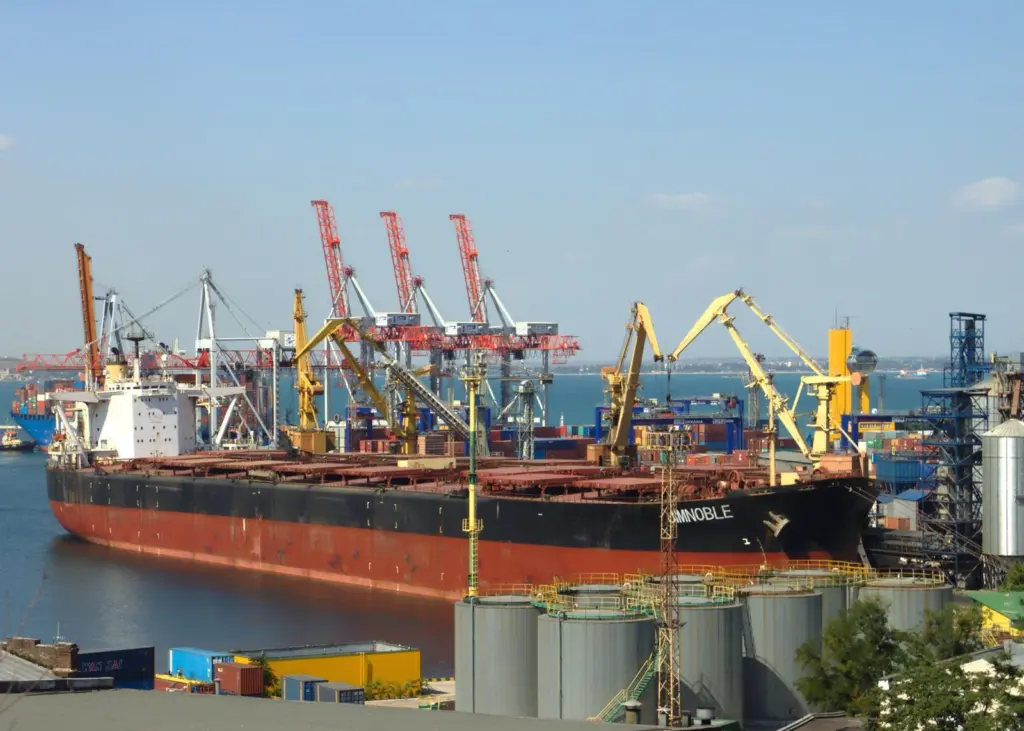
Predicting the future of Black Sea ports involves some political speculation, but the big question is, says Alistair Mackie of HFW, how much can commercial pragmatism influence the outcome?
After all, before this latest round of political strife kicked off there were signs of regrowth. Steve Wray of OSC points out that the region has, historically, a solid underpinning of demand: before 2008 Turkey, Ukraine and Romania were all booming, the lines putting in direct calls to Constanta in Romania, Odessa or Illichivsk in Ukraine and Ambarli in Turkey. Then in 2008 the bottom just fell out of the market: APMT mothballed its Constanta terminal and the Black Sea ports “reverted to type, relying on a dribble of feeder vessels to keep going”.
But slowly the area picked up again: that dribble started to grow in both frequency and size, vessels reaching the 3,000 teu mark and Mr Wray says that at this point, it would be reasonable to ask ‘why not get direct calls into the area again?’
HPC, for example, has recently been pushing for its Ukrainian terminal at Odessa to function as a direct port of call, with plans for the first phase of the Quarantine Mole facility to exceed 600,000 teu at a total cost of about UAH5bn ($210m) half of which is coming from HPC Ukraine, a subsidiary of Germany’s HPC Hamburg.
Nervous feeling
However, the word that everyone seems to use to describe the current sentiment is “nervous”, and Mr Mackie explains that the hesitation is spreading further than hotspots – at least in the medium term. So neither Odessa nor Illichivsk is making the most of capacity.
“A lot of people are adopting a ‘wait and see’ approach before getting too deeply involved, because of the prevailing political situation,” says Mr Wray. Further, while grain imports and exports follow gluts and shortages (some ports gaining from Turkey’s recent bad harvests), Ukraine’s slashed GDP has slowed the box trade down “as containers tend to follow luxury items, and many people there are now on subsistence-style living”, he explains. So it’s hardly surprising that Odessa, Illichivsk and Yuzhny together have seen an aggregate drop from 779,071 teu to just 666,802 teu – a fall of over 14%.
But there’s no justice. Novorossiysk seaport is doing fine, and according to Alexander Ignatov of Ignatov Associates, despite the loss of some import from the sanctions more came back in the way of rising exports – Russia’s ‘Looking East’ initiative has resulted in the APAC region becoming the fastest growing flow: Novorossiysk recently snared the AE3 Maersk service, connecting directly with China, Japan, Singapore and SE Asia.
It’s being spurred on “in part by collaboration by Chinese carriers’ plans to compete with MSC, Maersk, ZIM and Arkas”, adds Mr Ignatov; further, the return of Russia’s navy base to Crimea is freeing up some space and the port is looking at increasing berth lengths to handle 10,000 teu vessels, double the current size and growing it’s freight by 29m tonnes over the next five years. But rail links remain an issue – although it’s been agreed that Novorossiysk’s rail cargo capacity will have to grow to 50m tonnes under a 2020 federal project. To raise money the Russian government plans to sell its 20% share in the port to “interested private investors” (probably via a Transnet transfer) – and, given the rest of its turn eastward, it’s plausible that there will be some Asian players competing for ground traditionally taken by Russian oligarchs.
However, the focus on Novorossiysk means other, smaller ports won’t get a look in. Kavakaz will be significant only until a new bridge to Crimea is completed in 2018 and niche ports such as Anapa and Tuapse will in all likelihood plod along as before. Beyond its navy base in Sevastopol and passenger capacities in Yalta, Russia doesn’t seem to have Crimean ports among its commercial priorities either: Kerch, Evpatoriya and Feodosiya probably won’t see much investment, both because Crimea still occupies an ‘indefinite status’ with many of Russia’s trade partners – and because all that big development at Novorossiysk is sucking up all the available resources.
Hands-off
So, what of the other competition? Certainly western investment into the Black Sea area will likely be in short supply as Russian interests are deeply entrenched in the region and at the moment “no-one in Europe or the US wants to deal with them” says Mr Mackie: even if not presently blacklisted, Euro/US banks and firms are extremely twitchy about the possibility of partners suddenly falling under the axe.
Further, Batumi and Poti, Georgia, could have real reason to fret despite 2014’s near 10% growth: last year they handled 447,000 teu between them but now Putin has annexed the breakaway Georgian republic of South Ossetia, political conflict looks troublingly close. If the London Stock Exchange is taken as an indicator of the level of concern, it has to be a worry that APMT’s $86m, 37.5% stake in Russian-based Global Ports has dropped 73% in value since 2012 – even if the Global portfolio doesn’t directly include Poti.
More, there’s going to be tough competition on the doorstep with the new, 100m tonne, 1,000 ha facility at Anaklia – which isn’t looking west, but east for support.
In fact, Mr Ignatov points out the shortlist for a new port at Anaklia includes more Asian players than Georgian ones. It seems China sees it as a spin off from its Silk Road initiative as the new port could provide the opening to a direct land route to Asia and certainly Power China presently holds the $5bn ‘intention’ agreement with a local organisation to develop the port’s surrounding industrial park. Despite this, certain elements are proving challenging, he says. For example, the electrical infrastructure will need a new plant, but authorities say any generated power will have to run through Georgia’s centralised grid – and supply will be on its own terms.
So, while growth could return to the Black Sea and provide intrepid investors with ‘snip deal’ opportunities, there’s the potential of quite another business dynamic: that is, Russia getting even further swept up in a move eastward, says Mr Mackie.
This could leave China with a rising sphere of influence over business on the Black Sea’s north-eastern shores.
Catching the fallout
Certain regions will do better than others from the Black Sea’s political games but the area still makes for a tough call.
Further away from the hotspots, “Constanta is probably the go-to alternative for Black Sea transhipment right now”, says OSC’s Steve Wray, with the DP World’s Constanta South facility benefiting from some redirected cargo. Constanta saw a 4% rise in turnover last year and agribusiness Nidera’s acquisition of the USA/USC Terminal shows a rise in grain handling interest.
If the growth continues an older plan to provide an eco-friendly connection between Romania and the Danube may be dusted off, this could provide a link to central Europe and even steal some trade from Rotterdam and Hamburg, using a Black Sea hub such as CSCT instead of the traditional north Europe routes.
However Constanta has its issues: protestors recently blocked the port, accusing the board of directors and executives of the National Company Maritime Ports Administration (CNAPM) of bad practice, including raising the rent for operators by 380% within the next two years and redeveloping port land with a high-society residential and entertainment area complete with casinos – to the detriment, they say, of commercial port activity.
Constanta is by no means free of the strange, Byzantine intrigue that haunts so much of the region; the backdrop to these protests is the detention of the mayor, Radu Mazare, on suspicion of taking bribes worth E9m ($9.9) partly against contracts for city development – and the head of Romania’s anti-corruption department has also been accused of taking backhanders.
It’s not particularly unusual for the area. Although Ukraine has been pushing at port reforms, the long-running battle between Container Terminal Illichivsk and its state landlord ended with CTI having to abandon a $56m infrastructure outlay while in Georgia, Batumi Port has now been seized by a court order, following accusations by shippers that KazMunaiGas had violated contracts by increasing tariffs and creating other obstacles.
The laws in a lot of these jurisdictions are not straightforward and the rules aren’t always clear, says HFW’s Mr Mackie. “If you add in political uncertainty, it becomes even more difficult to know where your project is going. Some are willing to take this on a risk-reward basis, but for others, stability is a greater factor.”
Related Articles
 PORT & TERMINAL NEWS
 EXPANSION & DEVELOPMENT
 PORT & TERMINAL NEWS