

Gas stations
Reconsider re-fuelling roles as orders for LNG-fuelled ships increase, advises Aidan Grange
The implementation of additional emission control areas, a record orderbook for LNG-compliant vessels and a clearing regulatory environment when it comes to developing refuelling stations, suggest that LNG has every chance of becoming the fuel of the future for the maritime sector. But it will take time.
“LNG has great potential,” said Alfred Hartmann, president of the German Shipowners Association, speaking at a recent LNG conference sponsored by Hamburg’s trade authority and a number of German and Dutch-based LNG organisations and platforms. “We [the industry] know that from LNG operations on gas tankers that it is extremely safe to use, both on the ships and in bunkering facilities.”
Nonetheless, fears remain over the safety of the fuel and there are many challenges that governments, state/quasi-state agencies, including port authorities, have to overcome when it comes to both developing and subsequently operating LNG bunkering facilities.
This means it could take several years before a global network of refuelling stations is established. But such a network is critical if a competitive pricing environment is to prevail and shipowners/operators are to have the choice and flexibility they demand when it comes to maintaining their operations.
Low count
Currently, fewer than 20 ports offer LNG bunkering opportunities but interest is growing, according to classification societies such as Lloyd’s Register of Shipping and DNV GL.
Many of the ports that offer LNG fuelling facilities are those that are members of the International Ports & Harbours-inspired World Ports Climate Initiative (WPCI) and most are in Europe where grants and EU-funding are readily available. They include Rotterdam, Amsterdam, Antwerp, Zeebrugge and Stockholm. Nanjing and Zhoushan in China and Port Fourchon in the US also offer LNG bunkering services. In particular, WPCI has established an LNG working group and this has developed harmonised bunkering checklists for LNG operations in ports.
The use of LNG is definitely moving up the political ladder, especially in Europe. Since January 1, 2015, all ships sailing in the northern part of the region, stretching from south-west UK/northern France through the English Channel and North Sea to the Baltic have been subject to special Sulphur Emission Control Area (SECA) regulations. It means burning fuel with less than 0.1% sulphur content.
LNG has several advantages: it is much cheaper than various SECA-compliant fuels, such as marine gas oil which is as much as 50% more expensive; it is very competitive against traditional heavy fuel oil whose price is between 10% and 15% more expensive; it offers a 20% reduction in CO2 emissions; and it has very low nitrogen oxide (NOx)and particulate pollutants.
By 2016 all European Union member states have to specify in their national policy frameworks which of their maritime and inland ports are to provide access to LNG refuelling points. This comes as a result of the ‘directive for the deployment of the alternative fuels infrastructure’, which requires EU countries to provide a minimum infrastructure for alternative fuels such as electricity, hydrogen and natural gas, as well as common EU-wide standards for equipment needed and user information.
Master planning
The large ship and industrial classification society DNV GL is one such company that is advising several port authorities during the planning process, with Jan Tellkamp, principal consultant of project management at DNV GL, saying the group was involved in drawing up a master plan for the River Rhine. He expects the results to be published by the end of 2015.
Both Rotterdam and Antwerp are both planning to expand existing LNG refuelling operations and develop large-scale LNG bunkering facilities. DNV GL is also working closely on projects in many other areas of the world, including the US. However, there appears to be a general reluctance to invest in bunker facilities in the country given the capital costs involved and current projections for vessel owners/operators demanding LNG refuelling in the US.
In Asia, Singapore, which is the world’s largest port for conventional bunkering, is determined to become a large LNG refuelling hub. Several ports in South Korea, Japan and China also have plans in the pipeline, but with most facilities not due to come on stream until 2020. In Asia the drive for LNG refuelling stations is less acute as fuel with higher levels of sulphur is permitted on all trades.
While individual ports will offer different LNG bunkering services, surveys conducted by LR suggest that most ports will deliver the fuel to the ships by either road tanker and/or bunker barges. Direct pipeline deliveries to the berth will come at a later date.
Owner interest
Several owners addressed the conference. “Two of our 17 vessels will be running on LNG by the summer,” said Dr Bernhard Brons, director of AG Ems. “While one of them will be a retrofit, the other is a newbuild.” While Dr Brons executive expressed strong and positive views about LNG solutions, he was, like many in the global shipping industry, also cautious, stressing that the company would now “wait and see how LNG operation works in practice, before retrofitting any more vessels”.
A particular concern of Brons was the lack of common standards and certification documents for all engine parts in an LNG propulsion system.
Nonetheless, orders for LNG-compliant ships are at record level. However, when it comes to the mainline container shipping industry, no one operator has committed to ordering and/or retrofitting tonnage to LNG-only fuel solutions.
In the short-sea sector, things have been a little different, particularly where SECAs have been imposed and/or are planned to come into force. Currently, in addition to northern Europe, the east, Gulf and west coasts of the US and Canada, including Hawaii, are emissions-controlled areas.
In the future, the east and west coasts of Mexico and Central America, west coast of Norway, Mediterranean Sea, Singapore and Japan could become SECAs. Moreover, the International Maritime Organization (IMO), which is conducting various reviews into fuel, is planning to cut sulphur limits in bunker oil from 5% currently to 0.5% in 2020. The IMO’s review on this subject is due to be completed in 2018.
With changes also planned on NOx and other pollutants, these will be the main factors influencing the demand for LNG and hence refuelling stations.
LNG decisions
Several shipowners/operators have taken the view that full LNG propulsion rather than the use of scrubbers and other technological systems offers the most reliable and cost-effective solution and have committed to newbuilding programmes.
Helsinki-based Containerships is investing between €250m and €300m in its operations over the next few years as the carrier also aims to double its business within the next six years. This includes the purchase of six 1,400 teu ships for its intra-European networks, which include Scandinavia and the Baltic. The vessels will be delivered in 2016 and 2017.
Elsewhere, Tacoma-headquartered Totem Ocean Trailer Express, which operates in the country’s Jones Act trades, recently took delivery of the first of two 3,100 teu capacity Marlin-class ships.
While DNV GL’s Mr Tellkamp acknowledges the many challenges associated with using LNG, he says that from his company’s perspective, the sector is increasing exponentially. “In our view, it’s not so much a question of if LNG will be widely introduced as ship fuel, but when.”
LNG-fuelled ships gather on the horizon
A record number of LNG-fuel compliant vessels are on order with DNV GL estimating the total orderbook at 80 vessels. This compares with a current fleet of about 60 units (exclusing barges/inland waterway vessels).
One of the latest and most significant orders was that placed by Mitsui OSK Lines, which in conjunction with Japanese shipowner Shoei Kisen has six 20,150 teu ships on order. The ships will be fitted with Man B&W G95ME dual engines that allow for LNG to be used with a very limited amount of retrofitting. In general ships that are made LNG-compliant involve an additional $10m to $15m in capital expenditure.
Meanwhile, events over the past three months suggest that LNG can be used as a reliable fuel for the industry. In March, Nor-Lines sailed its new flagship vessel, Kvitbjorn from the Tsuji Heavy Industries shipyard in Jingsu province, China, to Norway, a distance of over 13,000 miles on LNG. The ship, which is powered by a Rolls Royce Bergen-designed gas engine and installed with a 400m3 capacity LNG tank, stopped to refuel at Kochi in India and Cartagena in Spain. It is understood a full tank can allow the ship to sail about 3,500 miles.
Nor-Lines is now deploying Kvitbjorn in its service between Hamburg and Norway’s northern city of Hammerfest. Later this year, a sistership Kvitnos will enter service.
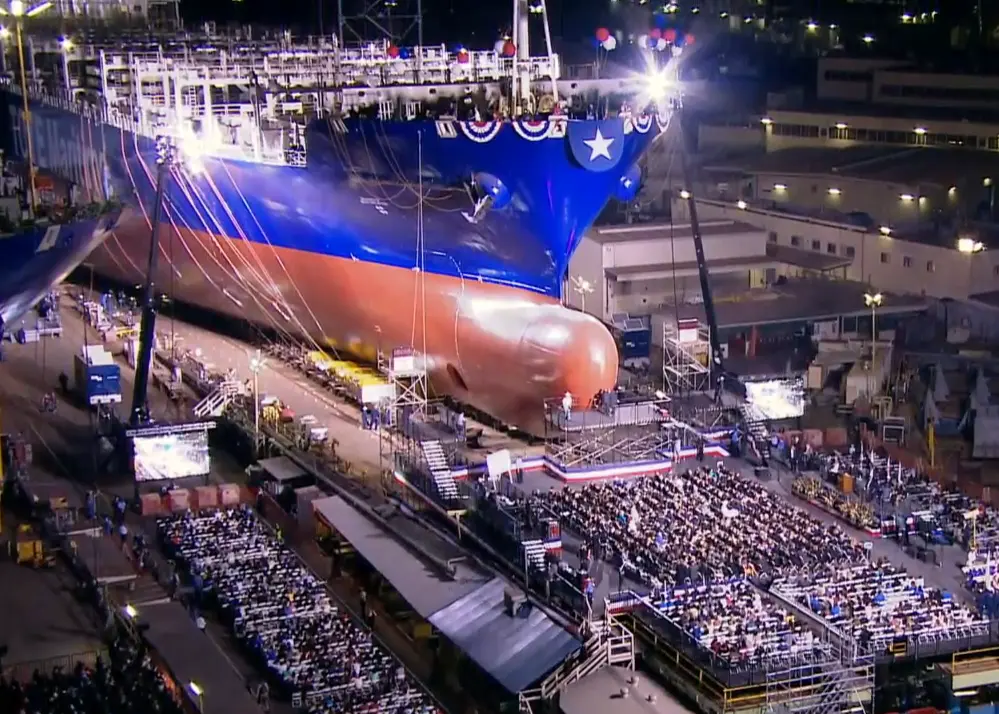
Another significant event took place in late April when TOTE’s first Marlin-class LNG vessel was launched by General Dynamics Nassco shipyard in southern California.
Fitting out and sea trials of the vessel, Isla Bella, will take place over the coming months after which TOTE will employ the vessel in the trade between Jacksonville and San Juan. It hopes to have the second ship in service in early 2016.
The Marlin-class ships, which have a nominal container capacity of 3,100 teu, feature MAN Diesel’s two-stroke dual-fuel engines. This is an innovative development as most vessels in service that can be powered by LNG are equipped with either medium-speed four-stroke dual-fuel engines or pure gas engines.
In addition to its new ships, TOTE is planning to retrofit two of its existing vessels with LNG propulsion systems.
Related Articles
 OPERATIONS
 OPERATIONS
 PRODUCTS & SERVICES