

A new era in port lighting
Today, outdoor lighting solutions no longer have to rely just on yellow light. The alternative is high quality white light. Its much more successful in combining the qualities of daylight with the energy efficiency associated with high pressure sodium, says Jeffrey J Newman, president of Global Tech LED.
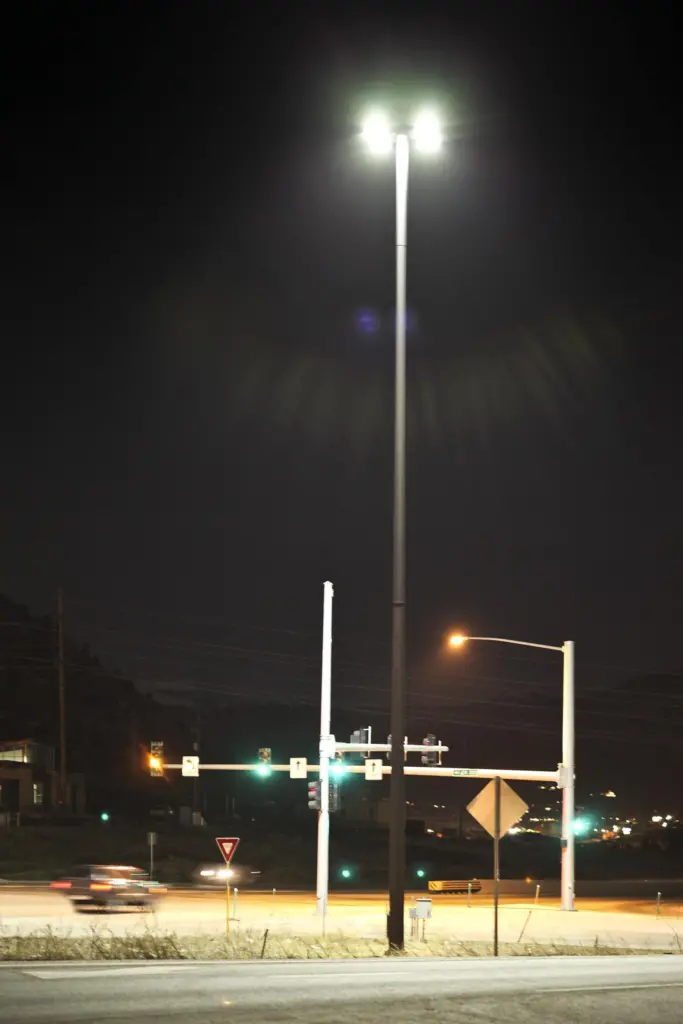
The needs for port lighting are changing. It’s no longer simply a matter of providing enough light to ensure visibility and security. Today, LED lighting is increasingly being used to create a safe environment in which the ports take on a new identity, creating a better image, more efficient operations and a productive environment that workers are proud of. LEDs provide an unparalleled way of illuminating ports in an exciting and practical manner. They are highly adaptable, allowing engineers to move away from the static lighting of the past and venture into creating safer and better terminals.
Mesopic Light/Energy Efficiency
The human visual system uses both cone and rod photoreceptors to provide the input for vision. This statement would be of academic interest only, if it were not for the fact that these types of photoreceptors respond differently to different parts of the visible spectrum (different colours of light). At high light levels, corresponding to daytime, the cone photoreceptors dominate vision, and have peak sensitivity at a visible wavelength of 555 nanometres, corresponding to yellow-green light. Rods, however, function under dark, night time conditions and are maximally sensitive at 505 nanometres, corresponding to blue-green light. What this means is that at low light levels, the visual system is actually more sensitive to lamps that produce more “bluish” light than to lamps that produce more “yellowish” light, when the measured LUX light levels are equal.
Since high pressure sodium (HPS) lamps, with a yellowish-pinkish appearance are the predominantly used lamp for both Crane and Mast lighting at ports, this practice could contribute to less than optimal lighting conditions for storage areas of containers, mooring quays for vessels and roads, and night-time loading and unloading of containers by cranes, and additionally use more energy than necessary at such locations. Global tech LED products improve visibility by delivering a light source that is spectrally colour tuned for scotopic, rod oriented vision thereby maximising energy efficiency. This provides acceptable lighting levels while using 70% less power and it goes hand in hand with minimal glare, which creates an ideal work environment for night time loading and the unloading of containers.
Maintenance
Lighting fixtures on port cranes are subject to constant vibration and traditional HID lamp filaments cannot stand up to the vibration and therefore fail prematurely, creating a costly maintenance issue. Solid state LED lighting has no filaments, and therefore eliminates this issue, thereby saving thousands of dollars on replacing lamps and ballasts.
Rated for 100,000 hours of service, the Global Tech LED product additionally provides savings of costly repairs to lowering devices on masts, since the devices are basically not used for over 15 years. The use of winch motors and lowering of the Mast Fixtures becomes a fond memory for Mast applications.
Controls
Global Tech LED products come with optional manual or wireless dimming controls that are ideal for saving even more energy. Since LED lighting needs no warm up time, crane operators can now manually or wirelessly control the crane lighting, dim them down, shut them off and turn them back on again as needed at the flick of a switch. For mast applications, typically the lights come on at dark, full power and with the use of our wireless multi stage sensor dimming, lighting can begin to drop to lower levels as activity and traffic drops off and full illumination is not necessary.
In some cases, fixtures can be turned completely off for maximum savings or simply dimmed down from between 20% and 50%. Usually an hour or so before dawn, lighting returns to higher levels before turning off again when dawn arrives. For added public safety, motion detector inputs can bring single fixtures or groups of fixtures back up to full illumination or higher when people or vehicles are detected in covered zones. Lighting will return to lower levels when movement in the zone has ceased and time delays have elapsed.
Safety/Security
High pressure sodium lamps have often been first choice in port lighting for a number of years, basically because they produce high levels of illumination for a given amount of energy and have a long, reliable lifespan. However, their distinctive yellow/orange light makes it difficult to distinguish colors. White light offers many clear benefits when compared to yellow light. For a start, the ambience is perceived as being brighter and natural. Various tests have shown that a considerable majority of people find it preferable and more pleasant. This greater clarity also gives a general feeling of improved security. Easier recognition of people’s faces and other details such as reading numbers and letters on containers reduce eye strain, act as a deterrent to crime, and also help generate sharper CCTV (Closed Circuit Television, for example security cameras) images. Research has shown that white light enables drivers and crane operators to see movement from a greater distance, giving them more time to react.
Financials
Crane and mast lighting systems deliver a good return on their investment.
a. Reduced energy consumption: Global Tech LED lighting products is up to 70% more efficient than HID lighting, thus, installing LED lighting cuts utility expense significantly.
b. Long term maintenance: Global tech LED lighting products last between 15- 25 years under normal use before replacement is required. If Sensor and dimming controls are implemented, the life is far greater. Compare this to HID bulbs on cranes which last for approximately 5,000 hours at best, replacing these lamps and ballasts using lifts or buckets with expensive labour will almost be eliminated. This can greatly decrease maintenance costs.
On average, Global Tech LED, energy efficient lighting projects generate an average 45% return on investment, and repay themselves in just 2.2 years. However, upwards of 80% of ports still operate on lighting systems installed before 1986. That kind of return certainly beats short term interest rate.
Related Articles
 ALTERNATIVE FUELS GREENPORT
 ENERGY & TECHNOLOGY GREENPORT
 ENERGY & TECHNOLOGY GREENPORT