
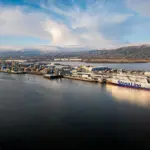

Latest hybrid ferry launches on the Clyde
A cutting edge ferry, which is the third of three unique ‘hybrid’ vessels, has been launched on the Clyde at Ferguson Marine Engineering Ltd’s (FMEL) shipyard in Port Glasgow.
The hybrid ferry MV Catriona, owned by Caledonian Maritime Assets Ltd (CMAL), is a passenger and vehicle roll-on roll-off ferry incorporating a low-carbon hybrid system of traditional diesel power and electric lithium-ion battery power.
Its sister ship, the MV Hallaig, was the first in the world to incorporate this technology in a sea-going vessel when it was launched in December 2011.
MV Catriona is 43.5m long, accommodating 150 passengers, 23 cars or two HGVs and will be operated by CalMac Ferries Ltd, the operator of the Clyde and Hebrides Ferry Service. Its sea trials are scheduled for spring 2016 and the vessel will enter service thereafter following testing and certification.
The £12.3 million vessel is a further investment by the Scottish Government in CMAL’s Clyde and Hebrides Ferry Service fleet and is the third commercial ship to be fully built and delivered on the Clyde in five years by FMEL.
CMAL now has three hybrid ferries – MV Hallaig, MV Lochinvar and MV Catriona. The first hybrid ferry, the MV Hallaig, was launched in December 2011 and services the Sconser to Raasay route. MV Lochinvar, the second hybrid ferry runs from Tarbert to Portavadie and launched in May 2013.
Their low-carbon hybrid system is leading to a reduction in fossil fuel consumption and carbon emissions. The hybrid vessels are capable of reducing fuel consumption by up to 38% compared to a conventionally powered vessel of the same size.
The reduction of fuel consumption results in a decrease in CO2 emissions in excess of 5,500 tonnes per vessel over their lifetime with a proportionally similar decrease in sulphur and nitrogen oxide emissions.
They also produce less noise and lower maintenance requirements. The ferries will charge overnight while they are moored on the islands they will serve. It is anticipated future energy from local wind, wave or solar systems will be used to charge the batteries, further reducing their carbon footprint.
Related Articles
 ALTERNATIVE FUELS GREENPORT
 ENERGY & TECHNOLOGY GREENPORT
 ENERGY & TECHNOLOGY GREENPORT