


Oysters: an engineer’s best friend
It seems oysters might become part of coastal defence engineers’ resources as they create three dimensional reefs which influence the current, erosion and sedimentation of coastal areas. Additionally, the oysters are a sustainable source of food and income for the local population, writes Stevie Knight.
The EcoBas (Eco-engineering in Bangladesh) project has been testing out the technical, economical and sociological feasibility of combining coastal defence with the sustainable production of oysters after small and large scale pilots with oyster reefs were trialled in the Netherland’s Oosterschelde, showing that enhanced sedimentation occurred behind the reef.
So far the project, supported by Netherlands-based Royal Haskoning, Wageningen and Chittagong Universities, points to the possibility of using oyster and other bivalve reefs to contribute to improved safety for humans against coast erosion and flooding while also delivering a sustainable source of aquatic food.
However, although this tactic replaces the classic approach of struggling against nature by constructing revetments or groynes to one of actually building with nature, there are still a number of details that could spell disaster for the bivalves.
The first is technical: Although the projects in the Oosterschelde were fairly large scale, these had a much more limited environment to deal with as the area is a tributary of the Rhine. Bangladesh is very different, explains Arjo Rothuis of Wageningen University. “The set of conditions in Bangladesh are quite extreme; cyclones, rains and floods transport much more sediment than you see in Europe.” He goes on to say that this means a possible rise and fall in the sediment of up to 30cm in either direction, and if the oysters are covered over they will die. Further, the flooding from rivers and torrential rain is likewise a problem since oysters have a very limited capacity for dealing with a drop in salinity levels and will also die if exposed to too much fresh water.”
However, he adds that some of this will be mitigated if the beds become large and established, since the colonies will become more resilient and protected by their scale – although it has to be said that Bangladesh’s weather can be so extreme you can’t completely predict the impact of the next big cyclone.
The next problem is more of a social one. Since only a part of the oyster reef can be harvested to ensure its continuity, it is therefore important to consider the way the oyster harvest is managed in order to prevent overexploitation. In this southeast corner of Bangladesh’s coast, it’s only the local minority people which collect oysters and other bivalves and gastropods from the intertidal area. This means that oysters themselves probably won’t attract too much attention from others, at least at the moment.
But even this minority needs to realise that the project has to be managed sustainably. “There’s no chance of attempting to use regulation in a place like this,” says Mr Rothuis: “The only thing you can do is show people the benefits, and get them to manage it.”
He points to other successful projects involving mangroves, where local people are given permits to go in and fish on the understanding that they don’t damage or cut down the trees themselves.
However, there are other advantages to creating the reef, as fish, crab and shrimp will be attracted to the area adding to both the biodiversity of the region and the diet of the locals. Of course, if really successful it might attract unwanted attention from other fishing enterprises, but that’s a perennial problem for Bangladesh, “and quite a way off” says Mr Rothuis.
The artificial core of the engineering will be trialled as well. “What you don’t want is a nice, smooth finish,” Mr Rothuis explains “You need to make the most of the available area”. There are a number of possibilities that will help to create the kind of crevassed or convoluted surfaces beloved of bivalves. However, in an area like Bangladesh where the financial costs have to be kept low in order to allow the project to replicate, you do have to think carefully, using the best balance of readily available materials.
To this end the proposed 100m EcoBas reef will – ideally – be trialling three sections: firstly there will be a simple rubble drop. Next come concrete sections which will have prongs sticking out: the central, columnar part of the design is a little like piping and so can be fitted together to form lengths which can be stacked together.
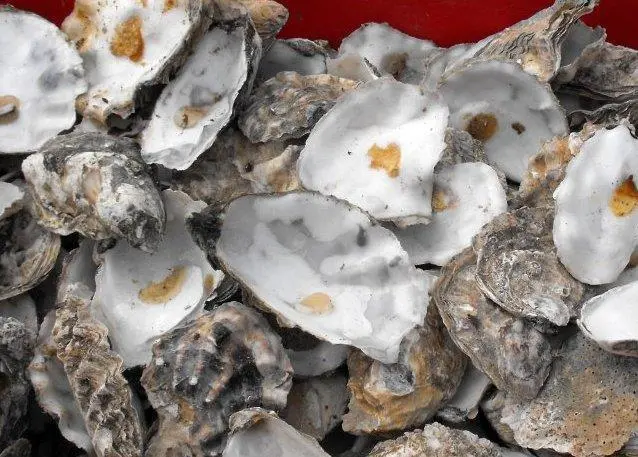
Lastly they are going to try bundles of old, empty shells. This is possibly the most plausible and intriguing because if the project can lay its hands on a good, economical source – perhaps a by-product from the shellfish industry – and it’s one of the surfaces that oyster larvae find it very easy to attach themselves to.
Having said this, he adds: “The nature of the trial is going to depend somewhat on costs and available materials, but we are aiming at a reef measuring between 50 and 100m long, with a core measuring 5m wide by 0.6m high. This will give enough depth and breadth for the larvae to get a foothold.
And once given that all-important foothold, the reef should be more resilient and able to survive its very labile, coastal environment.
Jonathan H Grabowski of Northeastern University says that “Oyster reefs are now being acknowledged for their ability to enhance water quality and stabilise shorelines.” He adds that generally, “shoreline stabilisation is the most valuable potential service, although not all reefs provide this”.
He helped work on a framework that helps assess the value of these services – and a conservative estimate is that the economic value of oyster reef services, excluding oyster harvesting, is a huge US$5,500 to US$99,000 per hectare per year. The reason for this ‘valuation’ of the ecosystem services that an oyster reef provides was to offer guidance about when oyster reef restoration is a good use of funds.
Prof Grabowski says that while reefs can recover median restoration costs in between two to 14 years, in contrast, if they have been subjected to destructive harvesting from dredging or using rake-like tongs, this isn’t the case: “Destructive harvesting damages the vertical structure and removes the living oysters, which collectively perform the important ecosystem services that we value.” However, important for the Bangladesh study, it seems that handpicking oysters – if monitored – can be sustainably maintained.
But it isn’t just harvesting, there is also the problem of nutrients in the water either from landside runoff or dumped waste. There are around 480 estuaries worldwide with eutrophication problems which lower the available oxygen in the water, strangling a reef, adds Prof Grabowski.
His point is that it is useful to look at what you want from the two functions: oyster harvests or a suite of ecosystem services. “You might want to treat the services differently, allowing some reefs to be harvested destructively and protecting others to promote higher water quality, stabilize shorelines, and provide habitat for finfish,” he says.
However, another study which Prof Grabowski is collaborating on with Steven Scyphers at Northeastern University is possibly of just as much interest: it’s what drives the decision making, and why people decide in favour of very costly manmade structures against ‘living’ structures like reefs – and what could tip the balance.
“Those constructions are expensive,” says Prof Grabowski, “and while they might stabilise your shoreline, they won’t provide the ecosystem benefits of a living shoreline like a salt marsh or an oyster reef.” So, if you can replace these barriers with a living process, you can get a number of benefits including giving a hand to the environment.
Related Articles
 ALTERNATIVE FUELS GREENPORT
 ENERGY & TECHNOLOGY GREENPORT
 ENERGY & TECHNOLOGY GREENPORT