


American dream
Yilports bid for Port America could prove to be a lynchpin for its global ambitions, finds Alex Hughes
It’s no secret that Turkish terminal operator Yilport Holdings has ambitions to become one of the world’s ten leading port terminal operators by 2025; it’s been particularly vocal about its goals and has had its name associated with bidding for some large scale concessions this year.
Indeed, company chairman Robert Yildirim acknowledges that Yilport is always looking for new projects to further enhance its global presence. Some 10-15 port and terminal projects are evaluated annually by the mergers and acquisitions team, with around one to three brownfield terminal deals expected to be realised each year.
In Mr Yildirim’s sights is Ports America, the largest terminal operator and stevedore in the US. In December 2015, a bid was made for the company, which is valued at close to $1bn, with Mr Yildirim revealing that Yilport is now through to what is a second round of bidding.
Significantly, the Turkish group is the only terminal operator bidding, although several financial institutions are also known to still be in the race. However, given the size of the potential deal, the process remains a complicated one.
If Yilport is successful in its acquisition, it will become the eighth largest terminal operator globally. Yet one sizable potential hurdle remains.
In 2006, DP World was prevented from acquiring the P&O Ports portfolio in the US following political concerns about selling key infrastructure to a foreign operator. The ports were eventually bought by Highstar Capital a year later, forming the core element of what is today’s Ports America corporation.
Although it is unlikely that Yilport will be treated in a similar manner, particularly given that UAE-based Gulftainer faced little opposition when it opened its Port Canaveral box terminal in Florida last year, the sheer size of the acquisition might still ring a few alarm bells.
US realities
But whether Yilport is ultimately successful or not, Mr Yildirim is under no illusions about moving into the US market, where he says ports are 20 years behind their European or Asian counterparts in terms of technology.
“Ports are not so profitable in the US right now,” he says, noting that this is because they are suffering from a chronic lack of investment right across the board. “However, as far as we can see, there is great growth potential, but only after making the necessary investment. It’s that which would trigger profitability.”
Yet while details of the Ports America bid have not yet been made public, Mr Yildirim unequivocally states that he would not accept anything less than a 51% stake in the company, given the sheer scale of investment that needs to be made.
“I might be willing to buy 100% control, if the price were right,” he adds.
Mr Yildirim also stresses that he is not fazed by the strength of port unions in the US, given extensive experience in a similar market in Turkey. “If I compare Yilport with the financial investors, I can say that we have the upper hand because we come from the industrial side. Most of our ports are unionised, so we have more experience working with the unions,” he says, although concedes that it will nevertheless be a difficult challenge.
In terms of the company’s overall growth strategy, he says Yilport is looking at both developing and emerging countries as well as studying opportunities in developed markets.
“We are constantly looking for new opportunities in both these markets. Since we are seeing an ever increasing consolidation – not to mention new alliances – among liner operators, we believe consolidation must take place in the port and container terminal industries as well. Single terminal port operators have no power to negotiate with the big monster container lines. In order to be in the game, you need to be an international terminal operator. We therefore believe potential mergers and acquisitions in the US will provide an extra boost,” says Mr Yildirim.
Purchase plan
For the time being, however, if Yilport is to realise its aspiration of entering the first rank of global terminal operators it will have to continue making acquistions.
“Yilport Holding has to perform continuous organic and inorganic growth. To accomplish that goal, we are conducting talks with dozens of ports in Europe, North America, Latin America and Africa. At the same time, we plan to offer 20% to 30% equity stakes in Yilport Holding to foreign investors as minority shareholders and will also change our partnership structure in order to finance our growth strategy in a healthy manner. Funding from the initial offering will be rerouted to the acquisition of new ports,” he says.
In February this year, Yilport acquired 100% of the shares in Portuguese terminal operator Tertir, which has interests in seven terminals in Portugal, two in Spain and one in Peru.
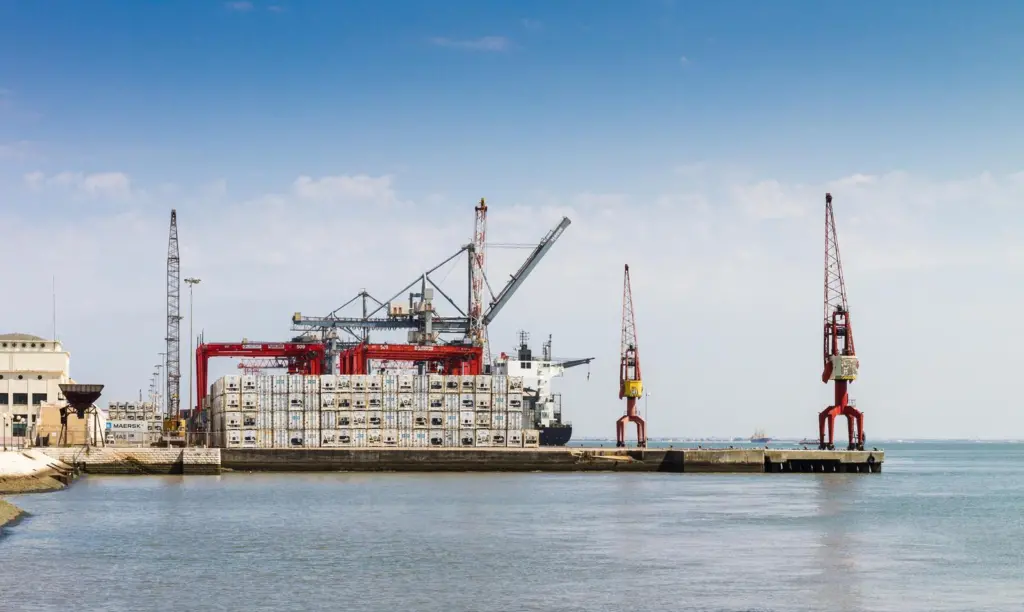
Christian Blauert, who became chief executive of Yilport Holding this summer, attended a recent conference in Lisbon that was looking at innovative solutions for port cities, where he spoke in a debate entitled Multimodal Solution for Alcântara Container Terminal.
His presence was particularly interesting, since it was the first time that Yilport Holding had made any information freely available since taking control of Tertir, which is the majority shareholder of Liscont, the terminal operator at Alcântara Dock, and also of Lisbon shortsea terminal Sotagus.
Much debate already exists in Portugal over how to develop container handling facilities in the nation’s capital, although Mr Blauert put forward some completely new ideas that Yilport is disposed to finance.
“We see Alcântara terminal as an excellent opportunity,” he said, going on to present an amibitious growth and expansion plan for the facility.
This will be implemented in two phases, one of which will involve a development on the opposite side of the river and one further downstream. If approval is given, Alcântara Container Terminal will see capacity grow from 350,000 teu per annum to 650,000 teu.
In respect of the terminal expansion project, he noted that Yilport is “talking to the port administration”, which he praised, pointing out that it now appears to be more proactive. Significantly, the port authority is backing a brand new container terminal on the south bank of the Tagus, whereas Alcântara remains on the highly urbanised north bank.
“The potential exists to make a globally high quality service terminal in Lisbon,” said Mr Blauert, although stressed this needed changes at the port of Lisbon, especially in the way that it presently sees developments along the Tagus. Three key areas need particular attention: investment – which Yilport is ready to make – stability, and productivity.
CONCENTRATION ON INTERMODAL CONNECTIONS
The success of expanding the container business at Alcântara will largely depend on improving intermodal connections, says Yilport’s Christian Blauert. The existing Liscont facility, in particular, suffers from being hemmed in by urban development, which does hinder road and rail movements.
He notes that it would be necessary “to improve truck management”, citing Hamburg as an example, whereby truck parks have been set up outside the city centre, with vehicles called forward at given times to prevent congestion from building up and cutting back on pollution caused by the movement of cargo through city streets.
As for rail, he said: “It is not enough for Yilport to create the largest rail terminal in the world within the container terminal”. There has to be a co-ordinated response to rail development, he argues.
Mr Blauert additionally recalled that inland waterway movements are becoming ever more popular, particularly in northern Europe, and help to remove unwanted cargo traffic from the roads. Nevertheless, handling small barges also invariably involves a terminal having to use its own cranes and operators, which often ramps prices up. Waterways can only compete with road if costs are comparable, he said. With this in mind, he mentioned the innovative Autonomous Barge Operating System, which if installed at Alcântara, could reduce costs to allow barges to compete.
If Alcântara is to see its capacity increased to 650,000 teu, it will also need to expand its hinterland in order to access additional traffic flows. Indeed, Mr Blauert cites markets in Spain as an example. He points out that this cross-border traffic is already a reality in some parts of Germany, which see the Dutch port of Rotterdam as their natural outlet to the sea, rather than either Bremerhaven or Hamburg.
“We must identify where cargo is leaving from, how we can be more competitive than those ports and how to capture that cargo by making a better offer.”
In this respect, several Tertir assets in Portugal are well placed to exploit the Spanish market, with both Liscont and TCL regularly running their own rail and truck services to Spain.
Related Articles
 PORT TALK
 PORT TALK
 PORT TALK