



Journey of Transformation
The Indian logistics sector has been undergoing a much-needed transformation with strong emphasis placed on the development of dedicated rail freight corridors, much needed to alleviate chronic road congestion. AJ Keyes assesses progress.
Indian Railways want to undertake a journey of transformation that will see dedicated freight corridors (DFCs) revolutionise the movement of goods and high speed rail (HSR) networks speeding up passenger travel.
The government of India maintains that DFCs will enable the reduction of high logistics costs in the country that are currently estimated to be twice as high as accepted global benchmarks.
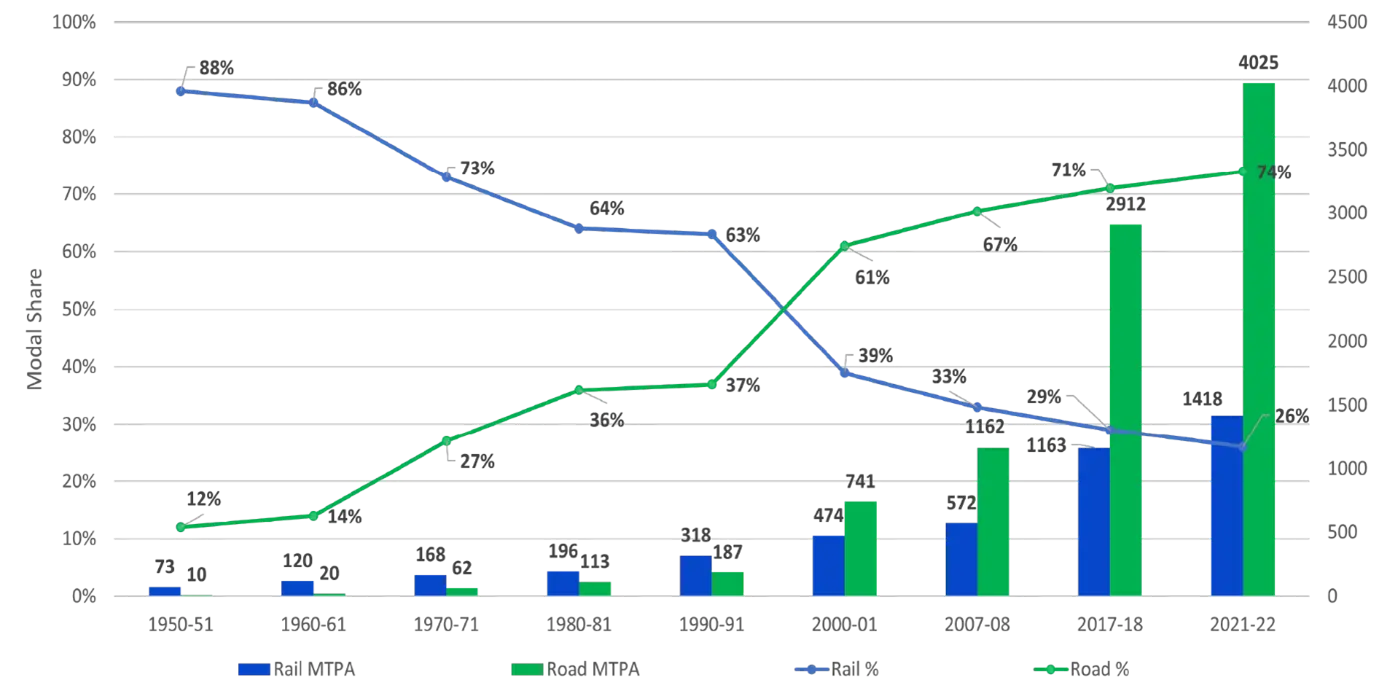
The development of DFCs is needed to enhance the railway’s capacity and capability to carry freight traffic and increase the modal share of the railways in the country’s total freight mix from the current 26 per cent to 45 per cent.
At the same time, each kilometre-long freight train on the DFC will replace an estimated 72 trucks, thereby easing congestion of the highly overcrowded roads that are already responsible for transporting 60 per cent of total Indian freight cargo.
So, what is being planned and what does it mean?
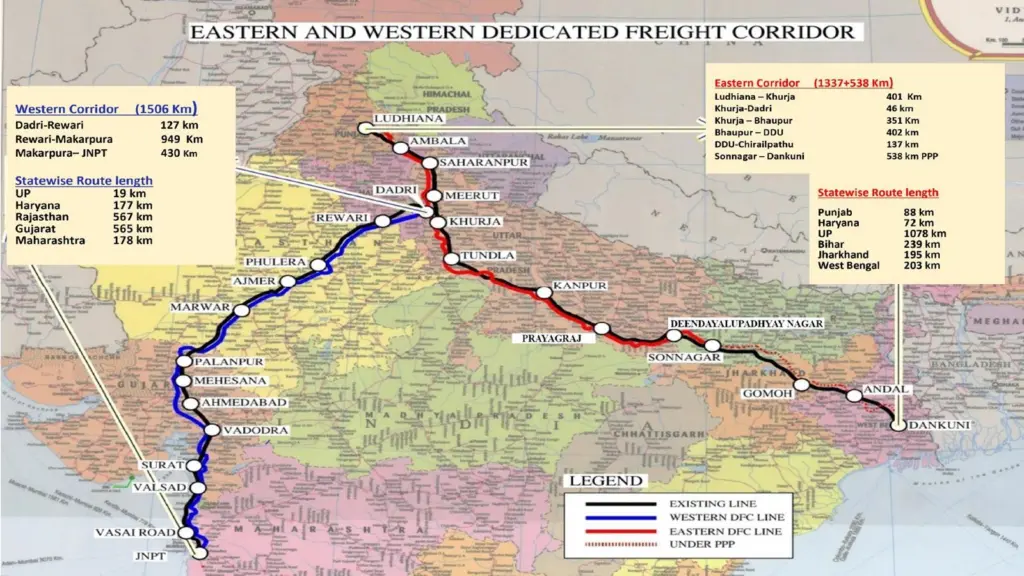
According to Dedicated Freight Corridor Corporation of India Ltd (DFCCIL), which is a Government of India (Ministry of Railways) enterprise and responsible for the construction of a dedicated network of broad gauge railway lines exclusively for freight trains, there are two corridors under implementation. These are the eastern DFC (EDFC), which has already been commissioned, and the western DFC (WDFC) which is slated for completion in 2024. Figure 1 provides an outline.
Executing these two corridors will see a total rail length of 2843km generated. The EDFC spans 1337 km, stretching from Ludhiana in Punjab to Sonnagar in Bihar, while the WDFC is 1506 km long, extending from Dadri in Uttar Pradesh to the Jawaharlal Nehru Port Trust (JNPT) in Mumbai.
The focus of these corridors is to link the Golden Quadrilateral route, which connects the four metropolitan cities of Delhi, Mumbai, Chennai and Howrah and its two diagonals (Delhi-Chennai and Mumbai-Howrah). This route is highly utilised and carries more than 58% of the revenue-earning freight traffic of Indian Railways.
NEED FOR DEDICATED FREIGHT CORRIDORS
As Figure 2 from DFCCIL confirms, Indian railways have been losing share in freight traffic over the long-term, from 88% in 1950-51 to 26% in 2021-22. Add to the mix that the national highways along these corridors currently comprise 0.5% of the available capacity but carry almost 40% of the road freight, then the use of rail is falling at a time when it needs to be increasing. Currently, roads carry 60% of national annual freight volumes.
However, the tide may be turning if 2023-24 information is considered. A total of 55,079 trains ran on the EDFC and WDFC, hauling over 70,285 million gross tonne km and 38,555 million net tonne km of freight, but demonstrating an increase of 192.1% and 213.22%, respectively, compared to the previous year.
The 1337-km EDFC enables freight trains to run at top speeds of 60-70 km per hour, a significant improvement over historic train speeds of just 25-30 km per hour – though these speeds must be maintained consistently for all services to ensure efficiencies, of course.
DFCCIL offers a summary of this position: “The surging domestic economy, booming infrastructure construction and growing international trade led to the conception of the Dedicated Freight Corridors along the Eastern and Western arms of Golden Quadrilateral.”
The DFCs in India are engineered differently from existing rail tracks, with an ability to handle longer and heavier trains. The average speed of these trains is around 65km per hour, powered by 2×25 kV electric traction and equipped with automatic signalling.
The EDFC, excluding the Sonnagar-Andal section, is already complete and has been fully operational since November 1, 2023. The Sonnagar-Andal section, which was originally planned to be developed in public-private partnership (PPP) mode, was abandoned and has now been taken over by the Ministry of Railways to be developed in engineering, procurement and construction mode (for both passenger and freight traffic).
For the WDFC, construction work on 1220 km out of the total 1506 km has been completed. The project has achieved financial progress of 92 per cent. Work on the Palanpur-Makarpura and Sachin-Vaitarna sections, and the Vaitarna-JNPT section, are all slated for completion by December 2024.
QUICK AND RELIABLE SOUGHT
So on the basis that there is pent-up demand, and the construction is well underway and proceeding on time, what does all of this actually mean for the movement of freight in India?
Well, the desire for quicker and reliable rail transportation offered by the DFCs is going to be beneficial for critical sectors such as power and heavy manufacturing in the northern and eastern states of the country. For example, since commencing operations the EDFC has reduced the time it takes to transport coal from eastern India to power plants in northern India by a reported 30-40%. As a result, there have been fewer blackouts due to coal shortages and reduced inventory costs for power plants.
DFCCIL has confirmed that there are other new corridors being proposed, which include the East-Coast Corridor spanning 1080km from Kharagpur to Vijayawada in West Bengal, Odisha and Andhra Pradesh; the 1738km East-West Corridor from Bhusaval to Dankuni traversing West Bengal, Jharkhand, Odisha, Chhattisgarh and Maharashtra; and the 890km North-South Corridor Itarsi-Nagpur-Vijayawada route across Madhya Pradesh, Maharashtra, Telangana and Andhra Pradesh. Detailed project reports (DPRs) for these projects are currently being prepared, but it seems that it is a strategy that will continue.
CONCOR – IN THE SLOW LANE
Yet while it seems that progress is being made with the network, the same is not necessarily true with the country’s major operator. The proposed and long-running disinvestment of railway public sector firm Container Corporation of India (CONCOR) looks set to stay in the slow lane for some time yet.
The Cabinet Committee of Economic Affairs (CCEA) approved the government’s 30.8% equity stake sale in CONCOR in November 2019, followed by agreeing to a policy of long-term leasing of rail land in September 2022.
Yet it remains business as usual for the rail operator, as Sanjay Swarup, Chairman and Managing Director, CONCOR, explained at the end of Q4 2023 when asked about the sale process: “That is the policy of Government of India. So whatever policy is given by them, we will follow that policy. We cannot comment on that… But having said that, we are doing normal business. We are expanding our terminals. We are expanding our customer base. And we are giving more and more—introducing more and more services for our customers. And so that the existing customers stay with us, new customers join us… The business is not stopping. As and when it comes, we’ll obey the orders of government.”
Clearly, progress with this transaction is slow and realistically CONCOR is expecting to continue with its current operating strategy………and for what is an unknown timeline.
POSITIVES AND NEGATIVES
Long term, DFCs in India will help reduce high logistics costs and reduce dependence on transporting freight through highways. Each km-long train on the EDFC can replace 72 freight trucks on roads, which reduces fossil fuel consumption and decreases the country’s carbon footprint. Add to the mix supporting the development of multimodal logistics parks and keeping pace with growing port capacity, the transformation of the railways in India cannot come soon enough. The role of CONCOR in India looks set to remain unchanged though, at least for the time being.
Related Articles
 TERMINAL OPERATIONS
 EQUIPMENT
 PORT & TERMINAL NEWS